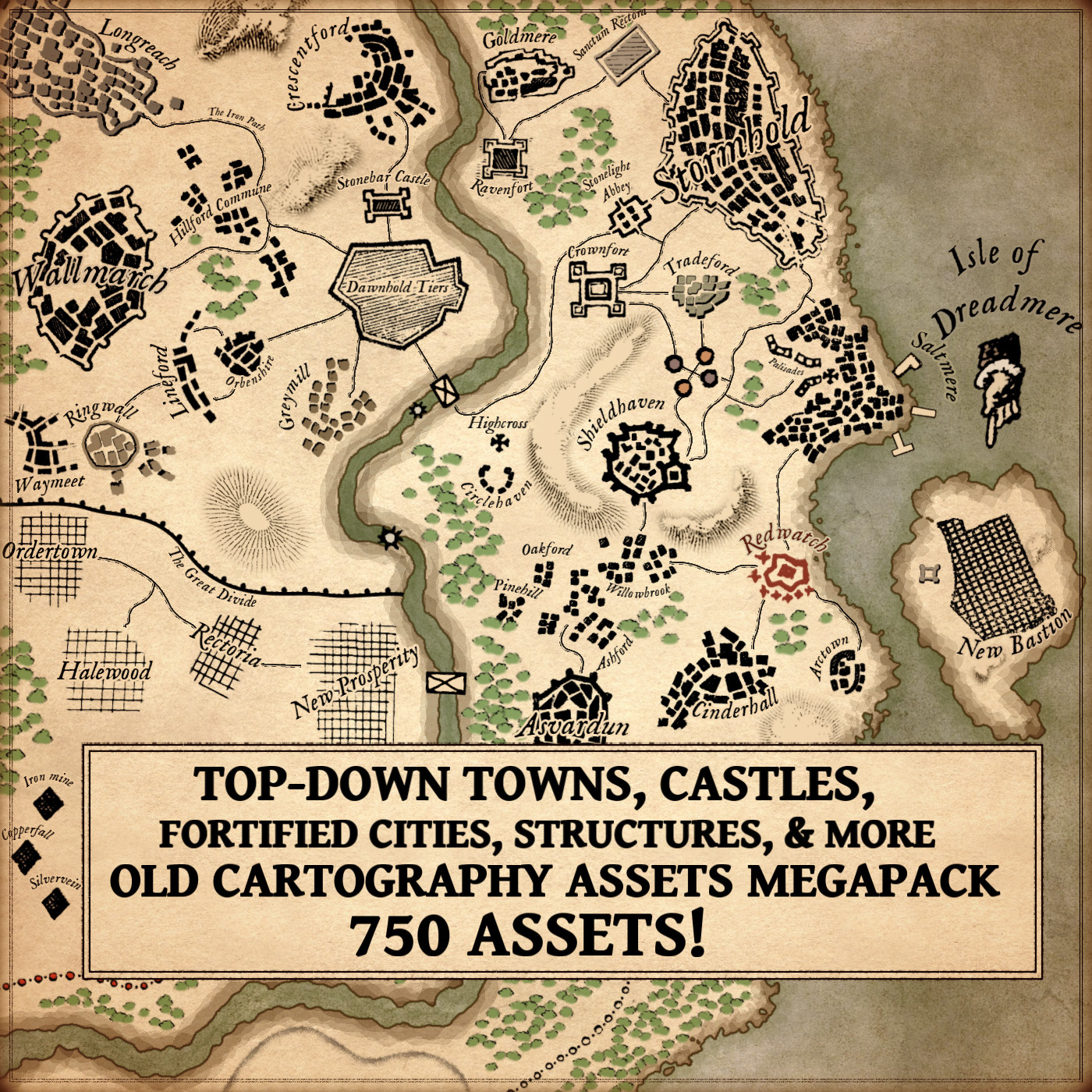
Maps have always been more than navigation tools. They are storytelling devices, cultural artifacts, and works of art. One of the most fascinating features of both historical and fantasy cartography is the use of top-down representations—miniature towns, villages, castles, piers, temples, and city walls that condense culture and history into symbols.
With modern Wonderdraft assets such as the Top-down towns, castles, villages, & more pack, today’s creators can continue this tradition, bringing life and depth to their fantasy maps while echoing centuries of cartographic practice.
BUY AND DOWNLOAD The Old Cartography top-down towns, castles, villages, & more – Assets Megapack here :
Grid-Planned Towns and Organic Settlements: Classic Fantasy Map Icons
Cartography has always revealed the contrast between organic towns and grid-planned cities.
- Organic settlements, especially in medieval Europe, grew around castles, rivers, and trade roads. Their winding streets and irregular clusters reflected centuries of adaptation to local geography.
- Grid-planned cities, by contrast, symbolize order and authority. While rooted in Roman military layouts, this approach became especially prominent in the 18th and 19th centuries in the United States. Cities such as Philadelphia and many Midwestern towns followed strict rectilinear grids, embodying Enlightenment ideals and practical governance.
This duality—wild frontier villages versus orderly planned colonies—remains central in fantasy storytelling. With the right fantasy map icons, you can bring this same historical authenticity into your own worlds.
Cartography Assets in the 18th and 19th Centuries
The Enlightenment and Industrial Age reshaped cartography. In the 18th and 19th centuries, maps were not only decorative—they became precise instruments of power, trade, and expansion.
- Military maps showed bastioned forts, walls, and ramparts, emphasizing defense.
- Colonial maps marked gridded towns to project administrative control.
- Commercial atlases depicted piers, harbors, and watermills, highlighting networks of commerce.
These standardized cartography assets made it possible to instantly read a landscape: every castle spoke of power, every bridge of trade, every temple of belief.
Functional and Symbolic Roles of Fantasy Map Icons
What makes top-down symbols so enduring is their dual function: they are both practical and symbolic.
- Bridges show strategic crossings and economic lifelines.
- Temples and churches act as cultural and spiritual centers.
- Castles and forts embody strength, protection, and political dominance.
- Mines, watermills, and piers reveal resources, labor, and prosperity.
Just as 19th-century engineers used icons to control colonial territories, today’s worldbuilders use fantasy map icons to create depth, history, and narrative.
Wonderdraft Assets: Timeless and Decorative
From Enlightenment atlases to digital fantasy maps, top-down cartography has proven timeless. These representations are not bound to a single period—they evolve with culture and remain relevant today.
Their beauty lies in versatility: they orient the reader, provide context, and embellish a map with life. A well-placed fortress or walled city transforms a flat map into a living world.
The Top-down towns, castles, villages, & more collection of Wonderdraft assets allows modern creators to combine utility and artistry. These tools produce maps that are not only functional but visually captivating.
Fictional Resonances: From Fantasy Maps to Storytelling
Modern fantasy inherits these traditions:
- Tolkien’s Minas Tirith, rising as a fortified emblem.
- Martin’s Winterfell and King’s Landing, echoing medieval strongholds.
- Countless tabletop RPG maps, where towns, villages, and forts serve both immersion and gameplay.
These examples prove that symbolic cartography is not just history—it is a living art form.
Conclusion: Cartography Assets for Worldbuilders
From grid-planned American cities to medieval strongholds, from Enlightenment atlases to modern fantasy campaigns, top-down cartography remains a universal language. Each bridge, rampart, or temple encodes both utility and meaning.
The Top-down towns, castles, villages, & more pack of fantasy map icons is more than a toolkit—it is a continuation of centuries of symbolic cartography. By using these cartography assets, you bridge history and imagination, building maps that are useful, decorative, and deeply cultural.