
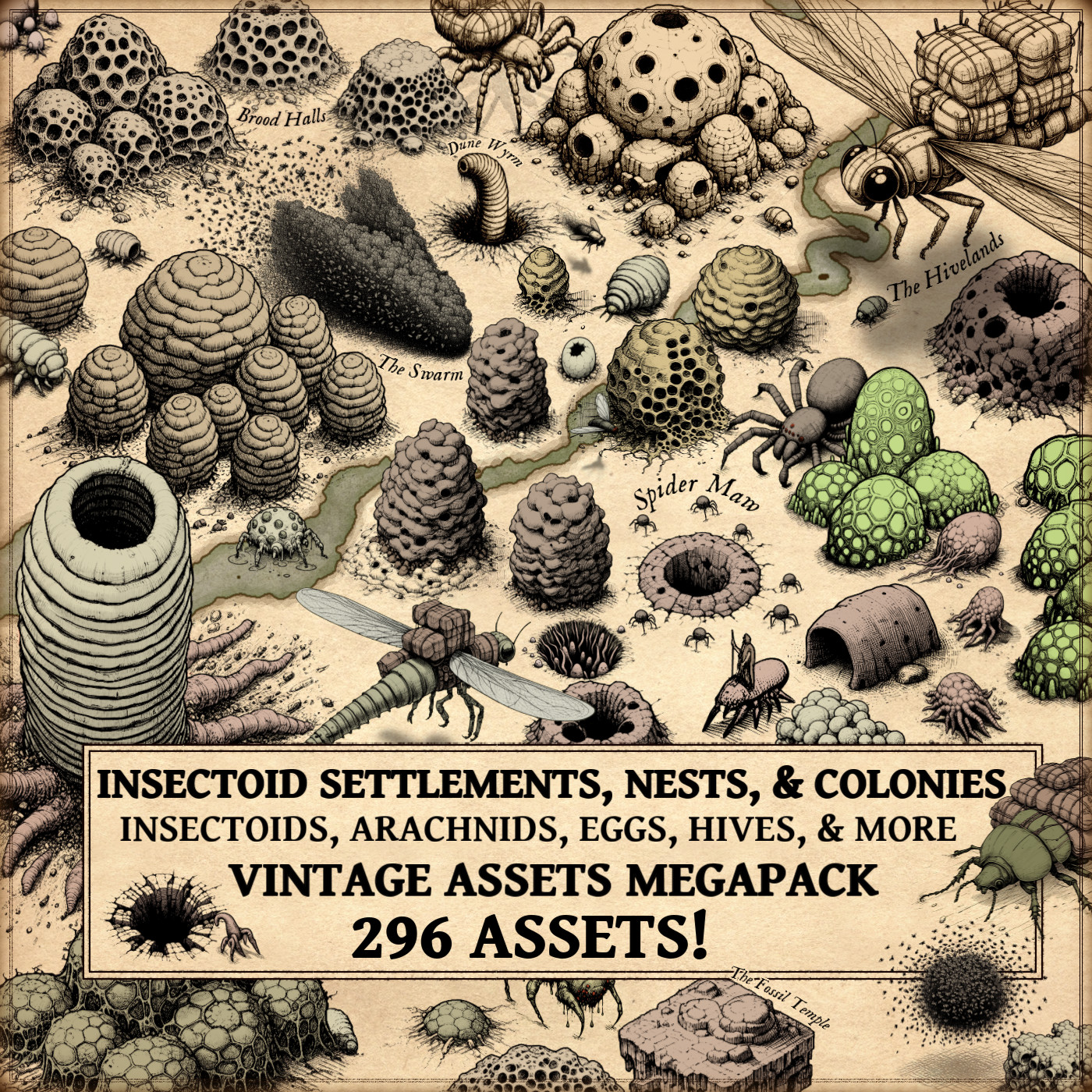
Exploring the Role of Insectoid Settlements, Hives, and Nests in Maps — Featuring the Insectoid Settlements – Vintage Assets Megapack for Wonderdraft
Throughout the long history of cartography, mapmakers have used symbols not only to guide travelers but to tell stories. Among the most fascinating and often overlooked visual traditions are those representing insectoid settlements, hives, lairs, and nests — motifs that appear in both antique maps and modern fantasy map making. These cartography assets, recreated in the Insectoid Settlements, Hives, Nests, & Colonies – Vintage Assets Megapack, revive a forgotten visual language that once expressed fear, fascination, and mystery toward the hidden world of insects.
BUY AND DOWNLOAD The Insectoid Settlements, Hives, Nests, & Colonies (Insectoids, arachnids, eggs, & more) – Vintage Assets Megapack here :
1. Ancient and Medieval Origins of Insectoid Imagery in Cartography
In the early eras of mapmaking — from Ptolemaic charts to the illuminated manuscripts of the Middle Ages — insects and arachnids were rarely literal depictions of fauna. Instead, they were symbolic creatures marking unknown or “forbidden” lands. Just as sea serpents guarded the uncharted oceans of the Carta Marina (1539) or the Hereford Mappa Mundi (c.1300), monstrous beetles, worms, and burrowing shapes sometimes appeared near deserts, caves, or ruins, suggesting infestation, decay, or divine punishment.
These fantasy map symbols were both warnings and metaphors. Insects, seen as agents of transformation, represented the volatile nature of unexplored territories. Burrows and pits echoed humanity’s fear of the subterranean — the unseen spaces beneath kingdoms and civilizations. Some early Islamic and Chinese cartographic manuscripts even featured hive-like structures to indicate subterranean cities or clustered dwellings, eerily similar to insectoid colonies depicted in modern fantasy maps.
2. The Cultural Meaning of Hives, Lairs, and Egg Clusters
The use of hives, nests, and egg clusters on maps was deeply tied to human perceptions of order and chaos. Beehives, for example, symbolized industriousness and divine architecture — a natural geometry that medieval monks associated with heavenly design. In contrast, spider lairs and worm burrows symbolized corruption or the demonic underworld.
In the context of fantasy map making, these same dualities persist. A hive might represent an alien civilization with perfect social structure, while a crater nest or egg sac can signify spreading corruption or plague. The “Insectoid Settlements” asset pack captures this range — from organic hive towers and cocoon chambers to sprawling burrows and larvae clusters — allowing map artists to visually express both civilization and contagion.
3. The Artistic Legacy in Fantasy Map Making
Modern creators, especially those using tools like Wonderdraft, have revived antique cartographic aesthetics through vintage-style fantasy map icons. The Insectoid Settlements, Hives, Nests, & Colonies – Vintage Assets Megapack continues this tradition by merging historical artistry with modern usability.
The pack displays an extraordinary variety of assets:
- Insectoids and arachnids: from hulking beetles to agile spiders and mounted insectoid figures.
- Flying insectoids: dragonflies, giant flies, and swarming species rendered in motion with aerial shadows.
- Organic architecture: hive domes, brood pods, tunnels, pits, burrows, and hive towers recalling natural citadels.
- Larval and parasitic lifeforms: eggs, sacs, clusters, and worm-like burrowers that evoke the life cycle of alien ecosystems.
Each of these cartography assets is designed in a vintage engraving style, echoing the textures of 17th–18th century natural history prints. The linework and muted tones emulate aged parchment — a deliberate nod to maps from explorers like Athanasius Kircher, whose Mundus Subterraneus (1665) famously combined geology, biology, and myth.
4. Insectoid Colonies and the Psychology of the Unknown
The fascination with insectoid civilizations is more than aesthetic. In ancient and modern maps alike, these forms represent the psychological projection of the alien within the familiar. The hive is not just a structure; it is a metaphor for collective intelligence, for the overwhelming and organized “other.”
In Tolkien’s Middle-earth, the “Mirkwood Spiders” and their forest lairs carry echoes of this tradition. In the Warhammer universe, Tyranid hives and brood chambers form the backbone of alien cartography. Even in the Dungeons & Dragons cosmology, underground maps of the Underdark feature nesting burrows and insectoid colonies, showing how this visual lexicon migrated from historical imagination into fantasy design.
These fantasy map symbols function as storytelling devices: the viewer instantly senses danger, fecundity, or expansion. A cluster of eggs near a swamp or crater signals life spreading uncontrollably — a cartographic shorthand for tension and threat.
5. The Decorative and Functional Purpose of Insectoid Map Icons
Historically, decoration in maps was never merely ornamental. Every embellishment had a purpose — to attract the eye, guide interpretation, and invoke emotion. The same is true for fantasy map icons in modern digital cartography.
In Wonderdraft map making, icons such as insectoid settlements, hives, or pits serve both narrative and compositional roles:
- Narrative: indicating regions dominated by swarms, brood queens, or hive-minded species.
- Compositional: providing textural variety, balancing visual density, and breaking the monotony of natural terrain.
By using these Wonderdraft assets, cartographers can emulate the layered symbolism of antique maps — where every mark on the parchment was a story, and every cluster of dots hinted at the unknown.
6. A Revival of Organic Cartography
The Insectoid Settlements, Hives, Nests, & Colonies – Vintage Assets Megapack is more than a design resource. It is a revival of organic cartography — a reminder that fantasy worlds, like the natural one, thrive on cycles of growth, decay, and rebirth.
The Megapack assets show the intricate diversity of forms:
- Brood pods, organic ruins, and hive towers evoke long-lost civilizations.
- Termite mounds and burrowing worms give a sense of subterranean life.
- Hive queens, insectoid porters, and flying swarms illustrate hierarchy and labor, mirroring historical allegories of empire and order.
In this sense, these assets are educational tools. They teach us to read maps as living organisms — dynamic, evolving, and filled with hidden motion beneath the surface.
7. From History to Fantasy: The Timeless Allure of the Hive
From the sacred beehives carved on Egyptian temple walls to the monstrous ant cities of modern fantasy, the image of the insectoid settlement has never left our imagination. It bridges myth, biology, and architecture — a symbol of how societies, whether human or alien, organize themselves in the face of chaos.
By studying antique depictions and applying them to fantasy map making, today’s artists rediscover an ancient truth: that maps are not just guides through space, but through imagination. The Insectoid Settlements, Hives, Nests, & Colonies – Vintage Assets Megapack transforms that tradition into a visual language — one that speaks in silk, soil, and swarm.
Final Thoughts
Whether you are a historian, an artist, or a digital cartographer, these cartography assets remind us that fantasy maps inherit a deep artistic lineage. What once decorated the margins of medieval manuscripts now thrives in the digital realms of Wonderdraft — the same fascination with pattern, life, and mystery rendered anew.
Through these assets, the hive lives on — not just as a structure, but as a metaphor for all the unseen civilizations buzzing beneath the surface of the world.