A deep exploration of terrain representation and the legacy revived by the Detailed Mountains & Hills – Old Cartography Assets Megapack
Mountains, hills, ridges, volcanoes, escarpments, and all the landforms included in the pack represent far more than decorative features. Across history, they formed a symbolic language that shaped geographical understanding, cultural identity, and storytelling. In both ancient traditions and modern fantasy map making, mountain drawings remain fundamental to how worlds, real or imaginary, are described.
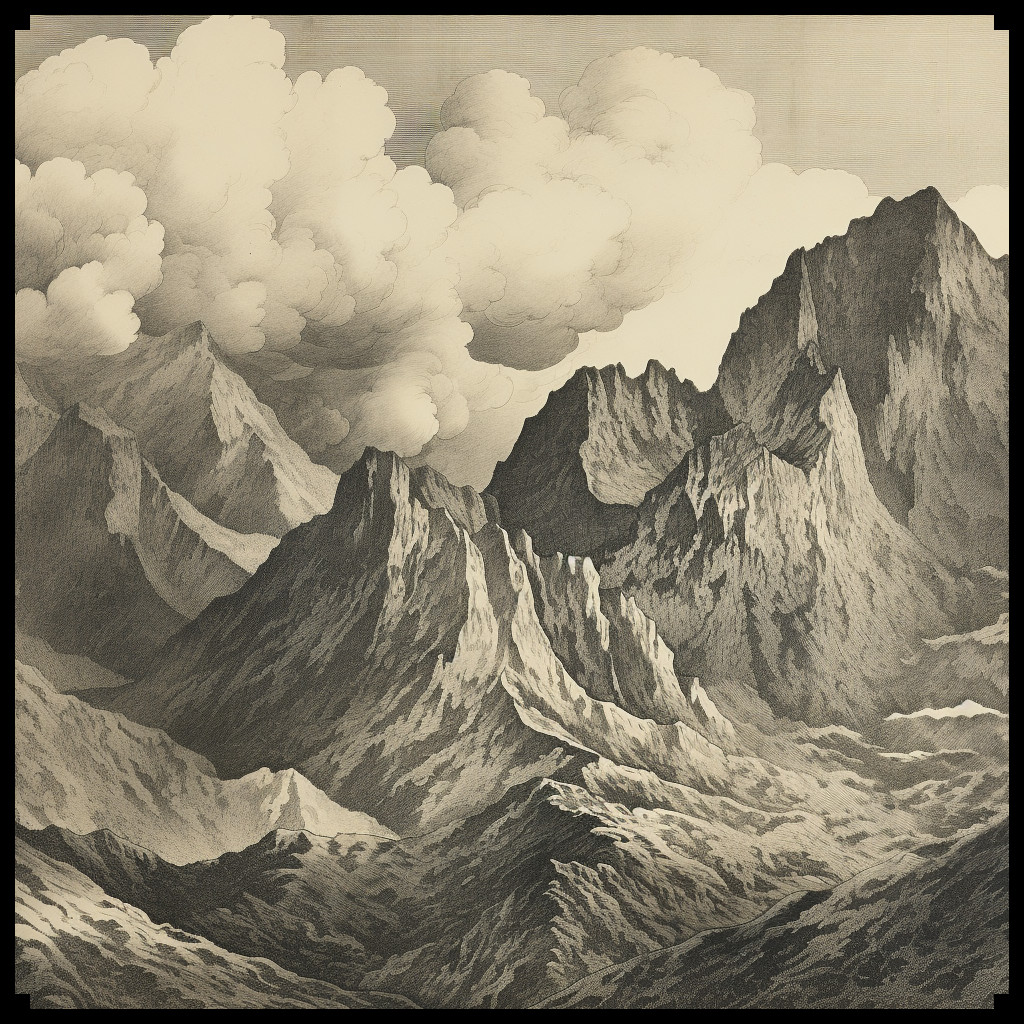
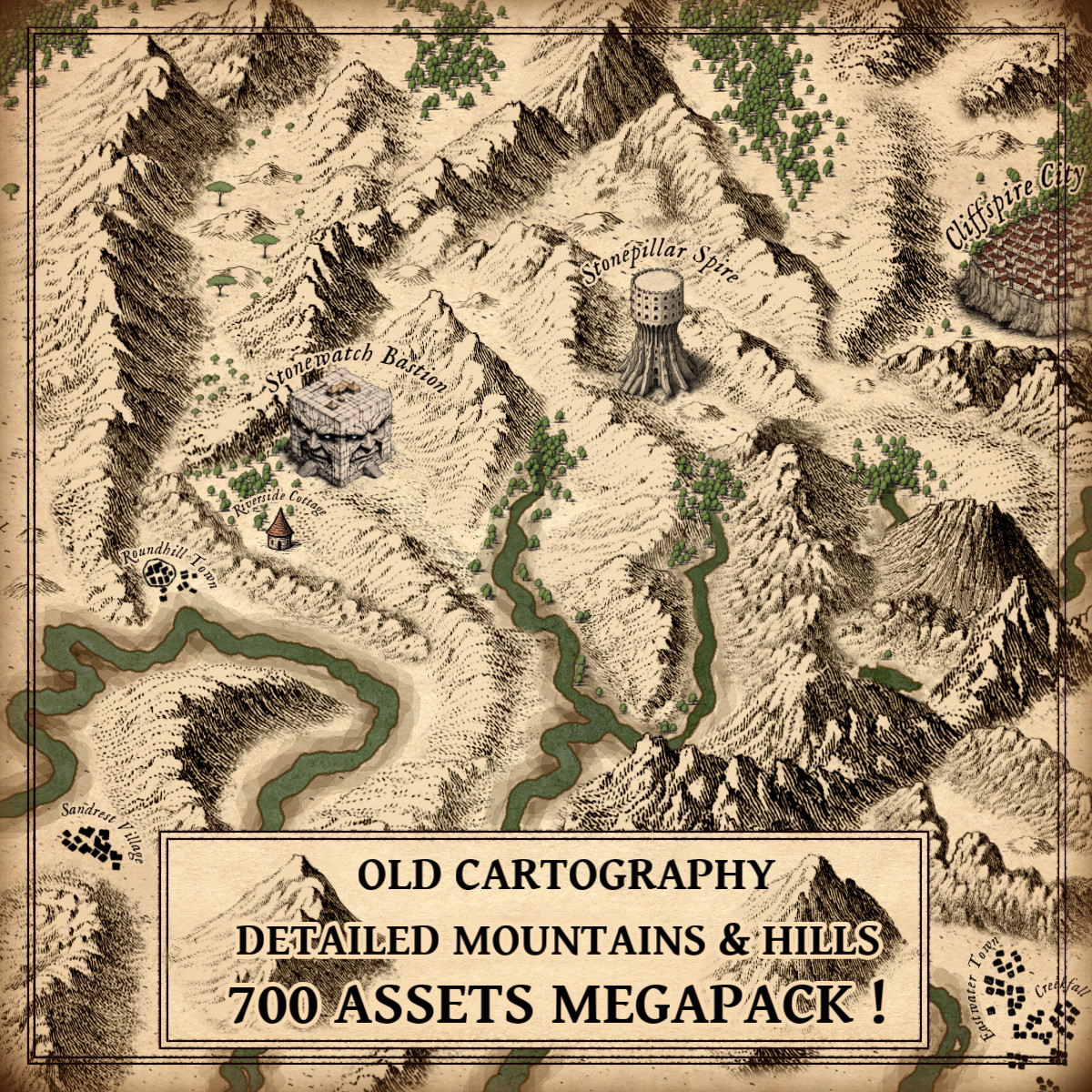
The Detailed Mountains and Hills – Old Cartography Assets MEGAPACK faithfully revives antique engraving styles with carefully crafted landforms such as mountains, mountain ranges, hill formations, broken ranges, buttes, plateaus, craters, knolls or escarpments. These drawings recall centuries of handcrafted maps and bring their evocative aesthetic into digital worldbuilding.
BUY AND DOWNLOAD The Detailed Mountains and Hills – Old Cartography Assets MEGAPACK HERE :
1. Origins of Mountain Symbolism in Early Maps and Their Legacy in Fantasy Map Icons
The representation of mountains began long before the notion of modern topography existed. Ancient cartographers understood that terrain could not simply be sketched scientifically, they needed symbolic forms.
Antiquity
- Ptolemy’s Geographia (2nd century CE) included simple hill-shaped symbols that defined early Western cartographic convention.
- In East Asian maps, especially during the Han and Tang dynasties, mountains symbolized cosmic balance and were drawn in isometric, stacked forms.
Medieval Europe
- The Hereford Mappa Mundi depicted mountains as dramatic clusters marking sacred regions, mythical realms, and uncharted territories.
- Islamic cartographer al-Idrisi used mountains as climatic markers and boundaries between cultural zones.
The landforms included in the pack; from isolated peaks to crags, highlands, and ridges; mirror this historical variety, making them ideal as fantasy map icons that enrich worldbuilding with cultural weight and ancient symbolism.
2. Renaissance Cartographic Innovation and the Emergence of Engraved Wonderdraft Assets
With the Renaissance came a flourishing of geographical detail and artistic precision.
- Ortelius’ Theatrum Orbis Terrarum (1570) introduced engraved mountain clusters with consistent shading and distinctive silhouettes.
- The Blaeu family refined the art of hachuring, creating some of the most beautiful mountain engravings ever published.
- Cassini’s cartographic work (18th century) brought proto-topographic systems that displayed altitude and slope through shading direction.
The mountains, hills, volcanoes, and landforms in the pack clearly follow these engraving traditions:
sharp hatching, coherent light direction, clean contours, and expressive silhouettes. As Wonderdraft assets, they allow mapmakers to reproduce Renaissance-level realism inside modern digital tools.
3. Cultural Symbolism and Narrative Weight of Mountains in Ancient Maps and Modern Cartography Assets
Across civilizations, mountains on maps expressed significance beyond terrain.
Mountains as Natural Borders
Historical maps often marked political or cultural divisions using mountain chains:
- The Pyrenees between France and Spain
- The Apennines shaping Italian regional identities
- The Himalayas forming colossal boundaries in South and Central Asia
In fantasy worldbuilding, the same logic applies. The mountain ranges, escarpments, cliffs, fragmented highlands, and plateaus in the pack serve to define kingdoms, territories, and frontier zones.
Mountains as Myth and Mystery
Throughout history:
- The Rhipaean Mountains of Greek lore
- The Mountains of the Moon, believed to feed the Nile
- Early depictions of Vesuvius as a gateway to the underworld
The presence of volcanoes, craters, broken ranges, and dramatic cliffs in the pack mirrors these mythic connotations, allowing creators to construct narrative-rich landscapes.
Mountains as Navigation
Travelers and explorers once relied on:
- Buttes
- Knolls
- Coastal cliffs
- Ridgelines
These features helped orient caravans, sailors, and pilgrims. Their equivalents appear in the pack, serving both functional map readability and aesthetic coherence within modern cartography assets.
4. Practical Uses of Terrain Symbols in Fantasy Map Making With Fantasy Map Icons
The antique style of the pack is not merely decorative, it offers structural clarity for map composition.
A. Building Geography Modularly
With elements such as:
- Mountains + mountain ranges
- Hills + hill formations
- Highlands + fragmented highlands
- Volcanoes + craters
- Plateaus + escarpments
worldbuilders can assemble fully coherent continents and regions with remarkable natural flow.
B. Clarity at Multiple Scales
Classical engravers designed symbols to remain readable even in small atlases.
Similarly, the pack provides landforms that retain clarity in both continent-sized maps and close-up regional maps.
C. A Full Vocabulary of Landforms
Few collections offer such richness:
- mountains
- hills
- knolls
- crags
- ridges
- lowlands
- broken ranges
- cliffs
- plateaus
- craters
This gives worldbuilders control over geological storytelling.
D. Paintable and Customizable Designs
Following the tradition of hand-colored maps, the pack includes variants suitable for:
- direct painting
- digital recoloring
- neutral monochrome engraving styles
These characteristics make the pack’s landforms perfect fantasy map icons for hybrid analog–digital creation.
5. The Artistic Craft Behind Antique-Style Wonderdraft Assets
The drawings in the pack reflect meticulous craftsmanship:
Engraving-inspired hatching
Line density and direction mimic copperplate techniques of the 16th–18th centuries.
Shading Consistency
Most peaks and hills employ a unified light direction, recalling classic European atlas design.
Natural Composition
Mountain ranges, broken ranges, and ridges cluster organically, just as in historic works by Ortelius, Blaeu, and Sanson.
Historical Geological Realism
- Volcanic shapes evoke early depictions of Etna and Vesuvius
- Crater symbols recall lunar cartography
- Highlands resemble Swiss shaded-relief engravings
The result is a set of Wonderdraft assets that are both historically inspired and artistically robust.
6. The Modern Revival of Antique Mapping Through Digital Cartography Assets
Why does this antique mountain style remain the gold standard in fantasy worlds?
Authenticity and Immersion
These landforms instantly communicate history, age, and believability.
Narrative Depth
A towering range hints at epic quests.
A smoking volcano signals danger and myth.
A fragmented highland suggests ancient cataclysms.
Aesthetic Harmony
The engraved look pairs perfectly with parchment textures and serif fantasy typography.
The mountains, hills, seas of ridges, buttes, and broken ranges of the pack help creators revive centuries-old mapmaking tradition in a modern context.
Direct Connection With Historical Art
This is the same style used (and loved) by Tolkien, whose maps were heavily influenced by 16th-century engraving conventions.
Thus, the MEGAPACK stands at the crossroads of history and creativity, offering digital cartography assets that feel timeless.
Conclusion: A Timeless Artistic Language Reborn Through Fantasy Map Icons
The Detailed Mountains and Hills – Old Cartography Assets MEGAPACK is more than an asset collection, it is a revival of the classical cartographic language that shaped humanity’s understanding of the world.
From ancient Greek scholars to medieval cosmographers, Renaissance engravers, Enlightenment explorers, and modern fantasy storytellers, mountains have always been symbols of mystery, power, ambition, and identity.
With its mountains, hills, volcanoes, plateaus, craters, cliffs, ridges, lowlands, knolls, and countless other landforms, the pack enables modern creators to tap into this heritage and build worlds that feel alive, authentic, and beautifully crafted.
In fantasy cartography, a mountain is never just a shape on a page.
It is story, culture, geology, myth, and art, all expressed through ink.