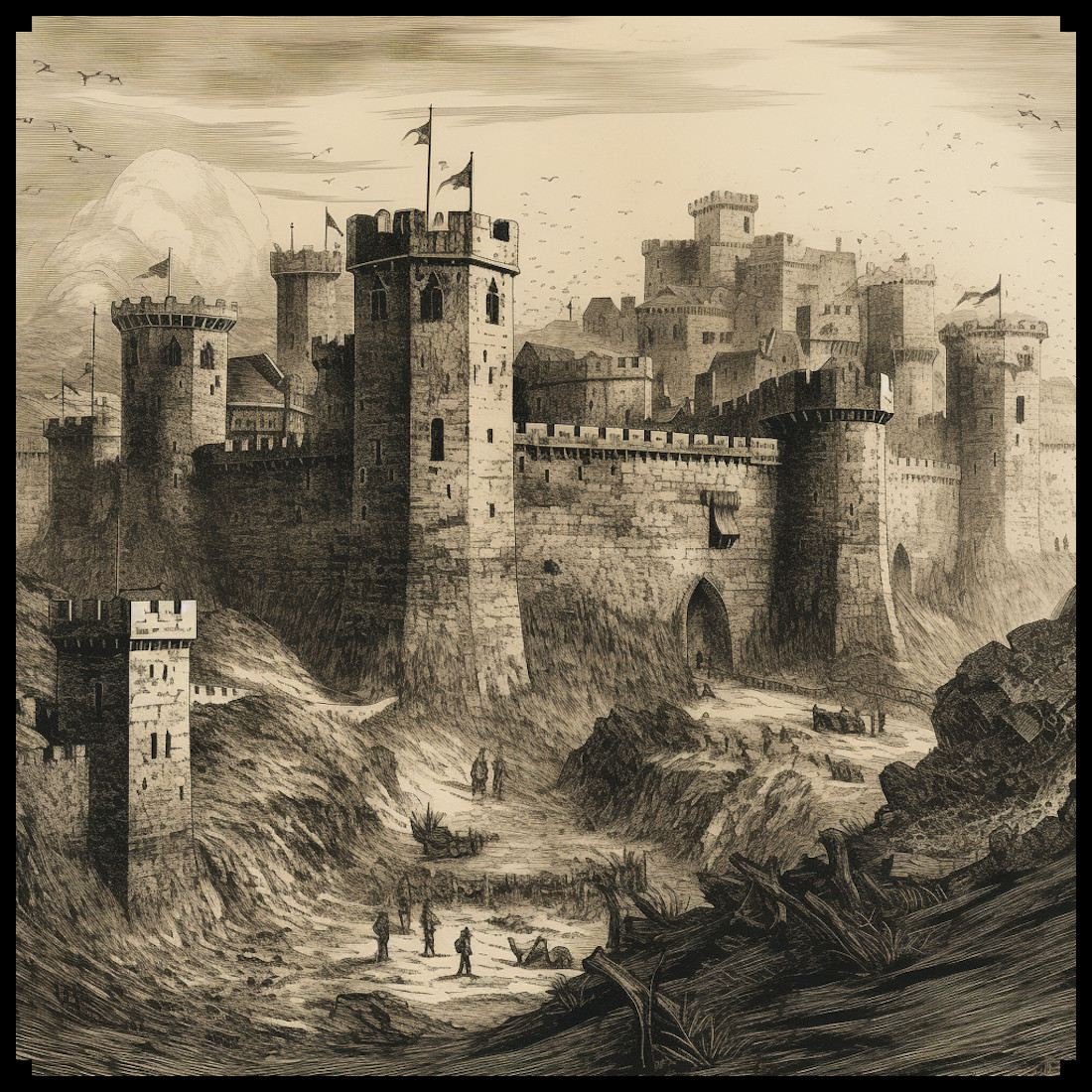
In both ancient cartography and fantasy map making, the depiction of ramparts, city walls, and defensive structures has always been more than mere decoration. These symbols tell stories of protection, power, and civilization itself. From the crenellated enclosures of medieval towns to the stylized fortifications of modern Wonderdraft assets and fantasy map icons, the way walls are drawn reflects both history and imagination.
The new Modular Medieval Ramparts & Castle Walls – Vintage Assets Megapack celebrates this rich tradition by bringing to life the artistic language of ancient and fantasy maps. Its hand-drawn style echoes the texture and charm of antique cartography while offering modern creators a vast library of cartography assets to build immersive worlds.
BUY AND DOWNLOAD The Modular Medieval Ramparts & Castle Walls – Vintage Assets Megapack here :
Walls as Borders and Symbols in Ancient Cartography
Long before satellite imagery and GIS data, maps were not purely geographic—they were conceptual. The Babylonian World Map (6th century BCE), etched on clay, is one of the earliest known examples: the world surrounded by a circular ocean, cities marked as fortified dots. The walls drawn around Babylon are not architectural records but symbols of order against chaos.
Similarly, in medieval mappa mundi—such as the famous Hereford Mappa Mundi (c. 1300)—Jerusalem sits encircled by massive ramparts, representing the divine center of the world. These circular walls are less about defense and more about sanctity and separation: the wall as the line between the holy and the profane.
Later, Renaissance cartographers like Sebastian Münster and Abraham Ortelius refined the visual grammar of fortification. Their maps of cities such as Venice or Nuremberg show detailed bastions and geometric ramparts—symbols of engineering pride as much as military might. Every line and crenelation was a proclamation of civilization’s control over the land.
City Walls and the Language of Fantasy Map Icons
When we shift to fantasy cartography, these traditions endure. Every fantasy map maker knows the satisfying logic of drawing a walled city—its circular perimeter promising safety from monsters, its gates marking trade and adventure. In worlds like Tolkien’s Middle-earth, Minas Tirith and Helm’s Deep are iconic examples of ramparted architecture, where geography and storytelling intertwine.
In Game of Thrones, George R.R. Martin’s King’s Landing and The Wall itself extend this visual heritage: fortifications not only divide nations but define entire mythologies. The map of Westeros—engraved with mountains, castles, and walls—owes much to the aesthetics of medieval European mapmaking.
Today, tools like Wonderdraft and other digital platforms continue this tradition. Through packs like the Modular Medieval Ramparts & Castle Walls – Vintage Assets Megapack, fantasy mapmakers can recreate these timeless symbols with authenticity and flexibility—choosing from medieval, gothic, eastern, Aztec, or Middle Eastern architectural styles to match the lore of their worlds.
The Practical and Cultural Role of Rampart Representation
Historically, the inclusion of ramparts and walls in maps served both utilitarian and symbolic functions.
- Defensive visualization: Early military engineers—like those of Vauban’s France—used detailed rampart plans to organize sieges, fortify cities, or project imperial power. The accuracy of wall representation could determine victory or defeat.
- Cultural identity: In ancient maps, walls were marks of prestige. A city without walls was not a city; it was wilderness. The Greek term polis implied both community and enclosure.
- Decorative artistry: In illuminated manuscripts and portolan charts, ramparts framed the miniature world with rhythmic, ornamental lines. They gave texture and weight to the map, guiding the eye and evoking grandeur.
In modern fantasy map making, this duality remains. Ramparts not only define territory—they add visual depth and narrative significance. A ruined wall suggests history; a massive bastion hints at a bygone war. Even the placement of a gate can tell the story of trade, pilgrimage, or invasion.
A Tribute to Historical Styles: The Modular Medieval Ramparts Megapack
The Modular Medieval Ramparts & Castle Walls – Vintage Assets Megapack revives this centuries-old visual language with an artistic nod to antique map engraving. Designed for fantasy cartographers, it provides an extensive collection of modular pieces that can be combined to build believable fortified landscapes.
The pack includes:
- Ramparts, castle walls, and ruined walls for every architectural taste—from western medieval to eastern or Aztec motifs.
- Defensive towers, gatehouses, bastions, and watchtowers, allowing creators to illustrate strongholds of any scale.
- Decorative elements such as gargoyles, shields, flags, stone ornaments, and palisades to enrich the storytelling texture of the map.
- Natural and civic additions—trees, farms, ponds, churches, and medieval houses—that integrate the fortified city into its surrounding world.
The visual tone imitates the sepia and ink-washed quality of old world cartography, making these fantasy map icons ideal for both historical maps and fantastical realms. Whether you are recreating Constantinople’s Theodosian Walls, the ruins of an ancient Aztec temple city, or an entirely invented fortress kingdom, these assets provide both precision and atmosphere.
The Enduring Appeal of Fortifications in Fantasy Cartography
Why do walled cities continue to fascinate us? Perhaps because they embody the human instinct to draw boundaries—to separate safety from danger, civilization from wilderness, the known from the unknown.
In ancient times, this was a matter of survival. In mapmaking, it became a language of form. In fantasy, it has become a language of emotion. When a reader or player sees a crenellated line on a parchment map, they instantly understand: “Here lies a city of strength.”
Thus, the artistic tradition of rampart representation unites millennia of human creativity—from Babylonian clay tablets to digital fantasy maps. And in tools like Wonderdraft or other modern cartography asset packs, that heritage continues to evolve, allowing every creator to become both historian and world-builder.
Conclusion
The Modular Medieval Ramparts & Castle Walls – Vintage Assets Megapack is not merely a collection of images—it is a bridge between ancient cartographic artistry and the modern imagination. By reviving the timeless symbols of defense, order, and beauty, it empowers creators to craft maps that feel truly alive—rooted in history, yet rich in fantasy.
Whether you are designing a fortified city for a tabletop campaign, illustrating an ancient empire, or mapping a fictional continent, these fantasy map making tools give you the vocabulary of ages past, rendered with modern precision.
Walls may divide lands, but in the realm of cartography, they unite centuries of art, storytelling, and design.