
In the history of mapmaking, few visual traditions are as fascinating as the representation of celestial bodies, astronomical symbols, and imagined worlds. Long before modern astronomy transformed our understanding of the cosmos, cartographers filled their maps with suns bearing human faces, moons watching over oceans, stars marking divine order, cherubs carrying banners across the heavens, and elaborate depictions of the universe itself. These images were never mere decoration. They communicated knowledge, authority, mythology, religious beliefs, scientific theories, and cultural aspirations.
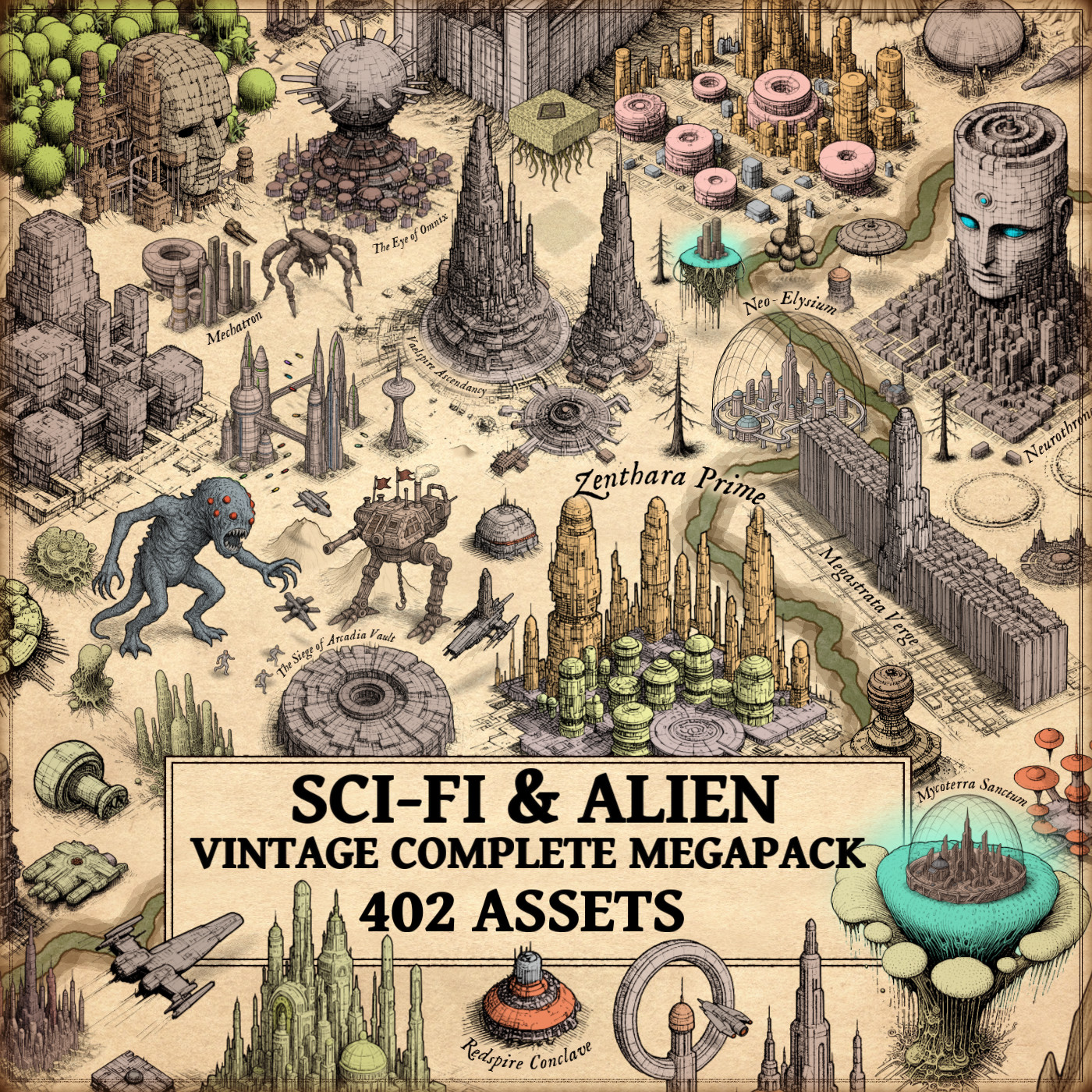
Today, those same visual traditions continue to inspire fantasy cartographers and worldbuilders. The Planetary & Sci-Fi Ultimate Megapack – Old Cartography Assets draws directly from this rich artistic heritage, adapting centuries of celestial iconography into a cohesive collection of cartography assets designed for science-fantasy worlds, planetary maps, ancient star charts, cosmic empires, and retro-futuristic settings. This pack blends historical aesthetics with science-fiction concepts, allowing creators to design maps that feel simultaneously ancient and futuristic.
Discover the Planetary & Sci-Fi Ultimate Megapack – Old Cartography Assets here :
Rather than relying on modern technical diagrams, the visual language evokes the age of hand-drawn atlases, celestial manuscripts, Renaissance cosmology, and speculative astronomy. Planetary cities, orbital installations, observatories, celestial symbols, crater fields, ringed planets, planetary pathways, mountain ranges, stars, moons, suns, and decorative cherubs all become part of a cartographic tradition that stretches back thousands of years.
Cartography Assets and the Ancient Origins of Celestial Mapping
Humanity has always attempted to place itself within a larger cosmos. Some of the earliest surviving maps already reveal a profound connection between geography and astronomy.
The famous Babylonian Map of the World (6th century BCE) combined geographical knowledge with cosmological ideas. The world was not simply a landmass but part of a larger ordered universe. Similarly, ancient Egyptian star ceilings and astronomical diagrams linked earthly territory with celestial realms. In Classical Antiquity, scholars such as Ptolemy developed geographical systems that merged astronomy and cartography, establishing principles that would influence mapmakers for over a millennium.
During the Middle Ages, maps frequently portrayed the universe as a divine creation. The celebrated Hereford Mappa Mundi and the Ebstorf Map did not merely document places; they expressed a complete worldview. Geography, theology, mythology, and astronomy existed side by side.
This historical fusion of world mapping and cosmic imagery is precisely what gives planetary-themed fantasy map icons their enduring appeal. A map becomes more than a navigation tool. It becomes a representation of an entire worldview.
Fantasy Map Symbols and the Tradition of Celestial Bodies on Maps
The depiction of planets, stars, suns, and moons has deep roots in historical cartography.
Throughout the Renaissance, celestial atlases became increasingly elaborate. The star maps of Johann Bayer’s Uranometria (1603) and the celestial charts of Andreas Cellarius in Harmonia Macrocosmica transformed astronomical diagrams into works of art. Planets were depicted not only as scientific objects but as symbolic entities carrying mythological significance.
The use of planetary globes and celestial spheres became particularly important. These representations helped viewers understand complex cosmological models while also serving as visual reminders of humanity’s place within the universe.
The planetary globe outlines featured throughout the Planetary & Sci-Fi Ultimate Megapack continue this tradition. They provide cartographers with a framework through which entire worlds can be imagined and visualized. The globe becomes both a practical mapping surface and a symbolic object representing exploration, discovery, and cosmic mystery.
Wonderdraft Assets Inspired by Historical Planetary Cartography
One of the most distinctive aspects of historical celestial maps is their combination of scientific purpose and artistic beauty. This balance is reflected in the pack’s extensive collection of planetary settlements, cities, villages, towns, buildings, and landmarks.
Historically, cities on maps served many functions. They marked political power, trade routes, military strength, and cultural significance. In fantasy and science-fiction cartography, planetary cities fulfill a similar role.
The planetary cities and settlements included in this collection allow mapmakers to establish hierarchy and scale. A sprawling planetary metropolis immediately communicates civilization, technological advancement, and political importance. Smaller settlements suggest frontier colonies, isolated communities, scientific outposts, or ancient civilizations.
This approach echoes historical maps in which the visual prominence of a city often conveyed its importance more effectively than any written description.
The result is a collection of Wonderdraft assets that feels rooted in traditional cartographic practice while expanding naturally into interplanetary storytelling.
Fantasy Map Icons for Planetary Bases, Orbital Installations, and Sci-Fi Metropolises
While historical cartographers could not map real extraterrestrial colonies, they frequently imagined distant realms beyond known geography.
Medieval maps included legendary kingdoms, mythical islands, and speculative territories. Renaissance cosmographers proposed inhabited celestial worlds long before space travel existed. Writers such as Johannes Kepler, particularly in Somnium (1634), imagined journeys to the Moon centuries before modern science made such ideas plausible.
The planetary bases, orbital stations, and advanced settlements found within this megapack inherit that spirit of speculative cartography.
On a science-fiction map, a planetary base functions much like a medieval fortress or colonial trading post. It becomes a focal point for exploration, defense, resource extraction, scientific observation, or interplanetary commerce.
Orbital installations occupy a similar symbolic role. Historically, ports and harbors connected distant regions. In a planetary setting, orbital bases become gateways between worlds.
These fantasy map symbols therefore carry both practical and narrative significance, helping mapmakers communicate infrastructure, power structures, and technological development at a glance.
Cartography Assets and the Visual Language of Craters, Mountains, and Planetary Terrain
Terrain representation has always been one of cartography’s greatest artistic challenges.
Early cartographers developed stylized mountain symbols to indicate relief. These techniques evolved into entire visual vocabularies that remained remarkably consistent across centuries.
The planetary mountains, hills, crater formations, and mountain-range paths included in the Planetary & Sci-Fi Ultimate Megapack continue this tradition.
Craters deserve particular attention because they serve a unique role in planetary cartography. Unlike mountains or rivers, craters immediately suggest extraterrestrial landscapes. They evoke impacts, geological history, ancient cataclysms, and the passage of immense spans of time.
Historically, mapmakers used terrain symbols not merely to represent geography but to shape perception. Mountain chains suggested barriers, deserts implied danger, and forests indicated mystery.
Planetary crater fields perform a comparable function within science-fiction worldbuilding. They suggest harsh environments, unexplored regions, archaeological mysteries, or evidence of cosmic events that shaped a world’s history.
As fantasy map resources, such terrain features provide visual storytelling before a single line of lore is written.
Fantasy Map Resources and the Cultural Meaning of Suns and Moons with Faces
Few cartographic traditions are more iconic than the sun and moon depicted with human faces.
These images appeared throughout medieval manuscripts, Renaissance maps, celestial atlases, and early astronomical illustrations. Far from being whimsical decorations, they reflected philosophical and religious beliefs.
In many cultures, celestial bodies were viewed as living entities or divine forces. The human-faced sun represented illumination, order, divine authority, and life itself. The moon often symbolized mystery, change, dreams, and the passage of time.
Maps frequently placed these figures in corners, borders, or celestial spaces above the mapped world. Their presence reminded viewers that earthly events unfolded beneath a larger cosmic order.
The sun figures and moon figures found within this collection preserve that visual heritage. They instantly evoke the atmosphere of antique maps while simultaneously enriching science-fantasy settings with symbolism and character.
Their appeal lies precisely in their dual nature. They are decorative, but they also communicate meaning.
Wonderdraft Assets and the Legacy of Stars, Celestial Symbols, and Cosmic Navigation
Stars have served as navigational tools for thousands of years.
From Polynesian navigators crossing the Pacific to European explorers charting new trade routes, celestial navigation was fundamental to human exploration. Consequently, stars became deeply embedded within cartographic traditions.
Historical maps often featured decorative constellations, celestial diagrams, and symbolic star fields. In many cases, these illustrations celebrated humanity’s growing understanding of the heavens.
The stars and celestial symbols included within this megapack extend that tradition into planetary cartography. They allow creators to establish cosmic geography in the same way historical maps established terrestrial geography.
A star can indicate a destination, a navigational reference point, a sacred location, or a region of cosmic importance. Celestial symbols can mark anomalies, ancient relics, forgotten civilizations, or mysterious astronomical phenomena.
In this way, these cartography assets contribute simultaneously to aesthetics, navigation, and narrative worldbuilding.
Fantasy Map Symbols and the Historical Role of Observatories
Observatories occupy a fascinating place in the history of cartography.
From the great astronomical centers of the Islamic Golden Age to the observatories of Renaissance Europe, these institutions played a crucial role in expanding geographical and astronomical knowledge.
The famous observatories of Tycho Brahe on the island of Hven transformed astronomy through systematic observation. Later institutions such as the Royal Observatory Greenwich became essential to navigation and global mapping.
The observatory symbols featured in this collection draw upon that historical legacy. On a planetary map, an observatory immediately suggests knowledge, science, exploration, and discovery.
Whether representing a scholarly order studying distant stars or a futuristic research complex monitoring interstellar phenomena, observatories become narrative anchors that enrich the world around them.
Cartography Assets and the Decorative Function of Cherubs in Antique Maps
To modern viewers, cherubs may seem unrelated to cartography. Yet they were among the most common decorative elements in Renaissance and Baroque maps.
Mapmakers often filled empty spaces with allegorical figures. Cherubs held banners, framed cartouches, pointed toward important regions, and interacted with celestial objects.
These figures transformed maps into works of art while also communicating prestige and cultural sophistication.
The cherubs carrying banners and telescope-bearing cherubs found in the Planetary & Sci-Fi Ultimate Megapack draw directly from this tradition.
The telescope is particularly meaningful because it bridges two historical eras. It evokes both classical decorative cartography and the Scientific Revolution, when humanity began observing the universe with unprecedented precision.
This combination perfectly captures the pack’s overall aesthetic: antique visual language meeting speculative planetary exploration.
Wonderdraft Assets for Creating Complete Planetary Worlds
What makes this collection especially compelling is not any individual symbol but the way all components work together.
Planetary globe outlines establish the framework of a world. Craters, mountains, hills, and terrain paths define geography. Settlements, cities, towns, villages, and bases introduce civilization. Orbital installations expand the setting beyond the surface. Observatories connect geography to astronomy. Celestial symbols, stars, suns, moons, and planets place everything within a larger cosmic context.
The result resembles the great historical atlases in which every decorative element reinforced a coherent worldview.
For fantasy cartographers, science-fiction authors, tabletop roleplaying game designers, and worldbuilding enthusiasts, this approach creates maps that feel authentic because they follow the same visual principles used by historical mapmakers for centuries.
Why These Fantasy Map Resources Matter for Modern Worldbuilding
The enduring power of antique cartography lies in its ability to combine information with imagination.
Historical maps were never purely functional. They informed, inspired, educated, entertained, and persuaded. They reflected scientific knowledge while simultaneously expressing cultural values and artistic ideals.
The Planetary & Sci-Fi Ultimate Megapack – Old Cartography Assets embraces this tradition by providing a complete visual vocabulary for planetary and science-fantasy cartography.
Its collection of planetary cities, bases, villages, towns, buildings, landmarks, alien settlements, orbital stations, crater fields, planets, ringed planets, moons, stars, observatories, celestial symbols, mountain ranges, planetary pathways, compass roses, suns, moons, cherubs, and decorative cosmic elements allows creators to construct maps that feel like lost relics from an alternate history of astronomy.
Rather than presenting the future through sterile technical diagrams, these Wonderdraft assets and fantasy map resources imagine what planetary exploration might look like if it had been drawn by Renaissance cosmographers, Baroque engravers, and the great celestial cartographers of the Age of Discovery.
That fusion of historical authenticity, artistic richness, and imaginative scope is what makes the Planetary & Sci-Fi Ultimate Megapack – Old Cartography Assets far more than a collection of symbols. It is a continuation of one of cartography’s oldest traditions: using maps not only to describe worlds, but also to dream of new ones.