Posted on Leave a comment

The Art and History of Mountains in Fantasy Cartography Through Antique Cartography Assets

Fantasy map symbols, mountains, hills, plateaus, knolls, fantasy map icons, Wonderdraft assets, vintage cartography assets

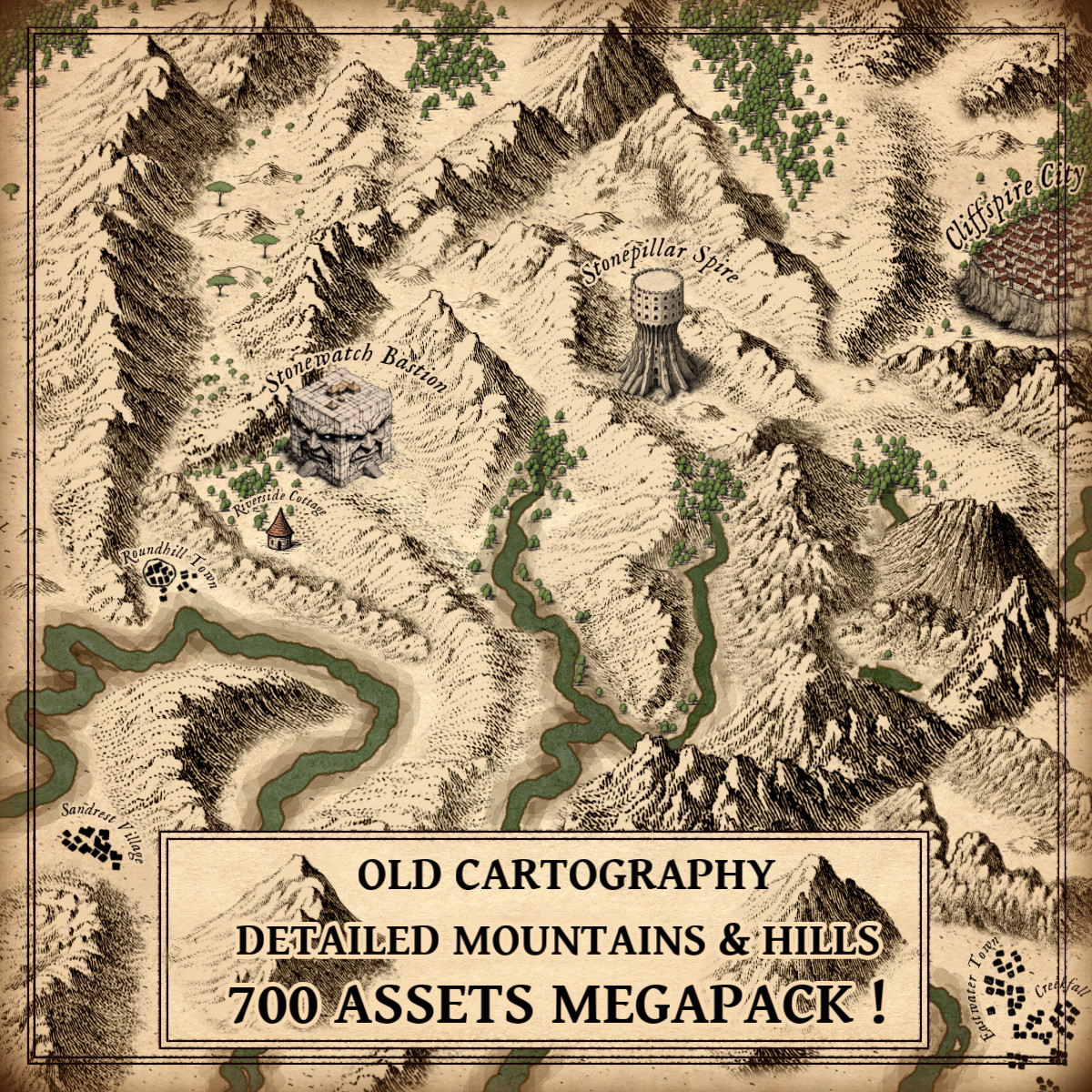
A deep exploration of terrain representation and the legacy revived by the Detailed Mountains & Hills – Old Cartography Assets Megapack

Mountains, hills, ridges, volcanoes, escarpments, and all the landforms included in the pack represent far more than decorative features. Across history, they formed a symbolic language that shaped geographical understanding, cultural identity, and storytelling. In both ancient traditions and modern fantasy map making, mountain drawings remain fundamental to how worlds, real or imaginary, are described.

The Detailed Mountains and Hills – Old Cartography Assets MEGAPACK faithfully revives antique engraving styles with carefully crafted landforms such as mountains, mountain ranges, hill formations, broken ranges, buttes, plateaus, craters, knolls or escarpments. These drawings recall centuries of handcrafted maps and bring their evocative aesthetic into digital worldbuilding.

BUY AND DOWNLOAD The Detailed Mountains and Hills – Old Cartography Assets MEGAPACK HERE :

1. Origins of Mountain Symbolism in Early Maps and Their Legacy in Fantasy Map Icons

The representation of mountains began long before the notion of modern topography existed. Ancient cartographers understood that terrain could not simply be sketched scientifically, they needed symbolic forms.

Antiquity

  • Ptolemy’s Geographia (2nd century CE) included simple hill-shaped symbols that defined early Western cartographic convention.
  • In East Asian maps, especially during the Han and Tang dynasties, mountains symbolized cosmic balance and were drawn in isometric, stacked forms.

Medieval Europe

  • The Hereford Mappa Mundi depicted mountains as dramatic clusters marking sacred regions, mythical realms, and uncharted territories.
  • Islamic cartographer al-Idrisi used mountains as climatic markers and boundaries between cultural zones.

The landforms included in the pack; from isolated peaks to crags, highlands, and ridges; mirror this historical variety, making them ideal as fantasy map icons that enrich worldbuilding with cultural weight and ancient symbolism.

2. Renaissance Cartographic Innovation and the Emergence of Engraved Wonderdraft Assets

With the Renaissance came a flourishing of geographical detail and artistic precision.

  • Ortelius’ Theatrum Orbis Terrarum (1570) introduced engraved mountain clusters with consistent shading and distinctive silhouettes.
  • The Blaeu family refined the art of hachuring, creating some of the most beautiful mountain engravings ever published.
  • Cassini’s cartographic work (18th century) brought proto-topographic systems that displayed altitude and slope through shading direction.

The mountains, hills, volcanoes, and landforms in the pack clearly follow these engraving traditions:
sharp hatching, coherent light direction, clean contours, and expressive silhouettes. As Wonderdraft assets, they allow mapmakers to reproduce Renaissance-level realism inside modern digital tools.

3. Cultural Symbolism and Narrative Weight of Mountains in Ancient Maps and Modern Cartography Assets

Across civilizations, mountains on maps expressed significance beyond terrain.

Mountains as Natural Borders

Historical maps often marked political or cultural divisions using mountain chains:

  • The Pyrenees between France and Spain
  • The Apennines shaping Italian regional identities
  • The Himalayas forming colossal boundaries in South and Central Asia

In fantasy worldbuilding, the same logic applies. The mountain ranges, escarpments, cliffs, fragmented highlands, and plateaus in the pack serve to define kingdoms, territories, and frontier zones.

Mountains as Myth and Mystery

Throughout history:

  • The Rhipaean Mountains of Greek lore
  • The Mountains of the Moon, believed to feed the Nile
  • Early depictions of Vesuvius as a gateway to the underworld

The presence of volcanoes, craters, broken ranges, and dramatic cliffs in the pack mirrors these mythic connotations, allowing creators to construct narrative-rich landscapes.

Mountains as Navigation

Travelers and explorers once relied on:

  • Buttes
  • Knolls
  • Coastal cliffs
  • Ridgelines

These features helped orient caravans, sailors, and pilgrims. Their equivalents appear in the pack, serving both functional map readability and aesthetic coherence within modern cartography assets.

4. Practical Uses of Terrain Symbols in Fantasy Map Making With Fantasy Map Icons

The antique style of the pack is not merely decorative, it offers structural clarity for map composition.

A. Building Geography Modularly

With elements such as:

  • Mountains + mountain ranges
  • Hills + hill formations
  • Highlands + fragmented highlands
  • Volcanoes + craters
  • Plateaus + escarpments

worldbuilders can assemble fully coherent continents and regions with remarkable natural flow.

B. Clarity at Multiple Scales

Classical engravers designed symbols to remain readable even in small atlases.
Similarly, the pack provides landforms that retain clarity in both continent-sized maps and close-up regional maps.

C. A Full Vocabulary of Landforms

Few collections offer such richness:

  • mountains
  • hills
  • knolls
  • crags
  • ridges
  • lowlands
  • broken ranges
  • cliffs
  • plateaus
  • craters

This gives worldbuilders control over geological storytelling.

D. Paintable and Customizable Designs

Following the tradition of hand-colored maps, the pack includes variants suitable for:

  • direct painting
  • digital recoloring
  • neutral monochrome engraving styles

These characteristics make the pack’s landforms perfect fantasy map icons for hybrid analog–digital creation.

5. The Artistic Craft Behind Antique-Style Wonderdraft Assets

The drawings in the pack reflect meticulous craftsmanship:

Engraving-inspired hatching

Line density and direction mimic copperplate techniques of the 16th–18th centuries.

Shading Consistency

Most peaks and hills employ a unified light direction, recalling classic European atlas design.

Natural Composition

Mountain ranges, broken ranges, and ridges cluster organically, just as in historic works by Ortelius, Blaeu, and Sanson.

Historical Geological Realism

  • Volcanic shapes evoke early depictions of Etna and Vesuvius
  • Crater symbols recall lunar cartography
  • Highlands resemble Swiss shaded-relief engravings

The result is a set of Wonderdraft assets that are both historically inspired and artistically robust.

6. The Modern Revival of Antique Mapping Through Digital Cartography Assets

Why does this antique mountain style remain the gold standard in fantasy worlds?

Authenticity and Immersion

These landforms instantly communicate history, age, and believability.

Narrative Depth

A towering range hints at epic quests.
A smoking volcano signals danger and myth.
A fragmented highland suggests ancient cataclysms.

Aesthetic Harmony

The engraved look pairs perfectly with parchment textures and serif fantasy typography.

The mountains, hills, seas of ridges, buttes, and broken ranges of the pack help creators revive centuries-old mapmaking tradition in a modern context.

Direct Connection With Historical Art

This is the same style used (and loved) by Tolkien, whose maps were heavily influenced by 16th-century engraving conventions.

Thus, the MEGAPACK stands at the crossroads of history and creativity, offering digital cartography assets that feel timeless.

Conclusion: A Timeless Artistic Language Reborn Through Fantasy Map Icons

The Detailed Mountains and Hills – Old Cartography Assets MEGAPACK is more than an asset collection, it is a revival of the classical cartographic language that shaped humanity’s understanding of the world.

From ancient Greek scholars to medieval cosmographers, Renaissance engravers, Enlightenment explorers, and modern fantasy storytellers, mountains have always been symbols of mystery, power, ambition, and identity.

With its mountains, hills, volcanoes, plateaus, craters, cliffs, ridges, lowlands, knolls, and countless other landforms, the pack enables modern creators to tap into this heritage and build worlds that feel alive, authentic, and beautifully crafted.

In fantasy cartography, a mountain is never just a shape on a page.
It is story, culture, geology, myth, and art, all expressed through ink.
Posted on

Fantastic Cartographies of the Future: The Cultural Power of Sci-Fi and Alien Elements in Fantasy Maps

Sci-fi map assets, Wonderdraft assets, alien settlements, alien flora, sci-fi towns, scifi city, Inkarnate

Maps are never just maps. From the clay tablets of Mesopotamia to the illuminated Mappa Mundi of the Middle Ages, cartography has always blended utility with wonder. It has been a tool for orientation, a cultural mirror, a political statement, and, crucially, a canvas for the imagination.

This tradition continues today in the realms of speculative fiction. Fantasy maps — whether drawn for roleplaying games, novels, or worldbuilding projects — are as much about visual storytelling as navigation. And in the age of science fiction, the visual vocabulary of maps has expanded to include towering megastructures, sprawling sci-fi cities, mysterious alien jungles, and intricate colony outposts.

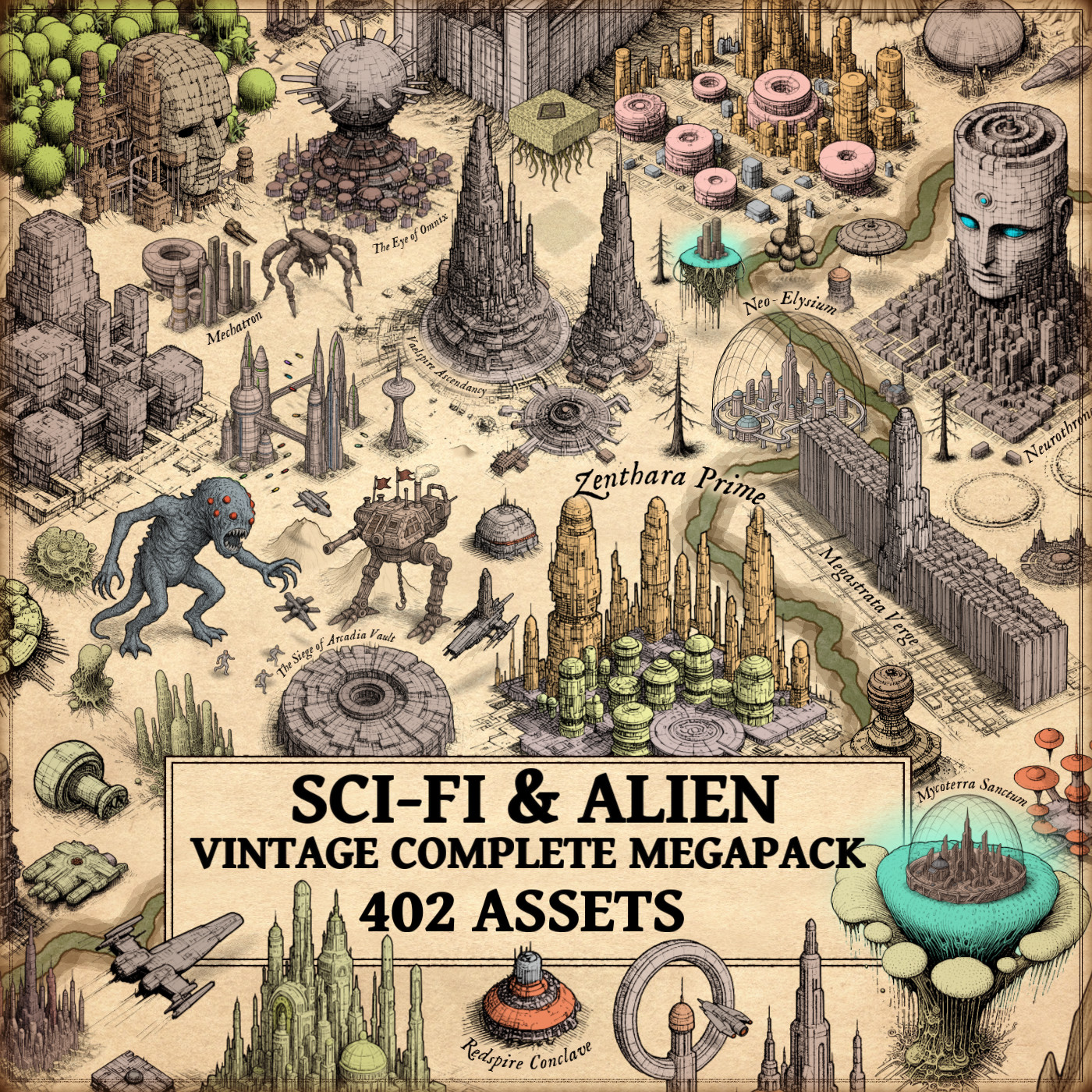
At the heart of this evolution stands the Sci-Fi & Alien Vintage Complete Megapack — a richly detailed collection of Wonderdraft assets, ideal for creators looking to build science-fiction or extraterrestrial worlds with style, coherence, and historical charm.

BUY AND DOWNLOAD The Sci-Fi & Alien Vintage Complete Megapack here :


From Antique Ink to Galactic Hubs: The Legacy of Speculative Cartography

Historical cartographers did not merely chart space — they mapped belief. Think of al-Idrisi’s Tabula Rogeriana (1154) or the Hereford Mappa Mundi (c. 1300): mythical beasts, the Garden of Eden, strange peoples, and symbolic cities. These early cartography assets did not just describe the world — they imagined it.

Modern fantasy map icons serve a similar function. When a sci-fi map includes a glowing domed city, a spaceport, or a grove of bioluminescent alien mushrooms, it doesn’t just tell us where something is — it tells us what that world believes in. It reflects our modern myths: progress, exploration, technology, and first contact.


The Functional and Symbolic Role of Sci-Fi Map Elements

In tabletop games, worldbuilding projects, or fictional atlases, sci-fi elements play vital narrative and strategic roles. Their visual representation, especially using high-quality Wonderdraft assets, enhances immersion and storytelling clarity.

Cities, Settlements, and Outposts

  • Sci-fi cities, futuristic towns, and colony outposts act as power centers, trading hubs, or strategic objectives.
  • Their design — often domed or fortified — mirrors themes of isolation, protection, or terraforming, reinforcing world narrative through visual cues.

Spaceports, Megacities, and Planetary Hubs

  • These elements serve as gateways between regions or planets, much like ancient ports once did on medieval nautical charts.
  • A megacity icon, placed on a galactic trade route, instantly signals importance and scale.

Spaceships, Crashed Vessels, and Star Cruisers

  • Mobile and iconic, they function like armies or fleets on historical battle maps — they bring motion to static landscapes.
  • Vintage-style designs evoke the golden era of pulp sci-fi, grounding even the most alien of maps in familiar cultural references.

Alien Settlements and Flora

  • Alien cities, biomechanical towers, or forests filled with luminescent mushrooms and gigantic alien trees recreate the surrealism once reserved for the margins of ancient maps.
  • These fantasy map icons suggest danger, mystery, or wonder — crucial atmosphere builders.

Cultural Depth and Decorative Power in Sci-Fi Mapmaking

While highly practical, these elements are also rich in aesthetic and symbolic meaning. Just as 16th-century maps by Ortelius or Mercator included ornate cities and decorative flourishes, today’s cartography assets bring visual rhythm and identity to sci-fi maps.

The Sci-Fi & Alien Vintage Complete Megapack is designed in the spirit of these historical works. Its unique style mimics antique linework and texturing, reimagining the visual language of ancient maps for use in futuristic settings. It’s a fusion of classical aesthetics with sci-fi imagination — a perfect blend for mapmakers seeking something more than digital clarity.


What Makes the Sci-Fi & Alien Vintage Complete Megapack Essential

This megapack is not just another asset collection — it’s a full visual toolkit for futuristic and alien worldbuilding. Whether you’re crafting a battle map, an interplanetary atlas, or a planetary hex map, this set offers:

  • A vast selection of fantasy map icons covering megastructures, technological ruins, orbital stations, and retro-futuristic spacecraft.
  • A rich variety of alien structures like monolith towers, biomechanical cities, and Lovecraftian alien forms.
  • Utility structures such as sci-fi bunkers, command towers, industrial buildings, and transparent domes.
  • Stylized icons for spaceports, sci-fi dungeons, fortresses, explorer vessels, and more.
  • A consistent visual tone — vintage, symbolic, and usable across multiple map types — especially compatible with Wonderdraft assets and similar software.

Each item was crafted with care for visual balance, storytelling impact, and stylistic cohesion. The icons are equally suited for tabletop maps, digital campaigns, and print-ready materials.


Bridging Ancient Style with Futuristic Vision

Why do we still decorate maps with fantastic places? Why are we drawn to alien towers, strange machines, and glowing flora?

Because, like ancient cartographers, we still crave mystery. We still want to fill the blank spaces with story.

The Sci-Fi & Alien Vintage Complete Megapack is a modern expression of an old desire: to capture the unknown in visual form. It transforms cartography assets into cultural artifacts, allowing creators to depict not only terrain, but worldview. And in doing so, it connects the speculative maps of the past with the imagined galaxies of the future.

Hang it on a wall, use it in a game, publish it in a book — whatever your purpose, this collection turns your world into a legend.

Posted on

Bizarre & Beautiful Mountains and Rolling Hills with Cartography Assets

Wonderdraft assets, rolling hills, fantasy mountains, peaks, vintage cartography assets, fantasy map icons

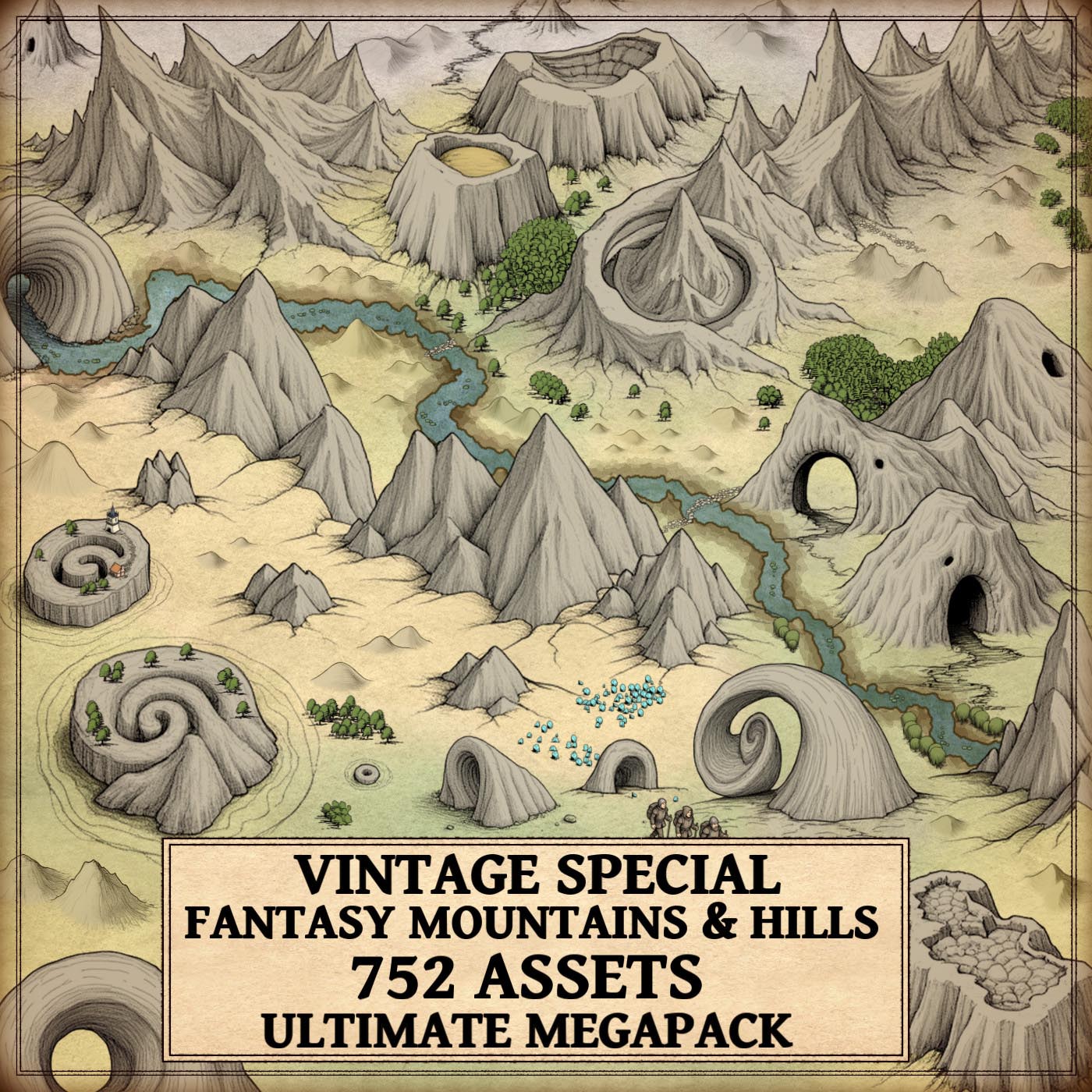
In the art of mapmaking, especially in fantasy cartography and antique mapping traditions, terrain features are far more than mere topographical markers. They are mythic symbols, narrative devices, and aesthetic focal points. The Vintage Special Fantasy Mountains & Rolling Hills Assets – Ultimate Megapack celebrates this rich tradition by offering a collection of PNG images and Wonderdraft assets that evoke the magic, mystery, and history of fantasy lands. From spiraling mountains that resemble the coils of time to jagged peaks, volcano-like craters, and cave-pierced cliffs, these fantasy map icons are rooted in a visual language that spans centuries.

BUY AND DOWNLOAD The Vintage Special Fantasy Mountains & Rolling Hills Assets – Ultimate Megapack here :


A Tradition Rooted in History and Myth

The fantastical terrain elements found in this asset pack are not a modern invention. Ancient and medieval maps, such as the Tabula Peutingeriana, a Roman road map, or the Hereford Mappa Mundi (circa 1300 AD), used symbolic and exaggerated representations to indicate not just geography but the presence of mythological beings, religious landmarks, and exotic dangers. Mountains were often shown as trilobed towers or spire-like stacks, while hills might be depicted as perfect domes or mysterious spiral forms.

In this tradition, topography was illustrative rather than scientific. It conveyed meaning: a spiral mountain might signify divine presence, time distortion, or magical influence. A cave in a cliff face might represent the entrance to the underworld or the domain of a dragon. These cartography assets in your megapack tap directly into that language.


The Aesthetic and Symbolic Power of Fantasy Terrain Icons

Spiraled Mountain Shapes

The surreal spirals seen in your collection—reminiscent of ammonites or whirlpools of stone—suggest temporal anomalies or places of magical power. These shapes are visual shorthand for the strange and sublime. Such designs echo the mysterious spiral motifs found in the Nazca Lines or Celtic art, now reinterpreted for fantasy worlds.

Mountains with Shadowy Caves

Cave-pierced cliffs call to mind Plato’s Allegory of the Cave or the mythic underworld entrances of Dante’s Inferno. They serve as thresholds between the known and unknown—perfect narrative cues for adventures and legends. These icons ground your fantasy map in mystery and peril.

Snail-Shell Rock Formations

Spiral rock forms are not just decorative; they hint at natural formations shaped by immense time or cosmic events. Similar shapes appear in the cosmic landscapes of Moebius’s sci-fi comics or the dreamlike terrains of Hayao Miyazaki’s Nausicaä of the Valley of the Wind. On your map, they draw the eye and spark the imagination.

Tall Peaks and Jagged Ridgelines

Classic yet powerful, these shapes signal grandeur, challenge, and impassibility. They are essential for natural borders, dramatic focal points, and elevation cues. The pack includes clustered peaks, jagged ridges, and isolated spires, offering a visual hierarchy perfect for directing a viewer’s gaze across your fantasy landscape.


Utility Meets Imagination: Why Stylized Terrain Matters

The Vintage Special Fantasy Mountains & Rolling Hills Assets aren’t just beautiful—they’re functional. In the hands of worldbuilders and gamemasters, these icons are tools of storytelling:

  • Route Planning: Use cobblestone paths and medieval hikers to create implied narratives of travel, danger, or pilgrimage.
  • Dungeon Entrances: Shadowed caves and crater-like formations suggest hidden lairs and lost civilizations.
  • Resource Placement: Crashed crystals or volcanic pits can symbolize rare magical resources or hazards.
  • Cultural Significance: Spiral hills and crater ridges can represent sacred sites, aligned with celestial events.

Just like ancient mappa mundi, your fantasy map becomes not just a chart of space, but a story about power, culture, and myth.


A Cartographer’s Dream: What’s in the Megapack?

This Wonderdraft assets and PNG images megapack includes 752 high-quality icons divided into multiple terrain types and visual styles. Here are some highlights:

  • Spiral rock formations
  • Volcanic craters and pits
  • Tunnel mountains and ringed hills
  • Natural arches and snail-shell hills
  • Cratered mesas and collapsed formations
  • Rolling hills and mound-shaped terrain
  • Custom color, sample color, normal, and outlined versions

Every asset is designed to blend seamlessly into a hand-drawn or vintage-style map. Whether you’re designing a D&D campaign world or a Tolkien-inspired realm, these icons enhance immersion and visual storytelling.


From Antique Maps to Modern Fantasy Worlds

The visual style of this asset pack pays homage to the woodcut illustrations of medieval Europe and Renaissance-era atlases. The detailed hatching and monochrome foundations evoke the tactile charm of maps drawn on parchment, while the colorized versions breathe new life into this heritage.

Fantasy worldbuilding is, at its core, the construction of believable illusions. With these terrain icons, your world will feel old, storied, and steeped in myth—even if it’s freshly imagined. Like the portolan charts of the 15th century or the myth-infused sketches of early explorers, your map becomes a bridge between imagination and cartographic art.


Conclusion: A New Chapter in Fantasy Cartography

The Vintage Special Fantasy Mountains & Rolling Hills Assets – Ultimate Megapack isn’t just a toolkit; it’s a visual language steeped in history, culture, and legend. It reconnects fantasy cartography with its ancient roots, blending the symbolic power of antique maps with the aesthetic demands of modern storytelling.

For worldbuilders, game masters, and visual storytellers, this pack is an essential trove of cartography assets. With 752 versatile and beautifully designed fantasy map icons, it invites you to chart realms not just with accuracy, but with wonder.

So the next time you place a spiral mountain on your map, remember: you’re not just marking a location—you’re evoking a legacy.