Posted on

Fantasy Map Icons & Wonderdraft Assets – Slavic Settlements in Vintage Cartography

slavic castles, slavic settlements, fantasy map symbols, vintage cartography assets, gimp, Wonderdraft assets, Photoshop

Introduction: Why Slavic Aesthetics Matter in Fantasy Map Making

In the world of fantasy map making, visual language is everything. Long before modern cartography prioritized scale and accuracy, antique maps relied on fantasy map icons and symbolic representations to communicate culture, power, danger, and belief. Among these traditions, Slavic-inspired settlements and landscapes occupy a unique place—both historically grounded and visually evocative.

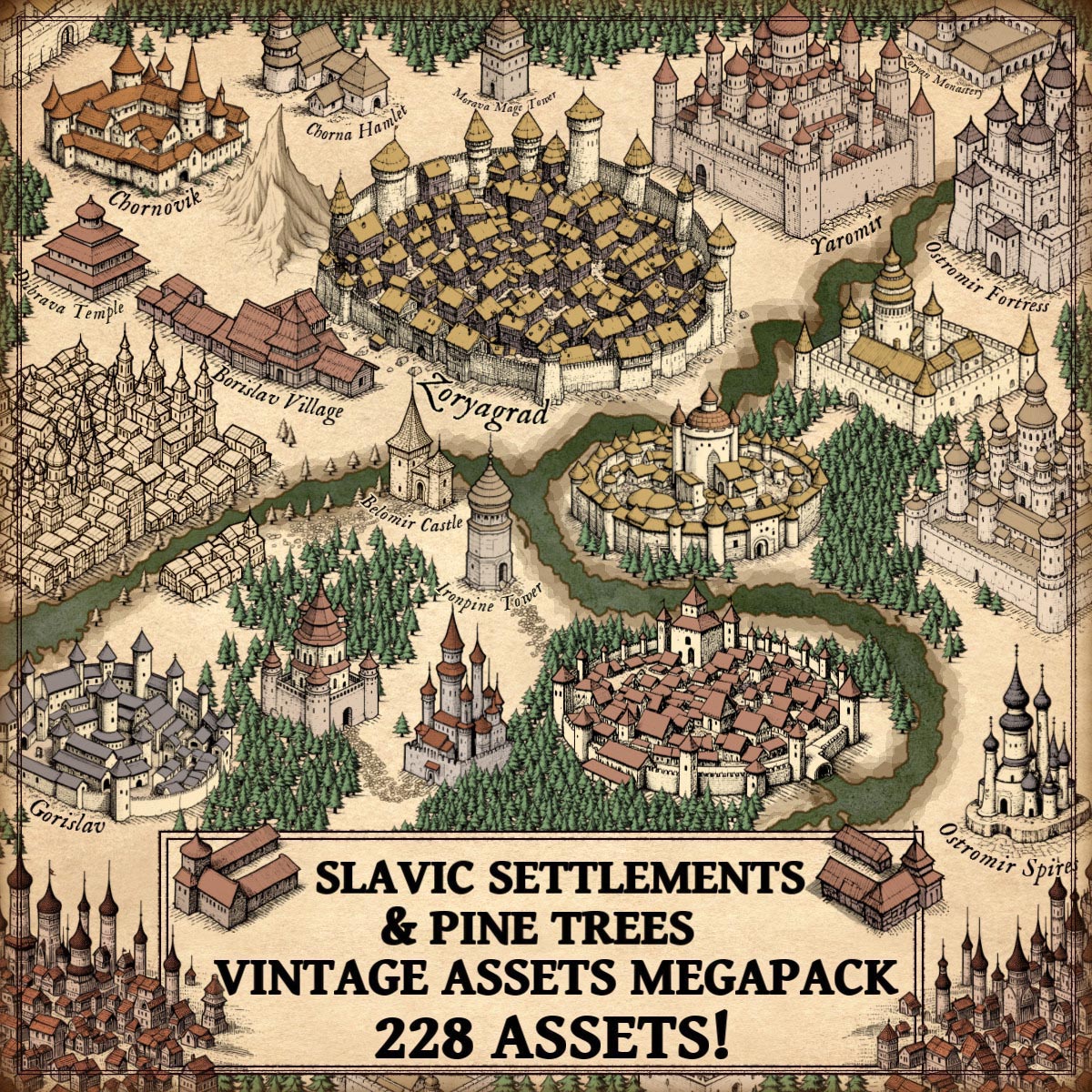
The Fortified Slavic Settlements, Towns, Castles, & Pine Trees – Vintage Assets Megapack draws directly from this legacy. Inspired by medieval and early modern cartography, the assets in the pack echo the same principles found in real antique maps: clarity, symbolism, hierarchy, and artistic storytelling. These wonderdraft assets are not merely decorative; they are functional heirs to centuries of cartographic practice.

Discover the Fortified Slavic Settlements, Towns, Castles, & Pine Trees – Vintage Assets Megapack here :

Slavic Settlements as Core Fantasy Map Icons in Fantasy Map Making

Slavic settlements form the structural backbone of many historical and fictional maps. From early medieval villages to organized towns, Slavic societies developed settlement patterns shaped by forests, rivers, and communal defense.

On antique maps, settlements were rarely drawn to scale. Instead, they were represented through:

  • Compact clusters of houses
  • Repeated architectural motifs
  • Simplified silhouettes readable at a distance

This megapack follow the same logic. Each Slavic settlement icon conveys population level, permanence, and importance at a glance. In fantasy map icons, these symbols allow mapmakers to build believable regions without overwhelming the composition.

Historically comparable examples include:

  • The city vignettes in the Nuremberg Chronicle (1493)
  • Early Eastern European regional maps where towns appear as emblematic miniatures

These assets translate that tradition directly into modern vintage cartography assets for fantasy worlds.

Fortified Slavic Towns in Vintage Cartography Assets and Medieval Fantasy Maps

Fortified Slavic towns—often known historically as gords or grads—were central to political and military life. Built with timber walls, earthworks, and later stone fortifications, they guarded trade routes and borders.

In antique cartography, fortified towns were emphasized visually:

  • Thick walls
  • Towers multiplied beyond reality
  • Circular or geometric layouts

Maps such as Olaus Magnus’ Carta Marina (1539) demonstrate this exaggeration clearly. Fortifications were symbolic first, accurate second.

The fortified towns in this pack embrace this same visual philosophy. As fantasy map symbols, they instantly communicate:

  • Strategic importance
  • Military control
  • Regional authority

For fantasy map making, these wonderdraft assets provide visual hierarchy—guiding the viewer’s eye across the map.

Slavic Towns, Hamlets, and Villages as Everyday Fantasy Map Icons

Not all power lies behind walls. Slavic hamlets and villages represent the daily life of the land: farmers, woodcutters, traders, and craftsmen.

Historically:

  • Villages were loosely organized
  • Houses were primarily wooden
  • Roofs and layouts reflected climate and local resources

Antique maps often depicted such settlements as small clusters of buildings, sometimes no more than a symbol. This abstraction is faithfully preserved in the megapack, making these assets ideal fantasy map icons for:

  • Filling rural spaces
  • Indicating population spread
  • Supporting narrative realism

In vintage cartography assets, these elements serve as connective tissue between cities and wilderness.

Slavic Castles, Fortresses, and Citadels as Fantasy Map Symbols of Power

Slavic castles and fortresses mark the transition from tribal organization to feudal authority. From early hillforts to later stone complexes, they symbolized rulership, defense, and permanence.

Historical counterparts include:

  • Wawel Castle in Kraków
  • Early fortified centers of Kievan Rus

In antique maps, castles were often oversized and idealized. Their purpose was symbolic dominance rather than architectural precision.

The castles, fortresses, and citadels in this megapack continue this tradition. As fantasy map icons, they:

  • Anchor political regions
  • Serve as narrative focal points
  • Reinforce medieval atmosphere

These wonderdraft assets excel at translating authority into visual form.

Slavic Cities and Dense Urban Medieval Blocks in Fantasy Map Making

Large Slavic cities developed around trade, religion, and defense. Dense housing, narrow streets, and layered fortifications defined their character.

Antique maps frequently represented cities as:

  • Dense masses of rooftops
  • Repeated towers and domes
  • Highly stylized urban blocks

This megapack’s dense urban medieval city blocks reflect those conventions precisely. In fantasy map making, they allow cartographers to suggest urban complexity without sacrificing clarity—an essential trait of effective vintage cartography assets.

Slavic Temples, Monasteries, and Sacred Architecture in Fantasy Map Icons

Spiritual geography was as important as political geography. Before Christianization, Slavic cultures maintained sacred temples and ritual spaces; later, monasteries became centers of learning and influence.

Antique maps routinely emphasized religious structures, often regardless of their actual size. This tradition is visible in:

  • Medieval pilgrimage maps
  • Early ecclesiastical atlases

The Slavic temples and monasteries in the pack act as fantasy map symbols for:

  • Faith systems
  • Cultural identity
  • Ideological influence

They enrich fantasy worlds with layers of belief and history.

Gatehouses, Watchtowers, Mage Towers, and Defensive Infrastructure

Infrastructure elements—gatehouses, watchtowers, and towers—were critical to medieval landscapes. On antique maps, such features often appeared as standalone symbols marking borders, roads, or dangerous zones.

In fantasy cartography, mage towers inherit the same symbolic role once held by keeps and signal towers. The assets in this pack respect antique visual logic, ensuring stylistic cohesion across realistic and fantastical elements.

As fantasy map icons, they guide movement, suggest danger, and support storytelling.

Pine Trees and Forest Landscapes in Vintage Cartography Assets

Forests defined the Slavic world. Vast pine woodlands shaped settlement patterns, warfare, and mythology.

Antique cartographers represented forests through repeated tree symbols, not shaded terrain. Pines often signaled:

  • Cold climates
  • Untamed regions
  • Natural borders

The pine trees in the pack fulfill exactly this role. They are not background decoration; they are cultural markers. In fantasy map making, they:

  • Frame settlements
  • Shape travel routes
  • Enhance regional identity

These vintage cartography assets remain faithful to historical precedent.

Utility, Culture, and Decoration in Fantasy Map Icons

Antique maps balanced three essential purposes:

  1. Utility — conveying information clearly
  2. Culture — expressing identity and worldview
  3. Decoration — engaging the viewer

The Fortified Slavic Settlements, Towns, Castles, & Pine Trees – Vintage Assets Megapack succeeds because it respects all three. Every asset is:

  • Readable at map scale
  • Historically inspired
  • Artistically cohesive

These wonderdraft assets are tools, but also storytelling instruments.

Conclusion: Slavic Heritage as a Foundation for Fantasy Map Making

Slavic-inspired fantasy map icons are not niche embellishments—they are foundational elements rooted in real cartographic history. By drawing from antique representations and medieval visual logic, this asset pack allows creators to build worlds that feel authentic, layered, and timeless.

In continuing the traditions of antique maps, these vintage cartography assets do what the best fantasy cartography has always done:
transform geography into narrative, and symbols into stories.

Posted on

Wonderdraft Assets – Fantasy Map Icons & Map Symbols

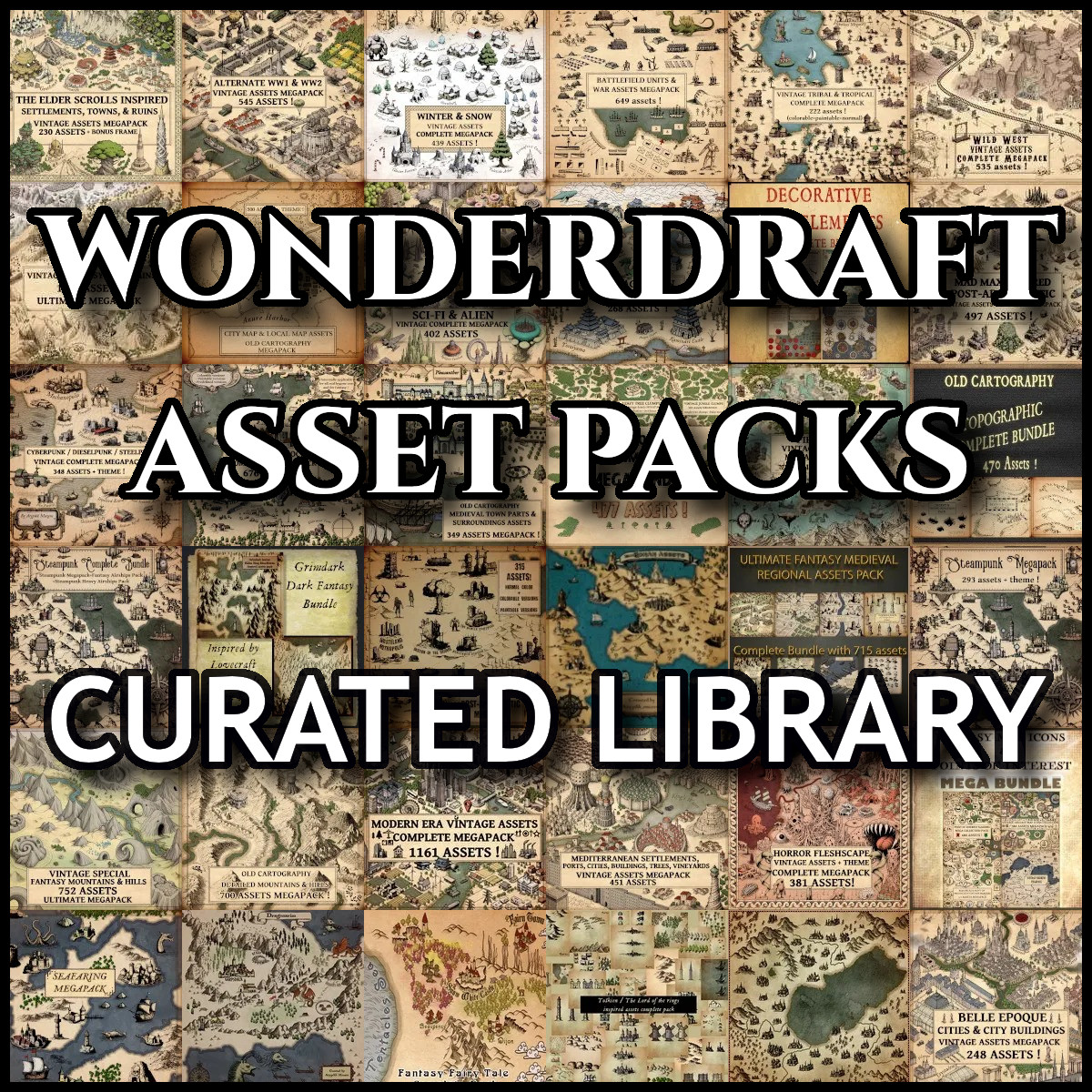
Wonderdraft assets pack library with fantasy map icons and cartography symbols

Wonderdraft assets are essential tools for creating detailed and immersive fantasy maps. They allow mapmakers to add mountains, cities, symbols, terrain features, and decorative elements directly inside Wonderdraft, transforming a simple map into a believable and readable world.

Whether you are a dungeon master preparing a campaign, a fantasy writer visualizing fictional regions, or a worldbuilder designing entire continents, high-quality Wonderdraft assets make a decisive difference in both clarity and atmosphere. Carefully curated Wonderdraft asset packs help creators work faster while maintaining a consistent visual identity across their maps.
This page serves as a reference hub for Wonderdraft assets, explaining how they are used in fantasy mapmaking and how to choose the right assets for professional-quality cartography.

Looking for Wonderdraft asset packs?
Browse the complete Wonderdraft asset library and packs

What Are Wonderdraft Assets in Fantasy Mapmaking?

Wonderdraft assets are graphic elements specifically designed to be imported and used within the Wonderdraft mapmaking software. They are usually provided as transparent PNG files and can be added as symbols or custom assets inside the editor.

These Wonderdraft map assets represent both natural and man-made elements: mountains, trees, cities, castles, roads, landmarks, and decorative cartography components. Well-crafted Wonderdraft assets follow consistent scale, perspective, and shading so that all elements blend naturally on the same map.

Rather than drawing every feature by hand, mapmakers rely on custom Wonderdraft assets to speed up their workflow while maintaining a coherent and polished visual style.

Why High-Quality Wonderdraft Assets Matter

Not all Wonderdraft assets produce the same results. Inconsistent or poorly designed assets can make a fantasy map feel cluttered, unreadable, or amateurish.

High-quality Wonderdraft assets offer several advantages:

  • Clear readability at different zoom levels
  • Consistent visual style across the entire map
  • Faster map creation without sacrificing detail
  • Professional results suitable for publication or sharing

For creators who care about immersion and presentation, using carefully designed Wonderdraft assets is essential.

Types of Wonderdraft Assets for Fantasy Maps

Wonderdraft supports a wide range of asset types, each serving a specific role in fantasy cartography. Together, these elements form complete fantasy map assets for Wonderdraft, suitable for both regional projects and large-scale world maps.

Mountains & Terrain Assets

Mountains, hills, ridges, volcanoes, trees, swamps, and deserts define the geography and mood of a fantasy world. Terrain assets establish scale, climate, and natural borders.

Cities, Settlements & Architecture

Cities, towns, villages, forts, castles, ruins, and harbors represent civilization, political power, and trade networks across the map.

Symbols & Map Icons

These Wonderdraft symbols highlight points of interest such as temples, towers, mines, ruins, battlefields, or magical locations. Map icons help guide the reader’s eye and support storytelling through visual cues.

Decorative Cartography Elements

Borders, frames, compass roses, banners, textures, and ornamental details add an old-world cartographic feel and elevate the visual presentation of a fantasy map.

Who Uses Wonderdraft Assets?

Wonderdraft assets are used by a wide range of creators working on different types of fantasy projects.

Dungeon Masters rely on them to build clear and immersive RPG campaign maps. Fantasy writers use Wonderdraft map assets to visualize fictional regions and maintain geographic consistency across their stories. Worldbuilders design continents, kingdoms, and trade routes, while game developers prototype fantasy settings during early production stages. Artists and cartographers also use Wonderdraft assets to explore historical and engraved map styles.

Across all these use cases, consistency and readability remain the key reasons for choosing high-quality Wonderdraft assets.

Vintage & Old Cartography Style Wonderdraft Assets

Many fantasy mapmakers prefer assets inspired by vintage and historical cartography. Engraved mountains, hand-drawn settlements, and antique symbols evoke the look of old atlases and medieval maps.

This old-world cartography style is especially effective for:

  • Classic or low-magic fantasy settings
  • Folklore-inspired regions
  • Historical or pseudo-historical worlds
  • Parchment and hand-drawn map aesthetics

Vintage Wonderdraft assets emphasize linework, texture, and shading rather than flat digital shapes, creating a timeless and immersive visual language.

How to Choose the Right Wonderdraft Assets

When selecting Wonderdraft assets, it is important to consider several factors:

  • Compatibility with Wonderdraft (transparent PNG files, correct scale)
  • Consistency in style across multiple Wonderdraft asset packs
  • Readability on both regional and world-scale fantasy maps
  • Licensing for personal and commercial projects

Using a curated collection of assets designed to work together usually produces better results than mixing unrelated styles.

Examples of Wonderdraft Asset Packs

The asset packs listed below are only a small selection from a much larger collection of Wonderdraft assets available on this site. They are presented as examples to illustrate the variety of styles, themes, and cartographic elements that can be combined to build cohesive fantasy maps.

The full library includes many more Wonderdraft asset packs covering terrain, settlements, symbols, and decorative cartography elements, all designed to work seamlessly with Wonderdraft.

Mountains, Trees, & Terrain Assets

Engraved-style mountains, hills, ridges, volcanoes, and natural terrain symbols inspired by vintage and hand-drawn cartography.

Explore Mountain & Terrain Assets for Wonderdraft

Cities, Settlements & Architecture

Towns, villages, fortified cities, castles, and architectural symbols suitable for regional and world-scale fantasy maps.

Browse Settlement & Town Assets

Symbols & Map Icons

Landmarks, temples, ruins, towers, magical locations, and point-of-interest icons for storytelling and worldbuilding.

Discover Fantasy Map Icons & Symbols

Vintage & Old Cartography Elements

Decorative borders, compass roses, ornaments, frames, and engraved-style elements inspired by historical atlases.

View Vintage Cartography Assets

Created by a Dedicated Fantasy Cartographer

All Wonderdraft assets available on this site are created by an independent fantasy cartographer and digital artist specialized in vintage and engraved-style map design.
These assets have been used by thousands of mapmakers worldwide for tabletop RPGs, fantasy novels, worldbuilding projects, and commercial publications.

Each Wonderdraft asset pack is developed with a strong focus on historical cartography references, visual consistency, and long-term usability within Wonderdraft.

Explore the Full Wonderdraft Asset Library

This site hosts a growing library of premium Wonderdraft assets created for fantasy mapmakers who value authenticity, consistency, and old-world cartography aesthetics.

All assets are designed to work together, allowing creators to combine different Wonderdraft asset packs into cohesive maps without visual clashes or stylistic breaks.

Browse the complete Wonderdraft asset library and packs

Posted on

The Art and History of Mountains in Fantasy Cartography Through Antique Cartography Assets

Fantasy map symbols, mountains, hills, plateaus, knolls, fantasy map icons, Wonderdraft assets, vintage cartography assets

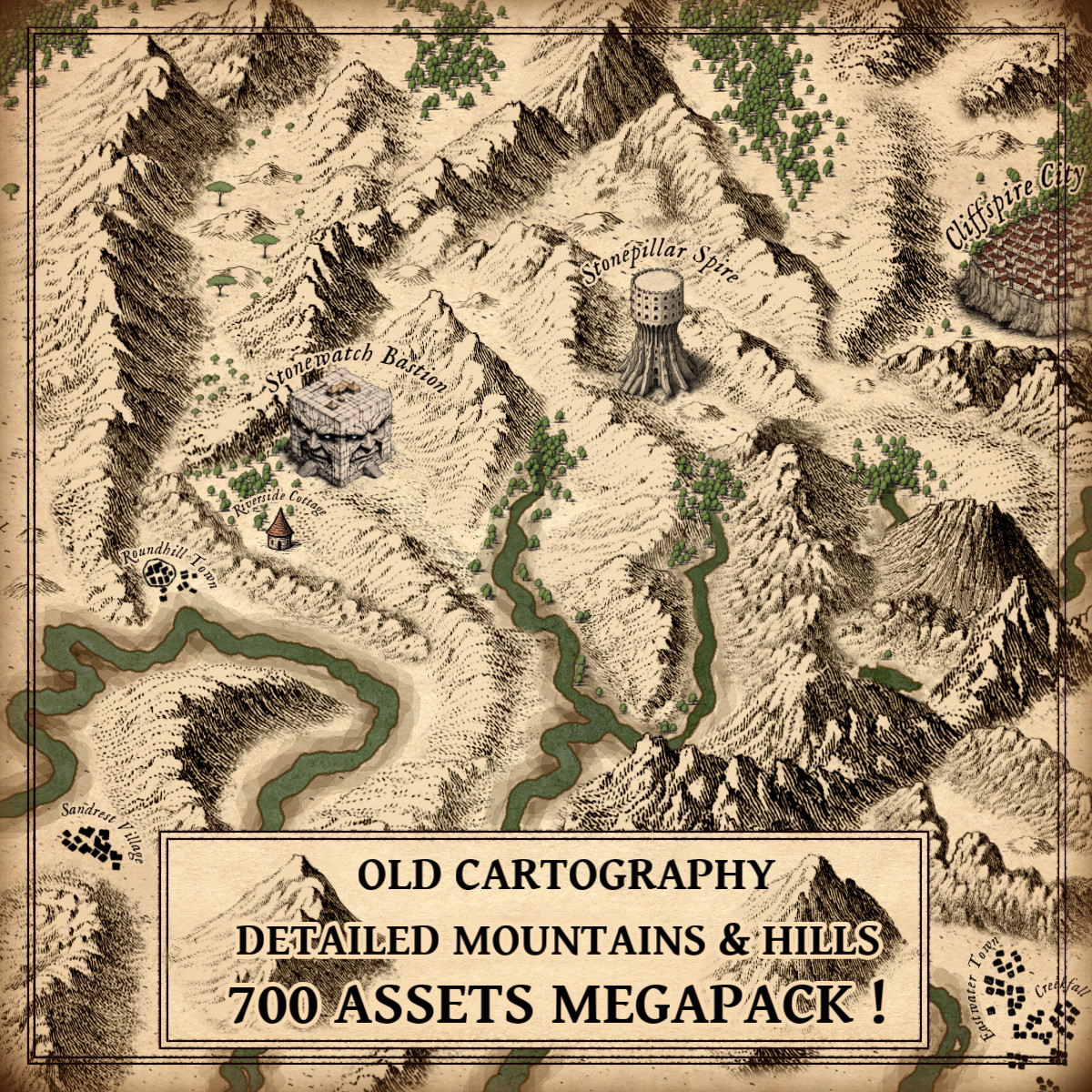
A deep exploration of terrain representation and the legacy revived by the Detailed Mountains & Hills – Old Cartography Assets Megapack

Mountains, hills, ridges, volcanoes, escarpments, and all the landforms included in the pack represent far more than decorative features. Across history, they formed a symbolic language that shaped geographical understanding, cultural identity, and storytelling. In both ancient traditions and modern fantasy map making, mountain drawings remain fundamental to how worlds, real or imaginary, are described.

The Detailed Mountains and Hills – Old Cartography Assets MEGAPACK faithfully revives antique engraving styles with carefully crafted landforms such as mountains, mountain ranges, hill formations, broken ranges, buttes, plateaus, craters, knolls or escarpments. These drawings recall centuries of handcrafted maps and bring their evocative aesthetic into digital worldbuilding.

BUY AND DOWNLOAD The Detailed Mountains and Hills – Old Cartography Assets MEGAPACK HERE :

1. Origins of Mountain Symbolism in Early Maps and Their Legacy in Fantasy Map Icons

The representation of mountains began long before the notion of modern topography existed. Ancient cartographers understood that terrain could not simply be sketched scientifically, they needed symbolic forms.

Antiquity

  • Ptolemy’s Geographia (2nd century CE) included simple hill-shaped symbols that defined early Western cartographic convention.
  • In East Asian maps, especially during the Han and Tang dynasties, mountains symbolized cosmic balance and were drawn in isometric, stacked forms.

Medieval Europe

  • The Hereford Mappa Mundi depicted mountains as dramatic clusters marking sacred regions, mythical realms, and uncharted territories.
  • Islamic cartographer al-Idrisi used mountains as climatic markers and boundaries between cultural zones.

The landforms included in the pack; from isolated peaks to crags, highlands, and ridges; mirror this historical variety, making them ideal as fantasy map icons that enrich worldbuilding with cultural weight and ancient symbolism.

2. Renaissance Cartographic Innovation and the Emergence of Engraved Wonderdraft Assets

With the Renaissance came a flourishing of geographical detail and artistic precision.

  • Ortelius’ Theatrum Orbis Terrarum (1570) introduced engraved mountain clusters with consistent shading and distinctive silhouettes.
  • The Blaeu family refined the art of hachuring, creating some of the most beautiful mountain engravings ever published.
  • Cassini’s cartographic work (18th century) brought proto-topographic systems that displayed altitude and slope through shading direction.

The mountains, hills, volcanoes, and landforms in the pack clearly follow these engraving traditions:
sharp hatching, coherent light direction, clean contours, and expressive silhouettes. As Wonderdraft assets, they allow mapmakers to reproduce Renaissance-level realism inside modern digital tools.

3. Cultural Symbolism and Narrative Weight of Mountains in Ancient Maps and Modern Cartography Assets

Across civilizations, mountains on maps expressed significance beyond terrain.

Mountains as Natural Borders

Historical maps often marked political or cultural divisions using mountain chains:

  • The Pyrenees between France and Spain
  • The Apennines shaping Italian regional identities
  • The Himalayas forming colossal boundaries in South and Central Asia

In fantasy worldbuilding, the same logic applies. The mountain ranges, escarpments, cliffs, fragmented highlands, and plateaus in the pack serve to define kingdoms, territories, and frontier zones.

Mountains as Myth and Mystery

Throughout history:

  • The Rhipaean Mountains of Greek lore
  • The Mountains of the Moon, believed to feed the Nile
  • Early depictions of Vesuvius as a gateway to the underworld

The presence of volcanoes, craters, broken ranges, and dramatic cliffs in the pack mirrors these mythic connotations, allowing creators to construct narrative-rich landscapes.

Mountains as Navigation

Travelers and explorers once relied on:

  • Buttes
  • Knolls
  • Coastal cliffs
  • Ridgelines

These features helped orient caravans, sailors, and pilgrims. Their equivalents appear in the pack, serving both functional map readability and aesthetic coherence within modern cartography assets.

4. Practical Uses of Terrain Symbols in Fantasy Map Making With Fantasy Map Icons

The antique style of the pack is not merely decorative, it offers structural clarity for map composition.

A. Building Geography Modularly

With elements such as:

  • Mountains + mountain ranges
  • Hills + hill formations
  • Highlands + fragmented highlands
  • Volcanoes + craters
  • Plateaus + escarpments

worldbuilders can assemble fully coherent continents and regions with remarkable natural flow.

B. Clarity at Multiple Scales

Classical engravers designed symbols to remain readable even in small atlases.
Similarly, the pack provides landforms that retain clarity in both continent-sized maps and close-up regional maps.

C. A Full Vocabulary of Landforms

Few collections offer such richness:

  • mountains
  • hills
  • knolls
  • crags
  • ridges
  • lowlands
  • broken ranges
  • cliffs
  • plateaus
  • craters

This gives worldbuilders control over geological storytelling.

D. Paintable and Customizable Designs

Following the tradition of hand-colored maps, the pack includes variants suitable for:

  • direct painting
  • digital recoloring
  • neutral monochrome engraving styles

These characteristics make the pack’s landforms perfect fantasy map icons for hybrid analog–digital creation.

5. The Artistic Craft Behind Antique-Style Wonderdraft Assets

The drawings in the pack reflect meticulous craftsmanship:

Engraving-inspired hatching

Line density and direction mimic copperplate techniques of the 16th–18th centuries.

Shading Consistency

Most peaks and hills employ a unified light direction, recalling classic European atlas design.

Natural Composition

Mountain ranges, broken ranges, and ridges cluster organically, just as in historic works by Ortelius, Blaeu, and Sanson.

Historical Geological Realism

  • Volcanic shapes evoke early depictions of Etna and Vesuvius
  • Crater symbols recall lunar cartography
  • Highlands resemble Swiss shaded-relief engravings

The result is a set of Wonderdraft assets that are both historically inspired and artistically robust.

6. The Modern Revival of Antique Mapping Through Digital Cartography Assets

Why does this antique mountain style remain the gold standard in fantasy worlds?

Authenticity and Immersion

These landforms instantly communicate history, age, and believability.

Narrative Depth

A towering range hints at epic quests.
A smoking volcano signals danger and myth.
A fragmented highland suggests ancient cataclysms.

Aesthetic Harmony

The engraved look pairs perfectly with parchment textures and serif fantasy typography.

The mountains, hills, seas of ridges, buttes, and broken ranges of the pack help creators revive centuries-old mapmaking tradition in a modern context.

Direct Connection With Historical Art

This is the same style used (and loved) by Tolkien, whose maps were heavily influenced by 16th-century engraving conventions.

Thus, the MEGAPACK stands at the crossroads of history and creativity, offering digital cartography assets that feel timeless.

Conclusion: A Timeless Artistic Language Reborn Through Fantasy Map Icons

The Detailed Mountains and Hills – Old Cartography Assets MEGAPACK is more than an asset collection, it is a revival of the classical cartographic language that shaped humanity’s understanding of the world.

From ancient Greek scholars to medieval cosmographers, Renaissance engravers, Enlightenment explorers, and modern fantasy storytellers, mountains have always been symbols of mystery, power, ambition, and identity.

With its mountains, hills, volcanoes, plateaus, craters, cliffs, ridges, lowlands, knolls, and countless other landforms, the pack enables modern creators to tap into this heritage and build worlds that feel alive, authentic, and beautifully crafted.

In fantasy cartography, a mountain is never just a shape on a page.
It is story, culture, geology, myth, and art, all expressed through ink.

Learn more about Wonderdraft assets

Posted on

Why Use Viking and Nordic Cartography Assets in Our Fantasy Maps?

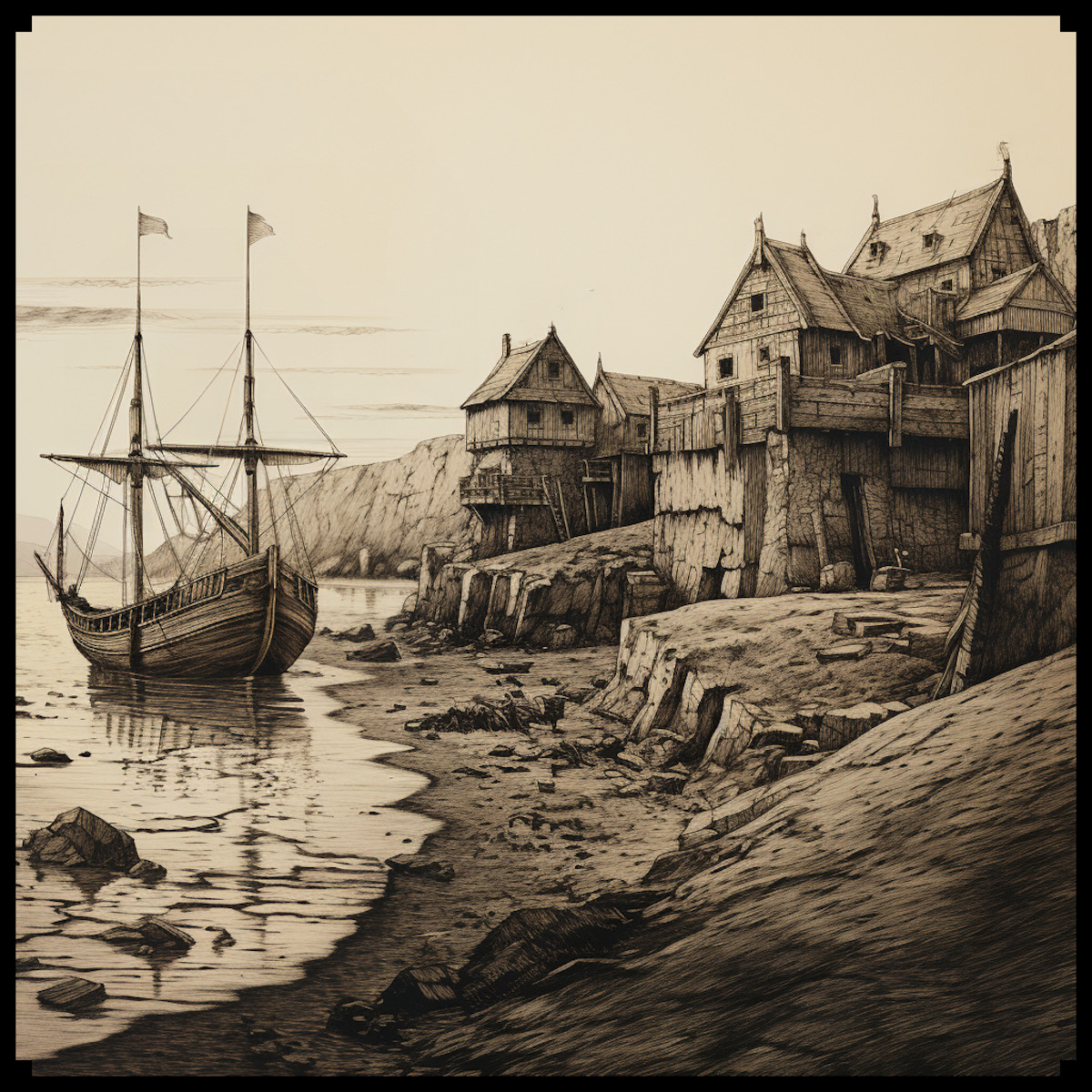
etching illustration of viking nordic towns with longship, fantasy map assets, wonderdraft assets and symbols

In the realm of fantasy cartography, the depiction of Viking longships, fortified wooden Nordic and Viking towns and settlements, as well as the grandeur of Norse castles and forts, holds a special place. These elements not only contribute to the aesthetic appeal of fantasy maps but also evoke a sense of cold, rugged, and untamed landscapes. In this article, we delve into the historical significance and visual impact of these elements, particularly in the context of fantasy maps, with a special focus on the Vintage Fortified Nordic & Viking Settlements – 129 assets Megapack (+ longships + creator kit!)—an asset pack that faithfully recreates these features in the style of antique maps.

BUY AND DOWNLOAD The Vintage Fortified Nordic & Viking Settlements – 129 assets Megapack ( + longships + creator kit !) :

Fortified Wooden Nordic and Viking Towns and Settlements

Nordic and Viking settlements were often constructed in harsh, cold, and arid environments, where resources were limited. As a result, the architecture of these settlements predominantly featured fortified wooden structures. These towns and villages, surrounded by wooden palisades and watchtowers, were designed to withstand both the elements and potential attacks from rival clans or marauders. In fantasy maps, these fortified settlements create an atmosphere of resilience and isolation, where communities huddle together in a harsh world. The use of wood in their construction also adds a rustic charm that resonates with fans of nordic fantasy settings, where the architecture is heavily influenced by Nordic and Viking motifs.

Fortified Stone Nordic and Viking Towns and Settlements

While wooden fortifications were common, stone fortifications were also a part of Nordic and Viking architecture. Stone walls, ramparts, and towers were constructed to protect strategic locations and harbors. In fantasy maps, the inclusion of fortified stone towns and settlements contrasts with the wooden ones, symbolizing a more established and formidable presence. These stone structures speak to the enduring nature of Nordic and Viking civilizations, which left lasting historical legacies across Europe.

Norse Castles and Forts: Strongholds of Power

Norse castles and forts were the pinnacle of Viking architecture. These imposing structures, often perched on cliffs overlooking the sea, were both defensive fortresses and symbols of authority. They evoke a sense of grandeur and dominance, making them compelling features on fantasy maps. Whether as the lair of a powerful ruler or the goal of a daring quest, Norse castles and forts bring an air of intrigue and drama to the fantasy world.

The Viking Longships: Symbols of Exploration

Viking longships, characterized by their long, narrow design and distinctive prows, were the quintessential vessels of exploration and raiding for the Norse seafarers. These ships played a pivotal role in shaping the Viking Age, allowing them to reach distant shores and establish settlements in lands as far-reaching as Iceland, Greenland, and even Vinland (North America). In fantasy maps, the inclusion of Viking longships invokes a sense of adventure and daring, as if the viewer is embarking on a journey to uncharted territories, mirroring the Vikings’ bold spirit.

The Creator Kit: Empowering Imagination

The Vintage Fortified Nordic & Viking Settlements asset pack not only includes pre-designed elements but also a creator kit. This kit empowers fantasy map makers to craft their own symbols of fortified Viking and Nordic towns and settlements. It allows for customization, enabling map creators to infuse their unique artistic vision into their maps while maintaining the vintage aesthetic.

Conclusion

In the realm of fantasy mapmaking, the inclusion of Viking longships, fortified Nordic and Viking settlements, and Norse castles and forts brings a rich historical depth and a captivating visual allure. These elements transport viewers to a world of cold, grandeur, and rugged beauty, much like the lands of Skyrim. The Vintage Fortified Nordic & Viking Settlements – 129 assets Megapack (+ longships + creator kit!) offers a treasure trove of resources for map creators, allowing them to craft immersive fantasy worlds that resonate with the enduring legacy of the Vikings and the Nordic peoples. So, whether you’re embarking on a virtual exploration or creating your own fantasy realm, these assets are sure to leave a lasting impression on the map and the imagination.