Posted on Leave a comment

The Art and History of Mountains in Fantasy Cartography Through Antique Cartography Assets

Fantasy map symbols, mountains, hills, plateaus, knolls, fantasy map icons, Wonderdraft assets, vintage cartography assets

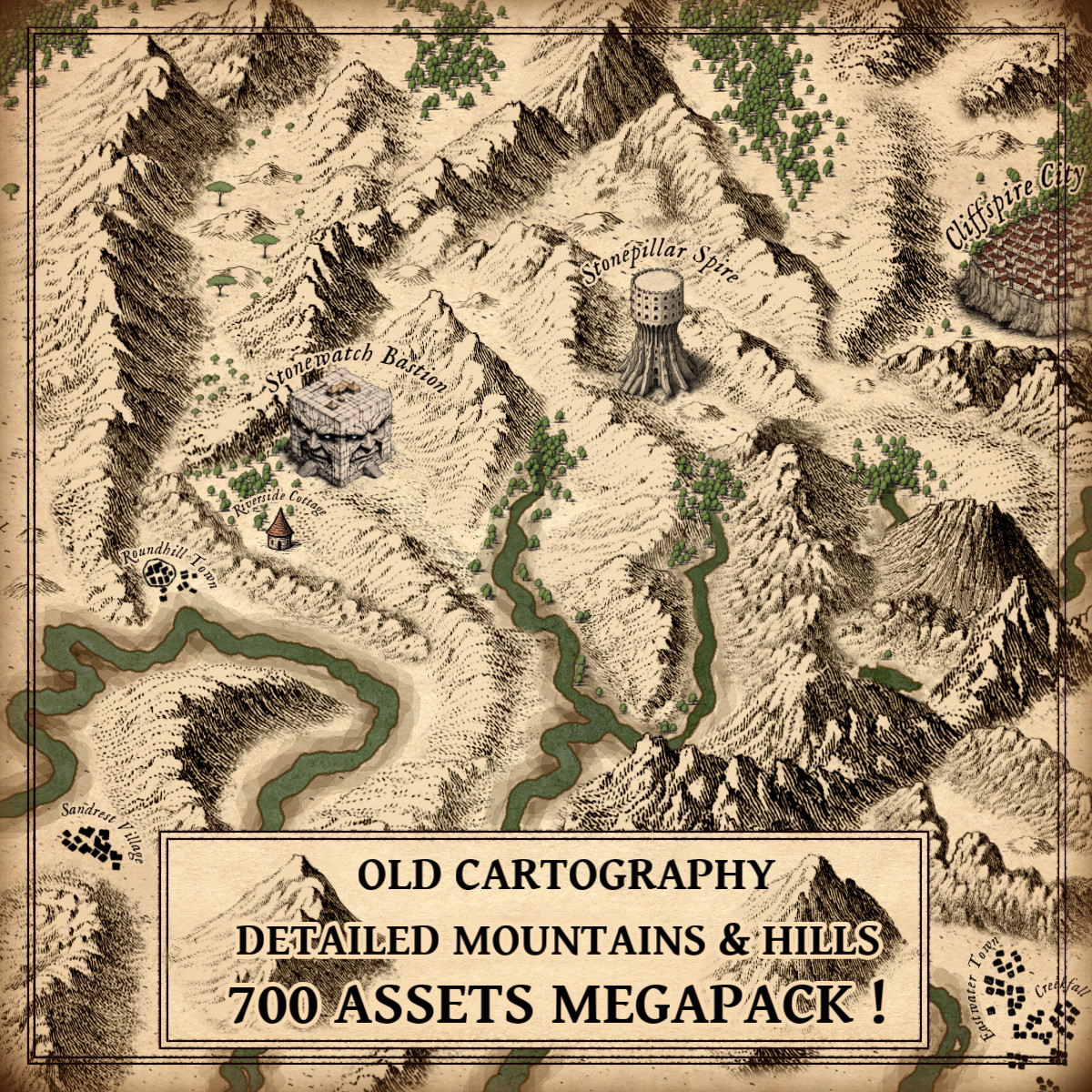
A deep exploration of terrain representation and the legacy revived by the Detailed Mountains & Hills – Old Cartography Assets Megapack

Mountains, hills, ridges, volcanoes, escarpments, and all the landforms included in the pack represent far more than decorative features. Across history, they formed a symbolic language that shaped geographical understanding, cultural identity, and storytelling. In both ancient traditions and modern fantasy map making, mountain drawings remain fundamental to how worlds, real or imaginary, are described.

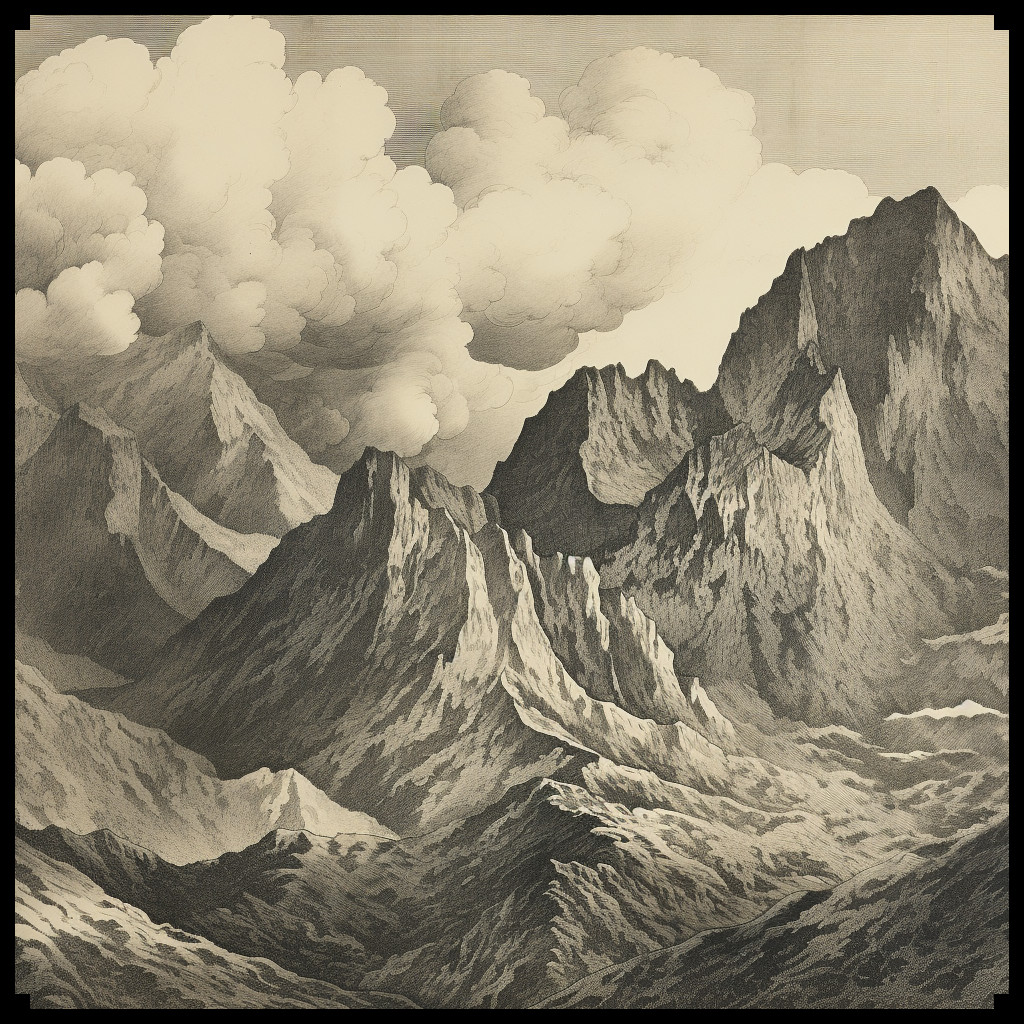
The Detailed Mountains and Hills – Old Cartography Assets MEGAPACK faithfully revives antique engraving styles with carefully crafted landforms such as mountains, mountain ranges, hill formations, broken ranges, buttes, plateaus, craters, knolls or escarpments. These drawings recall centuries of handcrafted maps and bring their evocative aesthetic into digital worldbuilding.

BUY AND DOWNLOAD The Detailed Mountains and Hills – Old Cartography Assets MEGAPACK HERE :

1. Origins of Mountain Symbolism in Early Maps and Their Legacy in Fantasy Map Icons

The representation of mountains began long before the notion of modern topography existed. Ancient cartographers understood that terrain could not simply be sketched scientifically, they needed symbolic forms.

Antiquity

  • Ptolemy’s Geographia (2nd century CE) included simple hill-shaped symbols that defined early Western cartographic convention.
  • In East Asian maps, especially during the Han and Tang dynasties, mountains symbolized cosmic balance and were drawn in isometric, stacked forms.

Medieval Europe

  • The Hereford Mappa Mundi depicted mountains as dramatic clusters marking sacred regions, mythical realms, and uncharted territories.
  • Islamic cartographer al-Idrisi used mountains as climatic markers and boundaries between cultural zones.

The landforms included in the pack; from isolated peaks to crags, highlands, and ridges; mirror this historical variety, making them ideal as fantasy map icons that enrich worldbuilding with cultural weight and ancient symbolism.

2. Renaissance Cartographic Innovation and the Emergence of Engraved Wonderdraft Assets

With the Renaissance came a flourishing of geographical detail and artistic precision.

  • Ortelius’ Theatrum Orbis Terrarum (1570) introduced engraved mountain clusters with consistent shading and distinctive silhouettes.
  • The Blaeu family refined the art of hachuring, creating some of the most beautiful mountain engravings ever published.
  • Cassini’s cartographic work (18th century) brought proto-topographic systems that displayed altitude and slope through shading direction.

The mountains, hills, volcanoes, and landforms in the pack clearly follow these engraving traditions:
sharp hatching, coherent light direction, clean contours, and expressive silhouettes. As Wonderdraft assets, they allow mapmakers to reproduce Renaissance-level realism inside modern digital tools.

3. Cultural Symbolism and Narrative Weight of Mountains in Ancient Maps and Modern Cartography Assets

Across civilizations, mountains on maps expressed significance beyond terrain.

Mountains as Natural Borders

Historical maps often marked political or cultural divisions using mountain chains:

  • The Pyrenees between France and Spain
  • The Apennines shaping Italian regional identities
  • The Himalayas forming colossal boundaries in South and Central Asia

In fantasy worldbuilding, the same logic applies. The mountain ranges, escarpments, cliffs, fragmented highlands, and plateaus in the pack serve to define kingdoms, territories, and frontier zones.

Mountains as Myth and Mystery

Throughout history:

  • The Rhipaean Mountains of Greek lore
  • The Mountains of the Moon, believed to feed the Nile
  • Early depictions of Vesuvius as a gateway to the underworld

The presence of volcanoes, craters, broken ranges, and dramatic cliffs in the pack mirrors these mythic connotations, allowing creators to construct narrative-rich landscapes.

Mountains as Navigation

Travelers and explorers once relied on:

  • Buttes
  • Knolls
  • Coastal cliffs
  • Ridgelines

These features helped orient caravans, sailors, and pilgrims. Their equivalents appear in the pack, serving both functional map readability and aesthetic coherence within modern cartography assets.

4. Practical Uses of Terrain Symbols in Fantasy Map Making With Fantasy Map Icons

The antique style of the pack is not merely decorative, it offers structural clarity for map composition.

A. Building Geography Modularly

With elements such as:

  • Mountains + mountain ranges
  • Hills + hill formations
  • Highlands + fragmented highlands
  • Volcanoes + craters
  • Plateaus + escarpments

worldbuilders can assemble fully coherent continents and regions with remarkable natural flow.

B. Clarity at Multiple Scales

Classical engravers designed symbols to remain readable even in small atlases.
Similarly, the pack provides landforms that retain clarity in both continent-sized maps and close-up regional maps.

C. A Full Vocabulary of Landforms

Few collections offer such richness:

  • mountains
  • hills
  • knolls
  • crags
  • ridges
  • lowlands
  • broken ranges
  • cliffs
  • plateaus
  • craters

This gives worldbuilders control over geological storytelling.

D. Paintable and Customizable Designs

Following the tradition of hand-colored maps, the pack includes variants suitable for:

  • direct painting
  • digital recoloring
  • neutral monochrome engraving styles

These characteristics make the pack’s landforms perfect fantasy map icons for hybrid analog–digital creation.

5. The Artistic Craft Behind Antique-Style Wonderdraft Assets

The drawings in the pack reflect meticulous craftsmanship:

Engraving-inspired hatching

Line density and direction mimic copperplate techniques of the 16th–18th centuries.

Shading Consistency

Most peaks and hills employ a unified light direction, recalling classic European atlas design.

Natural Composition

Mountain ranges, broken ranges, and ridges cluster organically, just as in historic works by Ortelius, Blaeu, and Sanson.

Historical Geological Realism

  • Volcanic shapes evoke early depictions of Etna and Vesuvius
  • Crater symbols recall lunar cartography
  • Highlands resemble Swiss shaded-relief engravings

The result is a set of Wonderdraft assets that are both historically inspired and artistically robust.

6. The Modern Revival of Antique Mapping Through Digital Cartography Assets

Why does this antique mountain style remain the gold standard in fantasy worlds?

Authenticity and Immersion

These landforms instantly communicate history, age, and believability.

Narrative Depth

A towering range hints at epic quests.
A smoking volcano signals danger and myth.
A fragmented highland suggests ancient cataclysms.

Aesthetic Harmony

The engraved look pairs perfectly with parchment textures and serif fantasy typography.

The mountains, hills, seas of ridges, buttes, and broken ranges of the pack help creators revive centuries-old mapmaking tradition in a modern context.

Direct Connection With Historical Art

This is the same style used (and loved) by Tolkien, whose maps were heavily influenced by 16th-century engraving conventions.

Thus, the MEGAPACK stands at the crossroads of history and creativity, offering digital cartography assets that feel timeless.

Conclusion: A Timeless Artistic Language Reborn Through Fantasy Map Icons

The Detailed Mountains and Hills – Old Cartography Assets MEGAPACK is more than an asset collection, it is a revival of the classical cartographic language that shaped humanity’s understanding of the world.

From ancient Greek scholars to medieval cosmographers, Renaissance engravers, Enlightenment explorers, and modern fantasy storytellers, mountains have always been symbols of mystery, power, ambition, and identity.

With its mountains, hills, volcanoes, plateaus, craters, cliffs, ridges, lowlands, knolls, and countless other landforms, the pack enables modern creators to tap into this heritage and build worlds that feel alive, authentic, and beautifully crafted.

In fantasy cartography, a mountain is never just a shape on a page.
It is story, culture, geology, myth, and art, all expressed through ink.
Posted on

From Stone to Cartography: Dwarven Towns & Mountainous Settlements in Fantasy Map Elements

cartography assets, wonderdraft assets, dwarven towns and dwarf towns, mountain towns, fantasy mapping

In the mesmerizing realm of fantasy maps, there exists a timeless allure that transcends the boundaries of reality. Among the many elements that captivate the imagination, few are as enchanting as the representations of dwarven towns, settlements, mountainous towns, mining towns, mountainous castles, and dwarven fortresses. These iconic landmarks, deeply entrenched in folklore and mythology, have long held a special place in the hearts of adventurers, world-builders, and map enthusiasts. In this article, we delve into the fascinating historical significance of these unique locations in fantasy maps and the intriguing assets found in the Dwarven & Mountainous Settlements and Towns – Vintage Assets Pack.

BUY AND DOWNLOAD The Dwarven & Mountainous Settlements and Towns – Vintage Assets Pack :

Dwarven Towns and Settlements: A Glimpse into Dwarven Culture

Dwarves, known for their craftsmanship and affinity for stone, have left an indelible mark on the world of fantasy maps. Dwarven towns and settlements, as depicted in these maps, are a testament to their architectural prowess. These small, hidden gems are often nestled deep within the mountains, hidden away from the prying eyes of outsiders. Dwarves carve their homes directly into the rocky terrain, creating a harmonious fusion of nature and craftsmanship. The Dwarven & Mountainous Settlements and Towns assets pack offers a myriad of options to create your own dwarven havens, complete with intricate detailing that captures the essence of these unique communities.

One such example is the legendary Dwarven city of Khazad-Dûm from J.R.R. Tolkien’s Middle-earth. This sprawling underground city, also known as Moria, is a masterpiece of dwarven architecture, with massive halls, intricate carvings, and a deep connection to the rock it was built within. It serves as a prime example of the awe-inspiring possibilities that the Dwarven & Mountainous Settlements and Towns pack offers.

Mountainous Towns and Mining Settlements: A Rich Tapestry of Resources

Mountainous towns and mining settlements are integral components of the fantasy world, serving as hubs of industry and resource extraction. They are often characterized by their reliance on the mountains for precious minerals and ores, and they frequently possess a distinct rugged charm.

An iconic example is the Lonely Mountain, Erebor, from The Hobbit by J.R.R. Tolkien. This vast dwarven kingdom was founded within a single enormous peak, and its halls were adorned with riches beyond imagination. The story of Erebor exemplifies the allure of mountainous towns and mining settlements in the world of fantasy, emphasizing their potential for both grandeur and peril.

The Dwarven & Mountainous Settlements and Towns assets pack provides an assortment of elements to construct your own mountain-based communities, each echoing the themes of resource extraction, hard work, and a deep connection to the earth.

Mountainous Castles, Dwarven Fortresses, and More: A Defensible Legacy

Mountainous castles and dwarven fortresses are symbols of strength and resilience. These imposing structures are often nestled high in the mountains, providing an impregnable defense against would-be invaders.

An excellent example of such a fortress is the Helm’s Deep from Tolkien’s The Two Towers. Although not dwarven, it showcases the architectural marvel of a mountain fortress. Its impervious stone walls and deep trenches highlight the strategic advantages of such structures in times of conflict. The Dwarven & Mountainous Settlements and Towns pack includes assets to craft mountainous castles and dwarven fortresses that evoke this sense of security and history.

The Unique Architecture of Dwarven Buildings: A Bond with Stone and Mountains

Dwarven architecture is a fascinating blend of craftsmanship and an inherent connection to the rocky environment. Dwarves are known for their skills in stone masonry, and their buildings often feature intricate carvings, sturdy stone structures, and an unmatched durability. Dwarven communities take advantage of the natural contours of the mountains, resulting in cities that seamlessly integrate with the surrounding rock.

With the Dwarven & Mountainous Settlements and Towns assets pack, you can infuse your fantasy maps with this unique architectural style, allowing you to create a world that pays homage to the dwarven craftsmanship and their profound bond with the mountains.

In conclusion, the Dwarven & Mountainous Settlements and Towns – Vintage Assets Pack invites map creators and world-builders to explore the rich history and cultural significance of dwarven and mountainous settings in fantasy maps. These assets offer an opportunity to weave tales of craftsmanship, resilience, and a deep connection to the earth in your imaginative worlds. With these meticulously crafted assets, your maps will truly come to life, immersing both creators and viewers in the enchanting realm of dwarven towns, mountainous settlements, and ancient fortresses.

Posted on

Exploring Fantasy Map Symbols: The Wonders of Mountains and Hills

mountains ranges and hills, fantasy map assets, wonderdraft assets and symbols, etching illustration

Maps have been pivotal tools for exploration, navigation, and storytelling throughout history. They combine practical utility with artistic expression, drawing inspiration from both the real world and the realms of imagination. In the realm of cartography, antique maps provide a rich source of inspiration for fantasy maps, fostering a bridge between history and creativity. This article delves into the significance of mountains, hills, and related features in both antique and fantasy maps, while showcasing the Ultimate Vintage Mountains & Mountain Ranges + Hills – 265 Assets Megapack, a collection that lovingly echoes the classic cartographic style.

BUY AND DOWNLOAD The Ultimate Vintage Mountains & Mountain Ranges + Hills – 265 Assets Megapack :

Mountains and Hills in Antique Maps

Antique maps are windows into the past, displaying a blend of geographical knowledge and artistic interpretation. The representation of mountains, hills, and related terrain features in these historical maps evolved over time and varied across cultures, but certain themes persisted:

Mountain Ranges: Antique maps often portrayed mountain ranges as towering, jagged formations. The Alps, illustrated in Ptolemy’s Geographia in the 2nd century, provide an early example of this style, with hatched lines indicating elevation.

Hill Ranges: Hills were depicted with gentler slopes compared to mountains, reflecting their smaller scale. A notable example is the “Tabula Rogeriana” by Muhammad al-Idrisi, where terrain features are illustrated with a mixture of artistic impression and geographical accuracy.

Individual Mountains: Prominent peaks, like Mount Fuji in Japanese Edo period maps, were detailed meticulously, often becoming iconic symbols of the region.

Rocky Isles: Coastal maps included rocky isles and outcrops, such as those found in the 16th-century maps of the Mediterranean by Abraham Ortelius, enriching the maritime landscape.

Pinnacles: Antique maps frequently featured towering pinnacles at mountain summits, as seen in the map of the Himalayas from the early 19th century, adding an element of grandeur and mystique.

Mountain Caves: Maps of famous caves or entrances, like those found in the legendary journeys of Sinbad the Sailor, often intrigued readers with their potential for adventure and discovery.

Fantasy Maps and the Ultimate Vintage Mountains & Mountain Ranges + Hills Megapack

Fast forward to the world of fantasy maps, where cartographers and world-builders craft imaginary realms replete with magic and adventure. The Ultimate Vintage Mountains & Mountain Ranges + Hills – 265 Assets Megapack breathes new life into antique cartographic aesthetics, offering a cornucopia of elements to aid modern fantasy map creators.

This remarkable collection includes an array of assets that impeccably recreate the antique map style:

Mountain Ranges and Hill Ranges: Drawing inspiration from classics like Abraham Ortelius’s “Theatrum Orbis Terrarum,” these assets echo the bold lines and intricate detail that convey an epic scale in fantasy maps.

Individual Mountains and Hills: Each peak and hill within the megapack boasts intricate craftsmanship reminiscent of prominent terrain features in antique maps.

Karst Mountains: These unique formations, akin to those found in limestone-rich regions like the Dinaric Alps, offer a geological authenticity to fantasy landscapes.

Foothills: The gradual ascent from lowlands to towering peaks, evident in maps like John Rocque’s 18th-century surveys, grants fantasy maps depth and perspective.

Peaks and Pinnacles: Evoking the breathtaking heights of the Matterhorn in Swiss cartography, these assets infuse fantasy landscapes with drama and mystery.

Rocky Isles: Just as islands and coastal features were integral to ancient portolan charts, these rocky isles embellish the coasts of fantasy worlds, enhancing immersion.

Caves and Cave Entrances: Caverns, like those documented in Chinese silk maps dating back to the 3rd century BCE, foster a sense of exploration and intrigue, mirroring the mystique of their historical counterparts.

Special Mountains: Symbolic peaks, reminiscent of Mount Olympus in ancient Greek mythology, offer a compelling focal point or adventure destination within a fantasy realm.

Conclusion

Fantasy maps, like their antique counterparts, owe much of their artistic flair and imaginative power to the traditions of old-world cartography. The Ultimate Vintage Mountains & Mountain Ranges + Hills – 265 Assets Megapack stands as a testament to the enduring influence of antique maps on contemporary fantasy cartography. These assets not only capture the essence of antique maps but also empower creators to conjure captivating, imaginative worlds replete with mountains, hills, and other terrain features that have shaped cartographic history. In this timelessly blended tapestry of the past and the present, fantasy maps continue to inspire and transport us to uncharted realms limited solely by the frontiers of our imagination.

Posted on

Cartography Assets : Reliefs and Vintage Cartographer’s Mountains in Maps

fantasy map assets symbols bundle, mountains, cliffs, desert dunes, rifts, chasms,desert cracks,buttes, for wonderdraft

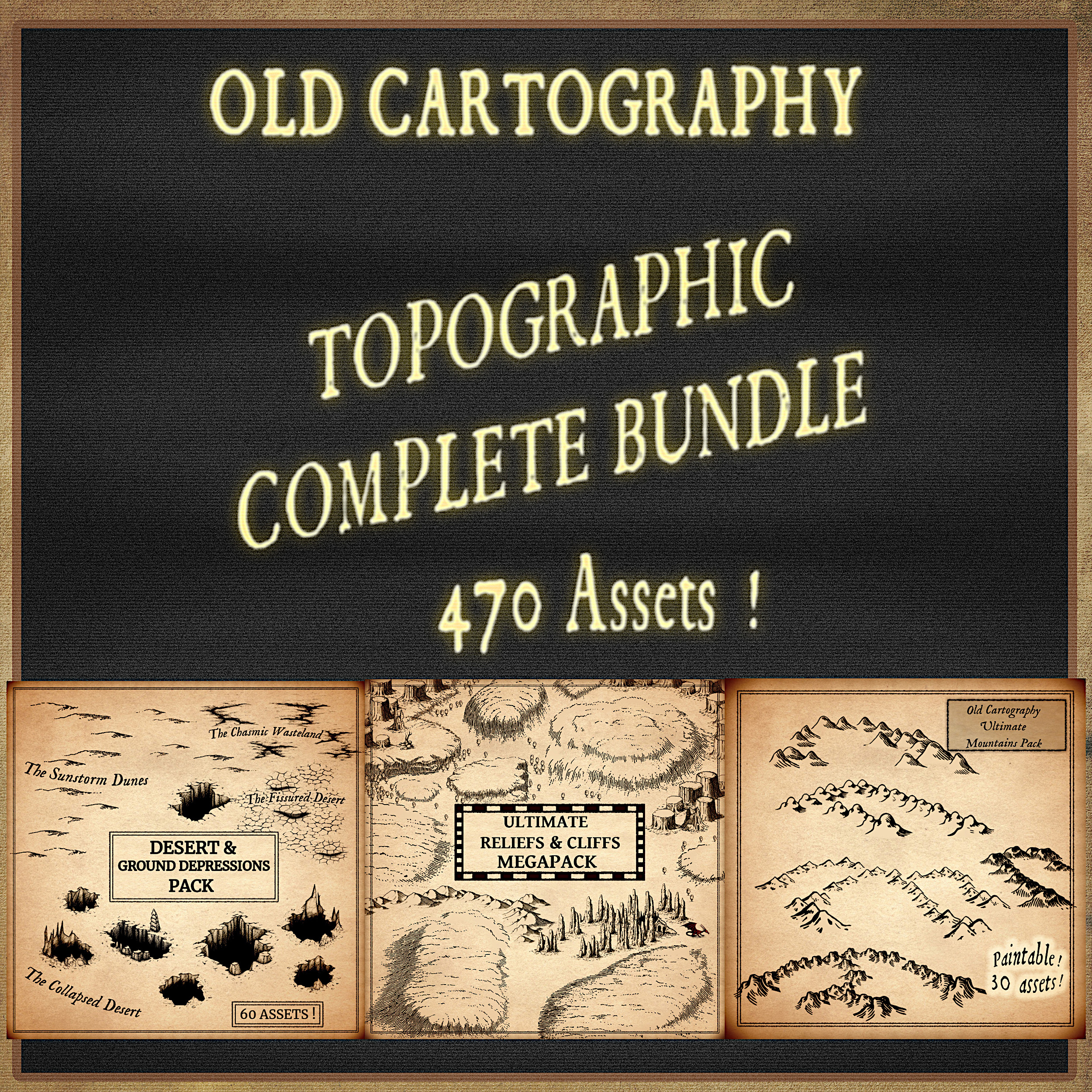
Geographical features have long played a significant role in both ancient and fantasy maps, adding depth, symbolism, and visual interest to the depicted landscapes. Let’s delve into the historical significance of various elements such as mountains, deserts, landforms, dragons, and decorative elements, and how they contribute to the captivating Old Cartography Topographic Assets Complete Bundle—an invaluable resource for fantasy map creators

BUY AND DOWNLOAD the Old Cartography Topographic Assets Complete Bundle :

Mountains
Mountains hold a prominent place in maps, both ancient and fantasy. In ancient maps, generic mountains were simple triangular shapes, symbolizing grandeur and mystery. Rocky antique mountains, on the other hand, were depicted with rugged terrain and intricate shading, evoking danger and creating natural barriers in fantasy realms.

Deserts
Deserts in maps are often filled with intriguing landmarks. Desert caves offer shelter or hidden treasures, while desert temples represent ancient knowledge or guarded secrets. Desert butte towns perch atop elevated landforms, providing vantage points and protection. Dunes, cracks, and decorative dead trees further enhance the desert’s mysterious and untamed nature, captivating readers and evoking a sense of exploration.

Landforms
Various landforms bring diversity and visual interest to maps. Canyons, with their deep gorges, add drama and a sense of scale. Plateaus, mesas, and cliffs create distinct elevated regions, offering strategic locations or breathtaking viewpoints. Chasms, rifts, sinkholes, and dolines introduce natural formations that can be obstacles, pathways, or hidden wonders, amplifying the sense of adventure in both ancient and fantasy maps.

Dragons and Pinnacles
Dragons and their lairs have long been symbols of power and mystery. In fantasy maps, a dragon’s lair represents a treacherous and awe-inspiring location, often hidden within formidable terrain. Pinnacles, tall and pointed formations, further contribute to the grandeur of these maps, signifying both danger and mythical creatures.

Decorative Elements
Ancient and fantasy maps often incorporate decorative elements to enhance visual appeal. Decorative desert dead trees and cracks create an eerie atmosphere, hinting at the harshness and unforgiving nature of the landscapes. These elements add depth and aesthetic charm to the maps, captivating readers with their intricate details and mysterious allure.

The Old Cartography Topographic Assets Complete Bundle
The Old Cartography Topographic Assets Complete Bundle offers an expansive collection of assets that faithfully replicate the antique style of ancient maps. By utilizing this bundle, map creators can bring their imaginative visions to life. The attention to detail in the portrayal of mountains, deserts, landforms, dragons, and decorative elements ensures an authentic and captivating visual experience for readers.

Conclusion
Geographical features hold immense significance in both ancient and fantasy maps, contributing to the overall narrative and immersive qualities of the depicted worlds. The Old Cartography Topographic Assets Complete Bundle serves as an indispensable resource for map creators, providing them with the tools to craft visually stunning and historically inspired fantasy maps. By incorporating elements such as mountains, deserts, landforms, dragons, and decorative elements, map creators can transport readers to enchanting realms, sparking their imagination and inviting them on thrilling adventures. Immerse yourself in the art of cartography with this remarkable collection, and embark on a captivating journey through awe-inspiring landscapes.

Posted on

Beyond the Flatlands: Embracing Cartography Assets to Capture the Essence of Reliefs

plateaus, cliffs with grass, etching representation of fantasy map assets from ancient and antique cartography, wonderdraft

Welcome, fellow cartography enthusiasts, to a whimsical exploration of the role of reliefs in both fantasy and ancient maps. For the past decade, I have been immersed in the captivating realm of fantasy cartography, marveling at the intricate details and captivating landscapes depicted in these imaginative creations. Today, we embark on a journey to uncover the significance of reliefs in maps, with a particular focus on the charmingly titled Old Cartography Ultimate Reliefs and Cliffs Megapack. So, grab your compass and strap on your imagination, as we traverse mountains, plateaus, buttes, mesas, and cliffs, while uncovering the subtle nuances that make these features so essential to the art of mapping.

BUY AND DOWNLOAD the Old Cartography Ultimate Reliefs and Cliffs Megapack here :

Throughout the annals of cartographic history, the inclusion of reliefs has played a pivotal role in providing a holistic representation of the Earth’s varied topography. These meticulously crafted additions allow map readers to transcend the two-dimensional plane and envision the undulating terrain that lies beneath their feet. From ancient maps etched onto stone tablets to the mesmerizing realms of fantasy, the depiction of reliefs has captured the imagination of countless adventurers, storytellers, and mapmakers alike.

Within the vast expanse of terrains and landscapes, a myriad of unique landforms awaits our exploration. Let us first venture into the realm of plateaus, those lofty tablelands that grace the pages of both ancient and fantasy maps. With their flat tops and steep edges, plateaus provide a natural vantage point for surveying the surrounding lands, making them ideal locations for fortresses, hidden sanctuaries, or the abodes of mythical creatures.

As we traverse further, we encounter the intriguing formations of buttes and mesas. Rising like sentinels from the earth, these towering monoliths inspire awe and wonder. Buttes, with their solitary and slender structures, often stand as solitary guardians, while mesas beckon with their wide tabletops, enticing adventurers to unravel the secrets that lie atop these elevated realms.

No exploration of reliefs would be complete without acknowledging the whimsical presence of rocky pinnacles. These enchanting formations, often protruding dramatically from the ground, capture the essence of fantasy itself. In ancient maps, they served as markers of treacherous terrains or hidden troves of treasure, whereas in fantasy realms, they are gateways to realms of magic, perches for mythical creatures, or simply scenic wonders to marvel at.

Now, let us turn our attention to the Old Cartography Ultimate Reliefs and Cliffs Megapack, a treasure trove of artistic assets that enables mapmakers to immerse their creations in the time-honored aesthetics of ancient maps. By adopting the distinctive style of antique cartography, this collection brings to life the intricate details and whimsical representations of various reliefs, plateaus, buttes, mesas, cliffs, and more.

From the majestic grandeur of towering mountains to the rugged allure of hidden canyons and desert caves, this Megapack offers a vast array of assets to unleash your imagination. Whether you seek to create a dragon’s lair perched atop a cliff or a sprawling city nestled amidst rolling plateaus, these assets will transport your maps to realms brimming with mystique, adventure, and countless storytelling possibilities.

Happy mapping, my fellow adventurers, and may your explorations be filled with wondrous reliefs and endless possibilities!