
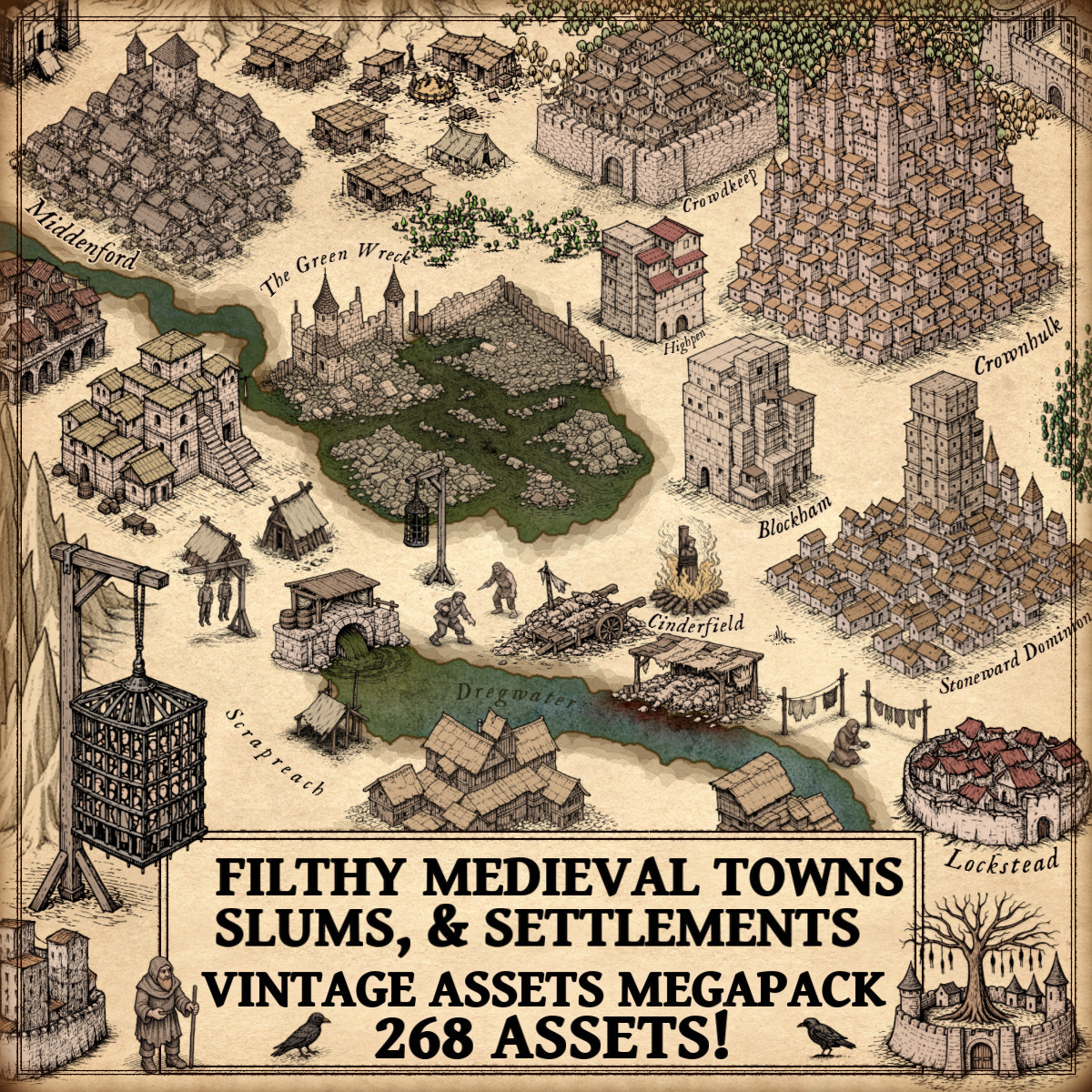
In contemporary fantasy cartography, creators increasingly seek tools capable of expressing not only grandeur but hardship, inequality, and decay. Among the most evocative collections designed for this purpose is the Filthy Medieval Towns, Slums, Villages, & Settlements – Vintage Assets Megapack, a richly detailed set of vintage-style cartography assets dedicated to the overlooked realities of medieval-inspired worlds. Rather than presenting idealized settlements, it provides a visual vocabulary of slums, filthy towns, ruined settlements, decaying castles, waste systems, prisons, execution structures, and marginal figures, elements that resonate deeply with the historical logic of mapmaking itself.
Maps have never been neutral objects. From the earliest medieval world diagrams to Renaissance city views, cartography has always been an art of selection, exaggeration, omission, and symbolism. What a map chooses to show, and what it chooses to hide, tells us as much about culture as it does about geography.
Modern fantasy cartography, particularly through detailed cartography assets and expressive map resources, inherits this long visual tradition. While towers, walls, and grand halls dominate many fictional landscapes, another vocabulary exists beneath the surface: slums pressed against city walls, sewer outfalls draining unseen refuse, gallows looming over roads, ruined settlements fading into memory. These are not simply darker embellishments. Historically speaking, they are profoundly authentic.
To understand why such imagery feels so convincing in fantasy worlds, one must look back at the cultural logic of ancient and medieval mapping.
Discover the Filthy Medieval Towns, Slums, Villages, & Settlements – Vintage Assets Megapack here :
Cartography Assets & Fantasy Map Symbols: Cities Beyond Idealization
When modern audiences imagine historical maps, they often picture elegant parchment sheets adorned with symmetrical cities and noble fortifications. Yet historical cartography rarely functioned as pure beautification. Medieval and early modern maps encoded ideology, morality, authority, and fear.
Take the Hereford Mappa Mundi. Though cosmological rather than urban in its primary structure, it demonstrates a crucial principle: maps were narratives. They contained monsters, dangers, moral allegories, and symbolic hierarchies. Geography and meaning were inseparable.
Later, Renaissance works such as Braun & Hogenberg’s Civitates Orbis Terrarum offered elaborate bird’s-eye city portraits. At first glance, these appear celebratory, emphasizing walls, churches, plazas, and civic pride. But closer inspection reveals subtle indicators of inequality. Density shifts. Peripheral clutter. Areas where order dissolves into compression. Even when filth was not drawn explicitly, urban realities emerged through structure.
Fantasy mapping draws from this same logic. A settlement composed entirely of orderly buildings lacks historical credibility. Real cities were layered organisms, shaped by trade, migration, poverty, waste, punishment, and collapse. In visual terms, this complexity is conveyed through carefully designed fantasy map symbols.
Wonderdraft Assets & Fantasy Map Icons: The Geography of Slums
Slums are among the most historically grounded features one can introduce into a fictional city.
In medieval Europe, urban poverty was not an incidental phenomenon. It was spatially organized. Economic exclusion, guild restrictions, population influx, and defensive architecture combined to produce districts defined by density and fragility. Poor quarters gathered near walls, rivers, workshops, or marginal land unsuitable for elite construction.
London, Paris, and countless smaller towns displayed this pattern. Constrained by fortifications, cities grew inward, generating overcrowded zones where sanitation deteriorated and buildings leaned precariously into one another. These were not aberrations. They were systemic outcomes.
When translated into fantasy cartography, slums perform an extraordinary narrative function. A sprawling slum belt hugging the outer defenses instantly suggests demographic pressure. Ramshackle slum buildings imply improvisation, survival, instability. Slum tents evoke transience, migration, or disaster.
Such imagery does not merely decorate a map. It transforms urban space into social space.
This is where thoughtfully crafted Wonderdraft assets become particularly powerful. The ability to integrate entire slum districts, irregular buildings, and improvised structures allows mapmakers to depict settlements that feel inhabited rather than staged.
Fantasy Map Resources & Wonderdraft Resources: Poverty as Landscape
Beyond urban slums lies the quieter, equally significant reality of poor medieval villages.
Historical villages varied enormously. Soil fertility, taxation burdens, warfare, and climate shaped settlement morphology. Some villages appeared as dense clusters bound by necessity; others scattered loosely across marginal terrain. Roof quality, building size, and spatial cohesion conveyed economic status as clearly as written records.
In fantasy mapping, poor villages perform a subtle yet essential role. They articulate regional disparity. They suggest neglected frontiers, exhausted lands, or oppressive governance. A map populated exclusively by prosperous towns and imposing castles lacks the unevenness that defines believable worlds.
Through expressive fantasy map icons, poverty becomes legible geography.
Cartography Assets & Fantasy Map Symbols: Waste, Water, and Urban Reality
Sanitation, though rarely romanticized, fundamentally structured historical settlements.
Medieval waste management depended heavily on proximity to water. Rivers functioned simultaneously as lifelines and disposal systems. Sewer outfalls, open drains, refuse heaps, and human waste accumulation defined the ecological metabolism of cities. Trades associated with unpleasant byproducts, tanning, dyeing, butchery, clustered accordingly.
Ancient precedents reinforce this logic. Roman engineering achievements such as the Cloaca Maxima illustrate how waste infrastructure was inseparable from urban identity. Even in highly advanced societies, the management of filth shaped spatial organization.
In fantasy cartography, sewer outfalls and refuse heaps communicate technological level, population scale, and civic order. They anchor cities in material processes. The presence of waste piles, rotting remains, or rubble piles suggests not only daily life but also neglect, catastrophe, or decay.
These details elevate cartography assets from architectural markers to environmental storytelling tools.
Wonderdraft Assets & Fantasy Map Icons: The Spectacle of Punishment
Public punishment occupied visible, deliberate space in medieval society.
Execution sites such as gallows were frequently positioned along roads or near city approaches, functioning as territorial statements. Structures like pillories and cages transformed justice into spectacle. Authority manifested through visibility.
The Tyburn Tree in London and the Montfaucon Gibbet in Paris stand as historical reminders that punishment landscapes were deeply embedded in civic geography. These were not hidden institutions. They were performative architecture.
When gallows, hanging prison cages, wooden cages, or pillories appear on fantasy maps, they carry centuries of symbolic weight. They evoke governance style, legal severity, and cultural atmosphere. A fortified city accompanied by prominent execution imagery communicates something profoundly different from one defined solely by towers and banners.
Fantasy Map Symbols & Cartography Assets: Ruins and the Memory of Collapse
Ruins may be the most enduring symbols in mapping history.
Ancient, medieval, and Renaissance cartography alike recognized the power of depicting decay. Ruined settlements, abandoned towns, and crumbling fortifications represent temporal depth made visible. They transform space into history.
A decaying castle on a map is not merely an architectural variation. It is a statement about succession, war, economic decline, or forgotten catastrophe. Rubble piles and corpse mounds intensify this narrative, implying recent violence or plague.
In fantasy worlds, ruins function as visual historiography.
Cartography Assets & Fantasy Map Resources: Filth as Narrative Infrastructure
What emerges from this historical perspective is a crucial insight. Filth, poverty, punishment, and decay are not peripheral themes. They are structural components of settlement realism.
Maps that incorporate slums, waste systems, prisons, ruins, and marginal populations resonate because they mirror historical urban dynamics. They depict worlds governed by forces rather than aesthetic symmetry.
This is precisely why dark, vintage-style fantasy map resources have gained such prominence among worldbuilders.
Within this artistic and historical lineage, the Filthy Medieval Towns, Slums, Villages, & Settlements – Vintage Assets Megapack occupies a distinctive position. Rather than offering generic settlement markers, it embraces the neglected vocabulary of medieval reality. Filthy medieval towns, sprawling slums, ruined settlements, decaying castles, sewer outfalls, human waste, dungeons, gallows, hanging cages, pillories, wooden sheds, rubble piles, ravens, brigands, beggars — each element contributes to a cartographic language of lived experience.
The vintage hand-drawn style reinforces this effect. It does not simply mimic old maps aesthetically; it participates in their symbolic tradition. The assets feel as though they belong to the same visual universe as engraved city plans and manuscript marginalia.
What makes such a collection compelling is not its darkness alone, but its narrative density. A city assembled from these Wonderdraft assets does not merely exist; it breathes with tension, inequality, history, and atmosphere.
Wonderdraft Resources & Cartography Assets: Building Worlds That Feel True
Fantasy cartography thrives on suggestion. Every icon implies systems, every symbol hints at stories. Slums imply migration and poverty. Waste heaps imply population scale and sanitation limits. Gallows imply law and fear. Ruins imply memory and loss.
By integrating richly detailed wonderdraft resources, mapmakers gain the ability to encode social, political, and environmental realities directly into geography. The result is not simply a darker map, but a more convincing one.
Historical cartography teaches us that beauty and discomfort have always coexisted on maps. Grandeur derives meaning from contrast. Order becomes legible through the presence of disorder.
In this sense, filth is not an intrusion into fantasy mapping. It is a return to cartographic authenticity.
And for creators seeking worlds marked by decay, oppression, survival, and history, the visual vocabulary provided by carefully designed cartography assets becomes not just useful, but indispensable.