Posted on Leave a comment

Cartography Assets & Map Resources: Slums, filth, and towns in Fantasy Mapping

Wonderdraft assets, fantasy medieval castles, cartography assets, medieval cartography symbols, medieval towns, villages, hamlets, slums

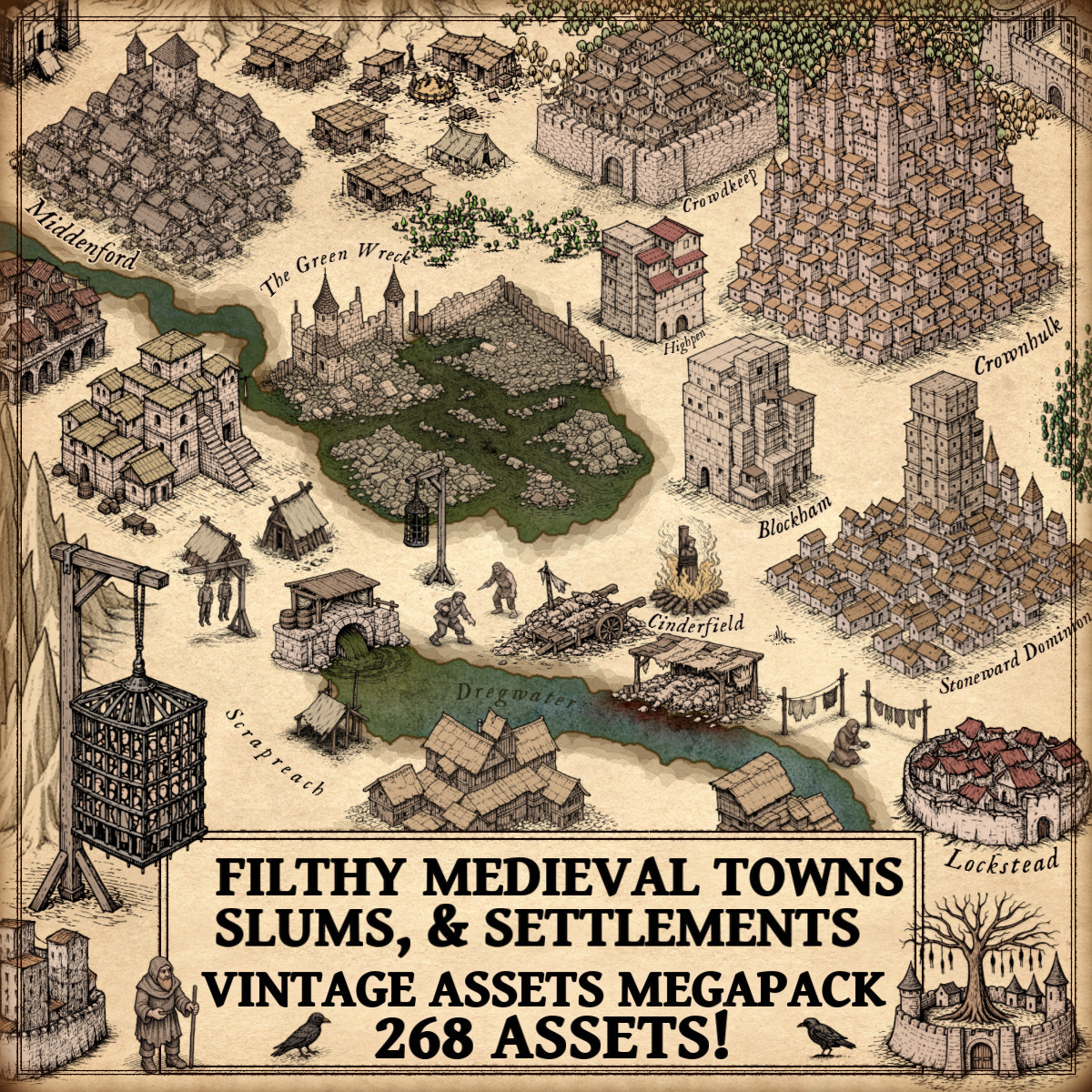
In contemporary fantasy cartography, creators increasingly seek tools capable of expressing not only grandeur but hardship, inequality, and decay. Among the most evocative collections designed for this purpose is the Filthy Medieval Towns, Slums, Villages, & Settlements – Vintage Assets Megapack, a richly detailed set of vintage-style cartography assets dedicated to the overlooked realities of medieval-inspired worlds. Rather than presenting idealized settlements, it provides a visual vocabulary of slums, filthy towns, ruined settlements, decaying castles, waste systems, prisons, execution structures, and marginal figures, elements that resonate deeply with the historical logic of mapmaking itself.

Maps have never been neutral objects. From the earliest medieval world diagrams to Renaissance city views, cartography has always been an art of selection, exaggeration, omission, and symbolism. What a map chooses to show, and what it chooses to hide, tells us as much about culture as it does about geography.

Modern fantasy cartography, particularly through detailed cartography assets and expressive map resources, inherits this long visual tradition. While towers, walls, and grand halls dominate many fictional landscapes, another vocabulary exists beneath the surface: slums pressed against city walls, sewer outfalls draining unseen refuse, gallows looming over roads, ruined settlements fading into memory. These are not simply darker embellishments. Historically speaking, they are profoundly authentic.

To understand why such imagery feels so convincing in fantasy worlds, one must look back at the cultural logic of ancient and medieval mapping.

Discover the Filthy Medieval Towns, Slums, Villages, & Settlements – Vintage Assets Megapack here :

Cartography Assets & Fantasy Map Symbols: Cities Beyond Idealization

When modern audiences imagine historical maps, they often picture elegant parchment sheets adorned with symmetrical cities and noble fortifications. Yet historical cartography rarely functioned as pure beautification. Medieval and early modern maps encoded ideology, morality, authority, and fear.

Take the Hereford Mappa Mundi. Though cosmological rather than urban in its primary structure, it demonstrates a crucial principle: maps were narratives. They contained monsters, dangers, moral allegories, and symbolic hierarchies. Geography and meaning were inseparable.

Later, Renaissance works such as Braun & Hogenberg’s Civitates Orbis Terrarum offered elaborate bird’s-eye city portraits. At first glance, these appear celebratory, emphasizing walls, churches, plazas, and civic pride. But closer inspection reveals subtle indicators of inequality. Density shifts. Peripheral clutter. Areas where order dissolves into compression. Even when filth was not drawn explicitly, urban realities emerged through structure.

Fantasy mapping draws from this same logic. A settlement composed entirely of orderly buildings lacks historical credibility. Real cities were layered organisms, shaped by trade, migration, poverty, waste, punishment, and collapse. In visual terms, this complexity is conveyed through carefully designed fantasy map symbols.

Wonderdraft Assets & Fantasy Map Icons: The Geography of Slums

Slums are among the most historically grounded features one can introduce into a fictional city.

In medieval Europe, urban poverty was not an incidental phenomenon. It was spatially organized. Economic exclusion, guild restrictions, population influx, and defensive architecture combined to produce districts defined by density and fragility. Poor quarters gathered near walls, rivers, workshops, or marginal land unsuitable for elite construction.

London, Paris, and countless smaller towns displayed this pattern. Constrained by fortifications, cities grew inward, generating overcrowded zones where sanitation deteriorated and buildings leaned precariously into one another. These were not aberrations. They were systemic outcomes.

When translated into fantasy cartography, slums perform an extraordinary narrative function. A sprawling slum belt hugging the outer defenses instantly suggests demographic pressure. Ramshackle slum buildings imply improvisation, survival, instability. Slum tents evoke transience, migration, or disaster.

Such imagery does not merely decorate a map. It transforms urban space into social space.

This is where thoughtfully crafted Wonderdraft assets become particularly powerful. The ability to integrate entire slum districts, irregular buildings, and improvised structures allows mapmakers to depict settlements that feel inhabited rather than staged.

Fantasy Map Resources & Wonderdraft Resources: Poverty as Landscape

Beyond urban slums lies the quieter, equally significant reality of poor medieval villages.

Historical villages varied enormously. Soil fertility, taxation burdens, warfare, and climate shaped settlement morphology. Some villages appeared as dense clusters bound by necessity; others scattered loosely across marginal terrain. Roof quality, building size, and spatial cohesion conveyed economic status as clearly as written records.

In fantasy mapping, poor villages perform a subtle yet essential role. They articulate regional disparity. They suggest neglected frontiers, exhausted lands, or oppressive governance. A map populated exclusively by prosperous towns and imposing castles lacks the unevenness that defines believable worlds.

Through expressive fantasy map icons, poverty becomes legible geography.

Cartography Assets & Fantasy Map Symbols: Waste, Water, and Urban Reality

Sanitation, though rarely romanticized, fundamentally structured historical settlements.

Medieval waste management depended heavily on proximity to water. Rivers functioned simultaneously as lifelines and disposal systems. Sewer outfalls, open drains, refuse heaps, and human waste accumulation defined the ecological metabolism of cities. Trades associated with unpleasant byproducts, tanning, dyeing, butchery, clustered accordingly.

Ancient precedents reinforce this logic. Roman engineering achievements such as the Cloaca Maxima illustrate how waste infrastructure was inseparable from urban identity. Even in highly advanced societies, the management of filth shaped spatial organization.

In fantasy cartography, sewer outfalls and refuse heaps communicate technological level, population scale, and civic order. They anchor cities in material processes. The presence of waste piles, rotting remains, or rubble piles suggests not only daily life but also neglect, catastrophe, or decay.

These details elevate cartography assets from architectural markers to environmental storytelling tools.

Wonderdraft Assets & Fantasy Map Icons: The Spectacle of Punishment

Public punishment occupied visible, deliberate space in medieval society.

Execution sites such as gallows were frequently positioned along roads or near city approaches, functioning as territorial statements. Structures like pillories and cages transformed justice into spectacle. Authority manifested through visibility.

The Tyburn Tree in London and the Montfaucon Gibbet in Paris stand as historical reminders that punishment landscapes were deeply embedded in civic geography. These were not hidden institutions. They were performative architecture.

When gallows, hanging prison cages, wooden cages, or pillories appear on fantasy maps, they carry centuries of symbolic weight. They evoke governance style, legal severity, and cultural atmosphere. A fortified city accompanied by prominent execution imagery communicates something profoundly different from one defined solely by towers and banners.

Fantasy Map Symbols & Cartography Assets: Ruins and the Memory of Collapse

Ruins may be the most enduring symbols in mapping history.

Ancient, medieval, and Renaissance cartography alike recognized the power of depicting decay. Ruined settlements, abandoned towns, and crumbling fortifications represent temporal depth made visible. They transform space into history.

A decaying castle on a map is not merely an architectural variation. It is a statement about succession, war, economic decline, or forgotten catastrophe. Rubble piles and corpse mounds intensify this narrative, implying recent violence or plague.

In fantasy worlds, ruins function as visual historiography.

Cartography Assets & Fantasy Map Resources: Filth as Narrative Infrastructure

What emerges from this historical perspective is a crucial insight. Filth, poverty, punishment, and decay are not peripheral themes. They are structural components of settlement realism.

Maps that incorporate slums, waste systems, prisons, ruins, and marginal populations resonate because they mirror historical urban dynamics. They depict worlds governed by forces rather than aesthetic symmetry.

This is precisely why dark, vintage-style fantasy map resources have gained such prominence among worldbuilders.

Within this artistic and historical lineage, the Filthy Medieval Towns, Slums, Villages, & Settlements – Vintage Assets Megapack occupies a distinctive position. Rather than offering generic settlement markers, it embraces the neglected vocabulary of medieval reality. Filthy medieval towns, sprawling slums, ruined settlements, decaying castles, sewer outfalls, human waste, dungeons, gallows, hanging cages, pillories, wooden sheds, rubble piles, ravens, brigands, beggars — each element contributes to a cartographic language of lived experience.

The vintage hand-drawn style reinforces this effect. It does not simply mimic old maps aesthetically; it participates in their symbolic tradition. The assets feel as though they belong to the same visual universe as engraved city plans and manuscript marginalia.

What makes such a collection compelling is not its darkness alone, but its narrative density. A city assembled from these Wonderdraft assets does not merely exist; it breathes with tension, inequality, history, and atmosphere.

Wonderdraft Resources & Cartography Assets: Building Worlds That Feel True

Fantasy cartography thrives on suggestion. Every icon implies systems, every symbol hints at stories. Slums imply migration and poverty. Waste heaps imply population scale and sanitation limits. Gallows imply law and fear. Ruins imply memory and loss.

By integrating richly detailed wonderdraft resources, mapmakers gain the ability to encode social, political, and environmental realities directly into geography. The result is not simply a darker map, but a more convincing one.

Historical cartography teaches us that beauty and discomfort have always coexisted on maps. Grandeur derives meaning from contrast. Order becomes legible through the presence of disorder.

In this sense, filth is not an intrusion into fantasy mapping. It is a return to cartographic authenticity.

And for creators seeking worlds marked by decay, oppression, survival, and history, the visual vocabulary provided by carefully designed cartography assets becomes not just useful, but indispensable.

Posted on

Fantasy Map Icons and Wonderdraft Assets: Trees and Nature

Wonderdraft assets, vintage cartography assets, trees, nature, flora, tree assets, forests, fantasy map icons

Trees, Flora, & Foliage – Old Cartography Assets Megapack

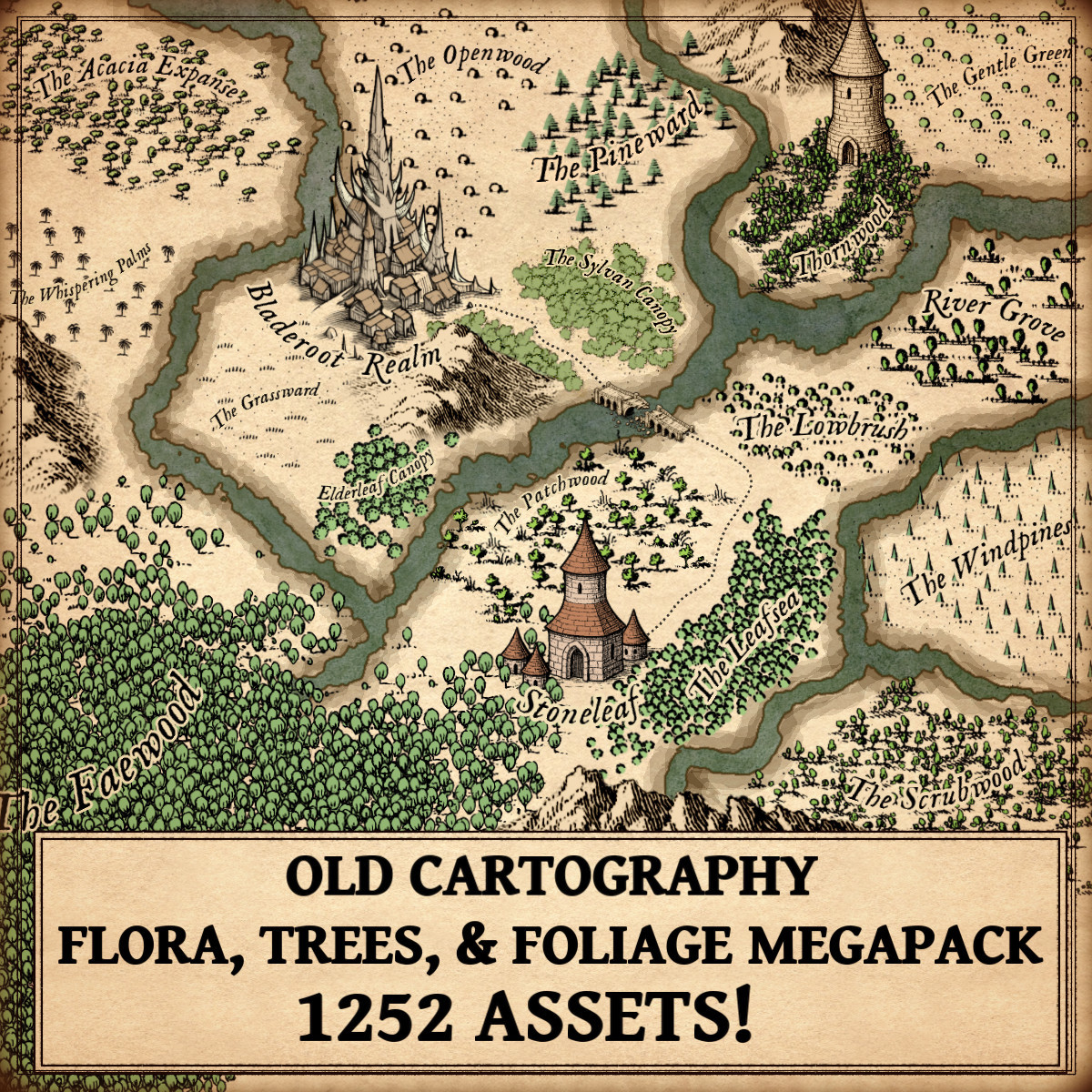
The Trees, Flora, & Foliage – Old Cartography Assets Megapack draws its strength from a long and venerable tradition. It does not merely offer visual elements for mapmaking; it echoes centuries of cartographic practice in which trees, vegetation, and textured ground were essential tools for understanding the world. Rooted in antique aesthetics and symbolic clarity, this collection belongs to the lineage of maps where nature was not background decoration, but meaning itself.

Discover the Trees, Flora, & Foliage – Old Cartography Assets Megapack here :

From the earliest hand-drawn maps scratched onto parchment to the richly illustrated fantasy maps of today, vegetation has always played a central role in cartography. Trees, oaks, fir trees, palms, acacias, bushes, soil textures, meadow grass, brushland, and top-down forests are not mere ornaments. They are symbols of climate, culture, economy, and myth, carefully placed to speak a visual language older than modern geography itself.

In the tradition of antique mapmaking, land was never empty. Every forest breathed meaning, every grove hinted at resources or danger, and every textured soil told a silent story of fertility or desolation. Modern Wonderdraft assets and cartography assets rooted in old cartographic styles naturally inherit this deep visual heritage, especially when used to build convincing and immersive fantasy worlds.

The Origins of Vegetation Symbols in Antique Cartography Assets

Ancient and medieval cartographers did not aim for scientific realism. Instead, they sought legibility, symbolism, and narrative clarity. Trees were drawn not as individuals, but as types: oak forests for temperate lands, fir trees for cold or mountainous regions, palms and acacias for distant, sun-burned realms.

A clear example can be found in Ptolemaic maps (2nd century AD), where wooded regions were marked with repeated tree symbols to distinguish fertile lands from deserts. Later, medieval mappaemundi, such as the Hereford Mappa Mundi (c. 1300), used stylized vegetation to frame the inhabited world and emphasize divine order in nature.

These early cartography assets established a visual grammar that still defines how fantasy map icons communicate terrain today.

Oaks, Fir Trees, Pines, and the Cultural Meaning of Forest Types

Oaks: Power, Ancestry, and Civilization

In European tradition, oak forests symbolized permanence, lineage, and authority. Roman maps and later Renaissance atlases often placed oak-heavy woodlands near settlements, roads, and political centers. In fantasy maps, oak tree clumps and woods continue this role, signaling stable kingdoms, ancient druidic sites, or regions settled for generations.

Fir and Pine Trees: Wilderness and the Unknown

Fir trees and pine forests, common in Alpine and Northern European maps such as Sebastian Münster’s Cosmographia (1544), represented harsher climates and untamed lands. Their sharp, vertical silhouettes became visual shorthand for cold winds, high altitudes, and perilous journeys, an essential cue still widely used in modern fantasy map icons.

Palm Trees, Acacias, and the Exoticism of Distant Lands

Palm trees and acacias entered Western cartography through trade routes, conquest, and imagination. Portolan charts and early maps of Africa and the Near East, such as those by Abraham Cresques in the 14th century, used palms to indicate unfamiliar climates and economically valuable regions.

In fantasy maps, palms and savanna trees instantly convey heat, distance, and otherness. Landscapes dotted with acacias suggest open horizons, nomadic cultures, and fragile ecosystems. These elements remain vital Wonderdraft assets for worldbuilders seeking clarity and atmosphere without relying on written explanations.

Bushes, Brushland, and Low Vegetation as Functional Cartography Assets

Not all landscapes are forests, and antique mapmakers understood this well. Bushes, brushland, and low vegetation were used to indicate transitional terrain, lands neither fully wild nor fully cultivated.

On Renaissance military maps, brushland often marked areas suitable for ambush or difficult movement. In fantasy cartography, bushland flora and trees help define biome boundaries, soften harsh transitions, and add realism without overwhelming the composition.

These subtle cartography assets are essential for visual rhythm and believable geography.

Soil Texture, Dots, and the Language of the Ground

One of the most understated yet powerful tools in antique cartography is soil texture, often represented by small dots, stippling, or scattered marks. These textures appear in early cadastral maps, medieval travel charts, and even ancient Roman land surveys.

Soil texture serves several purposes:

  • It fills empty space without overpowering the map
  • It indicates aridity, fertility, or wasteland
  • It creates depth and visual hierarchy beneath trees and vegetation

In fantasy maps, dotted soil textures beneath forests or meadows reinforce the continuity of the terrain. They are silent yet essential fantasy map icons, grounding imaginary worlds in historical visual logic.

Meadow Grass and the Idealized Landscape

Meadow grass appears frequently in early modern maps depicting “civilized” lands. These open, lightly textured areas suggested agriculture, safety, and prosperity. Dutch Golden Age cartographers such as Joan Blaeu used grassy plains to contrast dense forests and mountainous regions.

In fantasy cartography, meadow grass provides breathing space. It frames forests, supports settlements, and creates visual balance, an artistic necessity inherited directly from antique traditions.

Top-Down Trees and the Evolution of Perspective

While most antique maps relied on oblique or symbolic views, some late medieval and Renaissance works experimented with top-down representations for clarity, especially in city plans and regional surveys.

Modern fantasy maps adopt top-down trees and foliage to improve readability at smaller scales. This evolution does not break tradition, it refines it. These elements preserve the antique aesthetic while embracing functional clarity, making them indispensable Wonderdraft assets for contemporary mapmakers.

Vegetation Clumps, Forest Masses, and Visual Storytelling

Antique cartographers rarely scattered trees at random. Forests appeared as intentional masses, guiding the eye along roads, rivers, and borders. Vegetation clumps were compositional tools as much as geographic indicators.

In fantasy maps, oak forests, pine woods, Mediterranean woodland vegetation, rounded shrubs, and low vegetation serve the same narrative function. They guide the viewer, suggest deep history, and imply unseen stories: lost roads, ancient battles, forgotten sanctuaries.

This is where cartography assets become art.

Why These Elements Are Both Useful and Decorative

Vegetation symbols endure because they fulfill three functions at once:

  • Utility – conveying terrain, climate, and movement
  • Culture – reflecting myths, economies, and worldviews
  • Decoration – enriching the map as an illustrated object

Antique maps were not merely tools; they were precious objects. Fantasy maps follow the same philosophy. Carefully designed fantasy map icons for trees, flora, and foliage honor this legacy while empowering modern creators.

A Living Tradition in Modern Wonderdraft Assets

The visual language of trees, bushes, soil textures, meadow grass, brushland, and forests has survived centuries because it works. It is intuitive, symbolic, and endlessly adaptable.

The Trees, Flora, & Foliage – Old Cartography Assets Megapack firmly belongs to this tradition, offering a coherent collection of vegetation forms rooted in historical cartography. It does not invent a new language, it refines an ancient one.

For fantasy cartographers, worldbuilders, and storytellers, these Wonderdraft assets and .png cartography assets are not just tools. They are the continuation of a craft that once mapped the known world, and now maps imagined ones.

Posted on

Fantasy Map Icons & Wonderdraft Assets – Slavic Settlements in Vintage Cartography

slavic castles, slavic settlements, fantasy map symbols, vintage cartography assets, gimp, Wonderdraft assets, Photoshop

Introduction: Why Slavic Aesthetics Matter in Fantasy Map Making

In the world of fantasy map making, visual language is everything. Long before modern cartography prioritized scale and accuracy, antique maps relied on fantasy map icons and symbolic representations to communicate culture, power, danger, and belief. Among these traditions, Slavic-inspired settlements and landscapes occupy a unique place—both historically grounded and visually evocative.

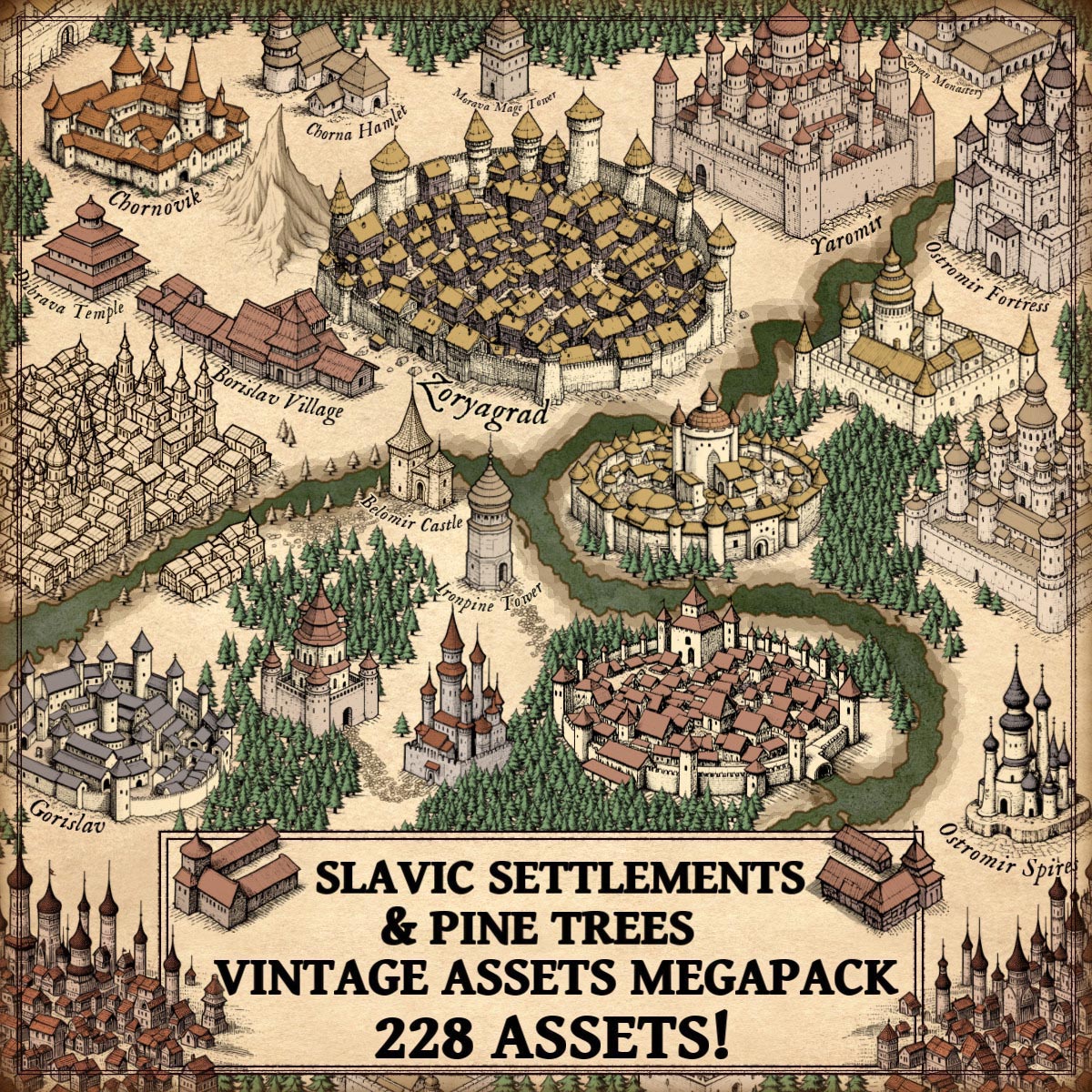
The Fortified Slavic Settlements, Towns, Castles, & Pine Trees – Vintage Assets Megapack draws directly from this legacy. Inspired by medieval and early modern cartography, the assets in the pack echo the same principles found in real antique maps: clarity, symbolism, hierarchy, and artistic storytelling. These wonderdraft assets are not merely decorative; they are functional heirs to centuries of cartographic practice.

Discover the Fortified Slavic Settlements, Towns, Castles, & Pine Trees – Vintage Assets Megapack here :

Slavic Settlements as Core Fantasy Map Icons in Fantasy Map Making

Slavic settlements form the structural backbone of many historical and fictional maps. From early medieval villages to organized towns, Slavic societies developed settlement patterns shaped by forests, rivers, and communal defense.

On antique maps, settlements were rarely drawn to scale. Instead, they were represented through:

  • Compact clusters of houses
  • Repeated architectural motifs
  • Simplified silhouettes readable at a distance

This megapack follow the same logic. Each Slavic settlement icon conveys population level, permanence, and importance at a glance. In fantasy map icons, these symbols allow mapmakers to build believable regions without overwhelming the composition.

Historically comparable examples include:

  • The city vignettes in the Nuremberg Chronicle (1493)
  • Early Eastern European regional maps where towns appear as emblematic miniatures

These assets translate that tradition directly into modern vintage cartography assets for fantasy worlds.

Fortified Slavic Towns in Vintage Cartography Assets and Medieval Fantasy Maps

Fortified Slavic towns—often known historically as gords or grads—were central to political and military life. Built with timber walls, earthworks, and later stone fortifications, they guarded trade routes and borders.

In antique cartography, fortified towns were emphasized visually:

  • Thick walls
  • Towers multiplied beyond reality
  • Circular or geometric layouts

Maps such as Olaus Magnus’ Carta Marina (1539) demonstrate this exaggeration clearly. Fortifications were symbolic first, accurate second.

The fortified towns in this pack embrace this same visual philosophy. As fantasy map symbols, they instantly communicate:

  • Strategic importance
  • Military control
  • Regional authority

For fantasy map making, these wonderdraft assets provide visual hierarchy—guiding the viewer’s eye across the map.

Slavic Towns, Hamlets, and Villages as Everyday Fantasy Map Icons

Not all power lies behind walls. Slavic hamlets and villages represent the daily life of the land: farmers, woodcutters, traders, and craftsmen.

Historically:

  • Villages were loosely organized
  • Houses were primarily wooden
  • Roofs and layouts reflected climate and local resources

Antique maps often depicted such settlements as small clusters of buildings, sometimes no more than a symbol. This abstraction is faithfully preserved in the megapack, making these assets ideal fantasy map icons for:

  • Filling rural spaces
  • Indicating population spread
  • Supporting narrative realism

In vintage cartography assets, these elements serve as connective tissue between cities and wilderness.

Slavic Castles, Fortresses, and Citadels as Fantasy Map Symbols of Power

Slavic castles and fortresses mark the transition from tribal organization to feudal authority. From early hillforts to later stone complexes, they symbolized rulership, defense, and permanence.

Historical counterparts include:

  • Wawel Castle in Kraków
  • Early fortified centers of Kievan Rus

In antique maps, castles were often oversized and idealized. Their purpose was symbolic dominance rather than architectural precision.

The castles, fortresses, and citadels in this megapack continue this tradition. As fantasy map icons, they:

  • Anchor political regions
  • Serve as narrative focal points
  • Reinforce medieval atmosphere

These wonderdraft assets excel at translating authority into visual form.

Slavic Cities and Dense Urban Medieval Blocks in Fantasy Map Making

Large Slavic cities developed around trade, religion, and defense. Dense housing, narrow streets, and layered fortifications defined their character.

Antique maps frequently represented cities as:

  • Dense masses of rooftops
  • Repeated towers and domes
  • Highly stylized urban blocks

This megapack’s dense urban medieval city blocks reflect those conventions precisely. In fantasy map making, they allow cartographers to suggest urban complexity without sacrificing clarity—an essential trait of effective vintage cartography assets.

Slavic Temples, Monasteries, and Sacred Architecture in Fantasy Map Icons

Spiritual geography was as important as political geography. Before Christianization, Slavic cultures maintained sacred temples and ritual spaces; later, monasteries became centers of learning and influence.

Antique maps routinely emphasized religious structures, often regardless of their actual size. This tradition is visible in:

  • Medieval pilgrimage maps
  • Early ecclesiastical atlases

The Slavic temples and monasteries in the pack act as fantasy map symbols for:

  • Faith systems
  • Cultural identity
  • Ideological influence

They enrich fantasy worlds with layers of belief and history.

Gatehouses, Watchtowers, Mage Towers, and Defensive Infrastructure

Infrastructure elements—gatehouses, watchtowers, and towers—were critical to medieval landscapes. On antique maps, such features often appeared as standalone symbols marking borders, roads, or dangerous zones.

In fantasy cartography, mage towers inherit the same symbolic role once held by keeps and signal towers. The assets in this pack respect antique visual logic, ensuring stylistic cohesion across realistic and fantastical elements.

As fantasy map icons, they guide movement, suggest danger, and support storytelling.

Pine Trees and Forest Landscapes in Vintage Cartography Assets

Forests defined the Slavic world. Vast pine woodlands shaped settlement patterns, warfare, and mythology.

Antique cartographers represented forests through repeated tree symbols, not shaded terrain. Pines often signaled:

  • Cold climates
  • Untamed regions
  • Natural borders

The pine trees in the pack fulfill exactly this role. They are not background decoration; they are cultural markers. In fantasy map making, they:

  • Frame settlements
  • Shape travel routes
  • Enhance regional identity

These vintage cartography assets remain faithful to historical precedent.

Utility, Culture, and Decoration in Fantasy Map Icons

Antique maps balanced three essential purposes:

  1. Utility — conveying information clearly
  2. Culture — expressing identity and worldview
  3. Decoration — engaging the viewer

The Fortified Slavic Settlements, Towns, Castles, & Pine Trees – Vintage Assets Megapack succeeds because it respects all three. Every asset is:

  • Readable at map scale
  • Historically inspired
  • Artistically cohesive

These wonderdraft assets are tools, but also storytelling instruments.

Conclusion: Slavic Heritage as a Foundation for Fantasy Map Making

Slavic-inspired fantasy map icons are not niche embellishments—they are foundational elements rooted in real cartographic history. By drawing from antique representations and medieval visual logic, this asset pack allows creators to build worlds that feel authentic, layered, and timeless.

In continuing the traditions of antique maps, these vintage cartography assets do what the best fantasy cartography has always done:
transform geography into narrative, and symbols into stories.

Posted on

Wonderdraft Assets – Fantasy Map Icons & Map Symbols

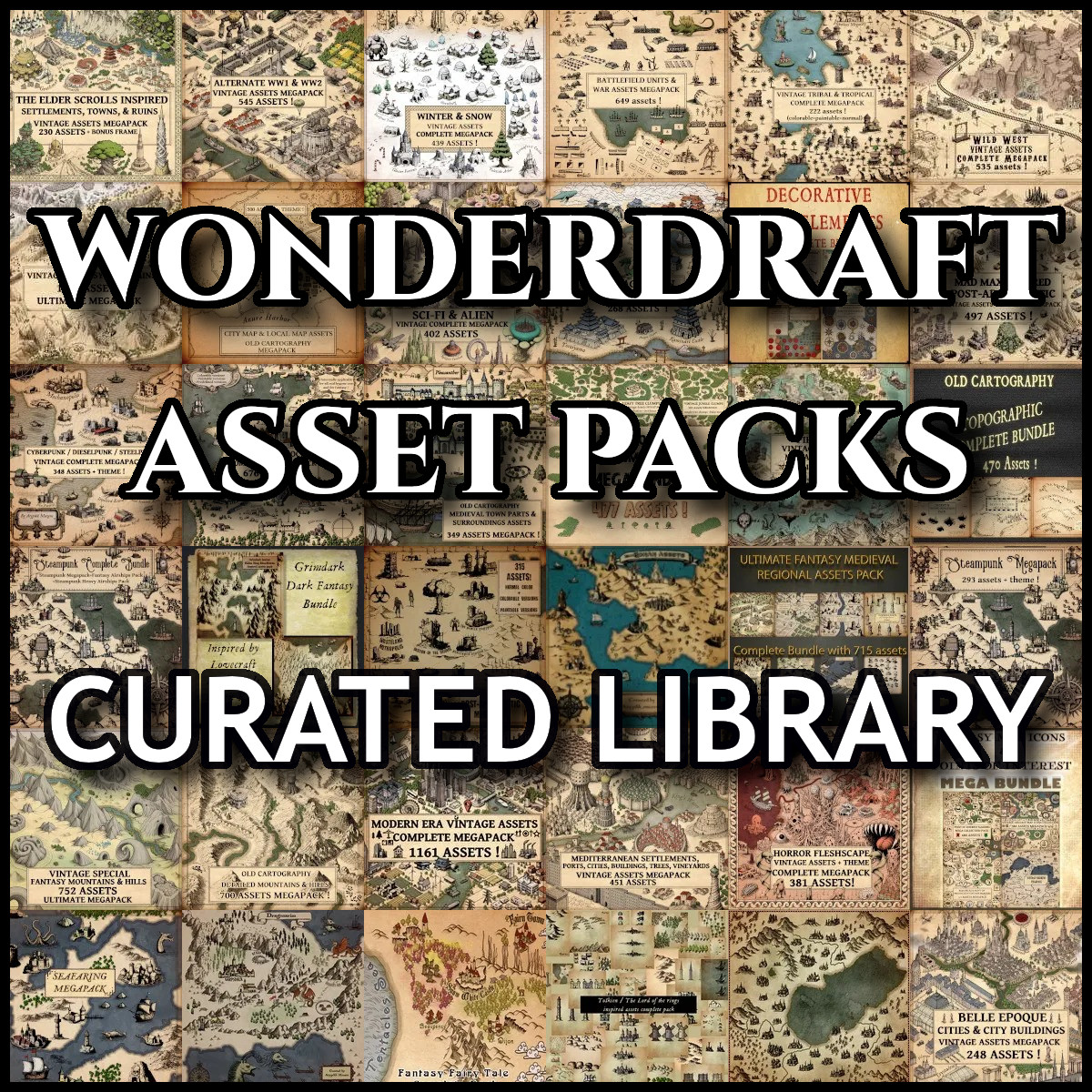
Wonderdraft assets pack library with fantasy map icons and cartography symbols

Wonderdraft assets are essential tools for creating detailed and immersive fantasy maps. They allow mapmakers to add mountains, cities, symbols, terrain features, and decorative elements directly inside Wonderdraft, transforming a simple map into a believable and readable world.

Whether you are a dungeon master preparing a campaign, a fantasy writer visualizing fictional regions, or a worldbuilder designing entire continents, high-quality Wonderdraft assets make a decisive difference in both clarity and atmosphere. Carefully curated Wonderdraft asset packs help creators work faster while maintaining a consistent visual identity across their maps.
This page serves as a reference hub for Wonderdraft assets, explaining how they are used in fantasy mapmaking and how to choose the right assets for professional-quality cartography.

Looking for Wonderdraft asset packs?
Browse the complete Wonderdraft asset library and packs

What Are Wonderdraft Assets in Fantasy Mapmaking?

Wonderdraft assets are graphic elements specifically designed to be imported and used within the Wonderdraft mapmaking software. They are usually provided as transparent PNG files and can be added as symbols or custom assets inside the editor.

These Wonderdraft map assets represent both natural and man-made elements: mountains, trees, cities, castles, roads, landmarks, and decorative cartography components. Well-crafted Wonderdraft assets follow consistent scale, perspective, and shading so that all elements blend naturally on the same map.

Rather than drawing every feature by hand, mapmakers rely on custom Wonderdraft assets to speed up their workflow while maintaining a coherent and polished visual style.

Why High-Quality Wonderdraft Assets Matter

Not all Wonderdraft assets produce the same results. Inconsistent or poorly designed assets can make a fantasy map feel cluttered, unreadable, or amateurish.

High-quality Wonderdraft assets offer several advantages:

  • Clear readability at different zoom levels
  • Consistent visual style across the entire map
  • Faster map creation without sacrificing detail
  • Professional results suitable for publication or sharing

For creators who care about immersion and presentation, using carefully designed Wonderdraft assets is essential.

Types of Wonderdraft Assets for Fantasy Maps

Wonderdraft supports a wide range of asset types, each serving a specific role in fantasy cartography. Together, these elements form complete fantasy map assets for Wonderdraft, suitable for both regional projects and large-scale world maps.

Mountains & Terrain Assets

Mountains, hills, ridges, volcanoes, trees, swamps, and deserts define the geography and mood of a fantasy world. Terrain assets establish scale, climate, and natural borders.

Cities, Settlements & Architecture

Cities, towns, villages, forts, castles, ruins, and harbors represent civilization, political power, and trade networks across the map.

Symbols & Map Icons

These Wonderdraft symbols highlight points of interest such as temples, towers, mines, ruins, battlefields, or magical locations. Map icons help guide the reader’s eye and support storytelling through visual cues.

Decorative Cartography Elements

Borders, frames, compass roses, banners, textures, and ornamental details add an old-world cartographic feel and elevate the visual presentation of a fantasy map.

Who Uses Wonderdraft Assets?

Wonderdraft assets are used by a wide range of creators working on different types of fantasy projects.

Dungeon Masters rely on them to build clear and immersive RPG campaign maps. Fantasy writers use Wonderdraft map assets to visualize fictional regions and maintain geographic consistency across their stories. Worldbuilders design continents, kingdoms, and trade routes, while game developers prototype fantasy settings during early production stages. Artists and cartographers also use Wonderdraft assets to explore historical and engraved map styles.

Across all these use cases, consistency and readability remain the key reasons for choosing high-quality Wonderdraft assets.

Vintage & Old Cartography Style Wonderdraft Assets

Many fantasy mapmakers prefer assets inspired by vintage and historical cartography. Engraved mountains, hand-drawn settlements, and antique symbols evoke the look of old atlases and medieval maps.

This old-world cartography style is especially effective for:

  • Classic or low-magic fantasy settings
  • Folklore-inspired regions
  • Historical or pseudo-historical worlds
  • Parchment and hand-drawn map aesthetics

Vintage Wonderdraft assets emphasize linework, texture, and shading rather than flat digital shapes, creating a timeless and immersive visual language.

How to Choose the Right Wonderdraft Assets

When selecting Wonderdraft assets, it is important to consider several factors:

  • Compatibility with Wonderdraft (transparent PNG files, correct scale)
  • Consistency in style across multiple Wonderdraft asset packs
  • Readability on both regional and world-scale fantasy maps
  • Licensing for personal and commercial projects

Using a curated collection of assets designed to work together usually produces better results than mixing unrelated styles.

Examples of Wonderdraft Asset Packs

The asset packs listed below are only a small selection from a much larger collection of Wonderdraft assets available on this site. They are presented as examples to illustrate the variety of styles, themes, and cartographic elements that can be combined to build cohesive fantasy maps.

The full library includes many more Wonderdraft asset packs covering terrain, settlements, symbols, and decorative cartography elements, all designed to work seamlessly with Wonderdraft.

Mountains, Trees, & Terrain Assets

Engraved-style mountains, hills, ridges, volcanoes, and natural terrain symbols inspired by vintage and hand-drawn cartography.

Explore Mountain & Terrain Assets for Wonderdraft

Cities, Settlements & Architecture

Towns, villages, fortified cities, castles, and architectural symbols suitable for regional and world-scale fantasy maps.

Browse Settlement & Town Assets

Symbols & Map Icons

Landmarks, temples, ruins, towers, magical locations, and point-of-interest icons for storytelling and worldbuilding.

Discover Fantasy Map Icons & Symbols

Vintage & Old Cartography Elements

Decorative borders, compass roses, ornaments, frames, and engraved-style elements inspired by historical atlases.

View Vintage Cartography Assets

Created by a Dedicated Fantasy Cartographer

All Wonderdraft assets available on this site are created by an independent fantasy cartographer and digital artist specialized in vintage and engraved-style map design.
These assets have been used by thousands of mapmakers worldwide for tabletop RPGs, fantasy novels, worldbuilding projects, and commercial publications.

Each Wonderdraft asset pack is developed with a strong focus on historical cartography references, visual consistency, and long-term usability within Wonderdraft.

Explore the Full Wonderdraft Asset Library

This site hosts a growing library of premium Wonderdraft assets created for fantasy mapmakers who value authenticity, consistency, and old-world cartography aesthetics.

All assets are designed to work together, allowing creators to combine different Wonderdraft asset packs into cohesive maps without visual clashes or stylistic breaks.

Browse the complete Wonderdraft asset library and packs

Posted on

The Art and History of Mountains in Fantasy Cartography Through Antique Cartography Assets

Fantasy map symbols, mountains, hills, plateaus, knolls, fantasy map icons, Wonderdraft assets, vintage cartography assets

A deep exploration of terrain representation and the legacy revived by the Detailed Mountains & Hills – Old Cartography Assets Megapack

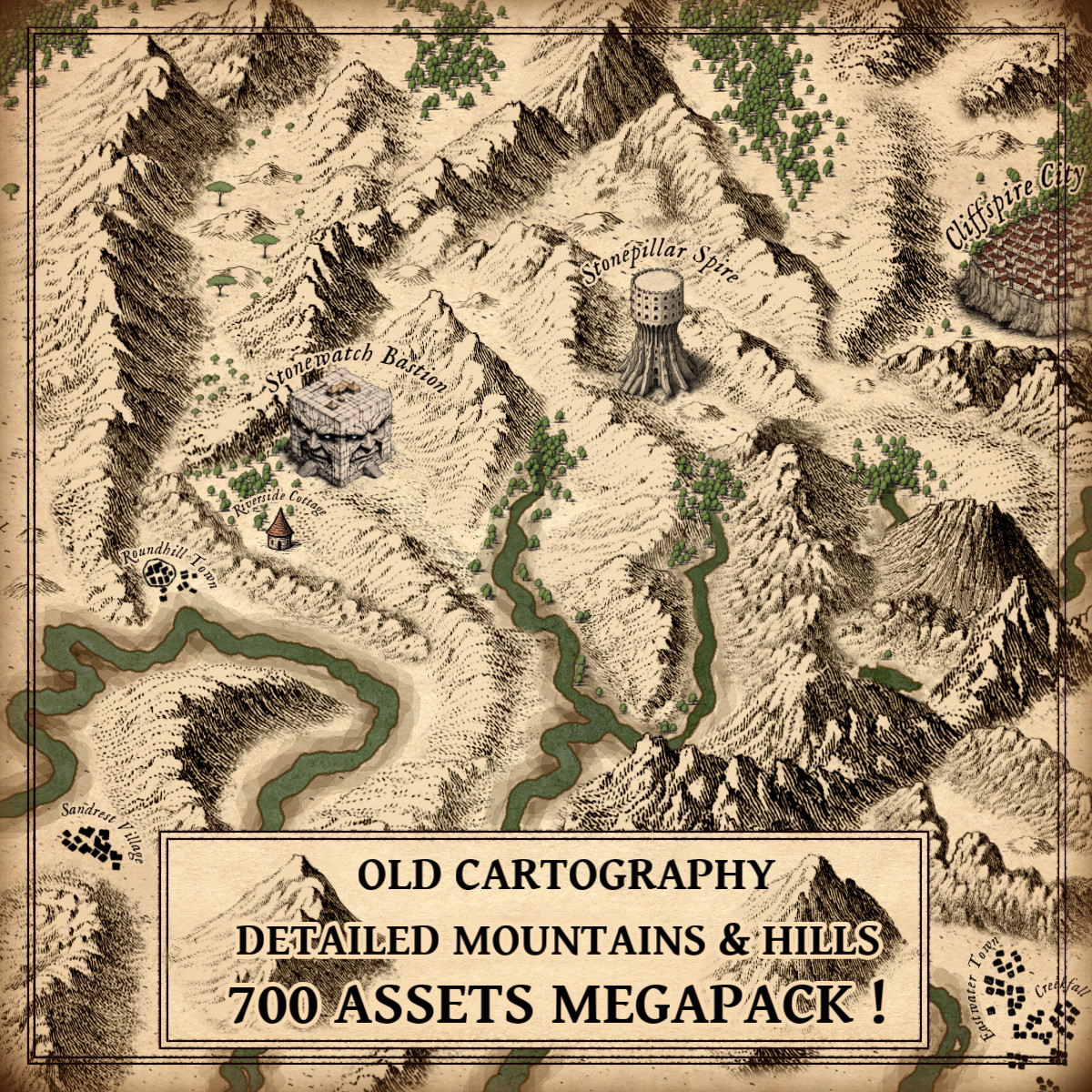
Mountains, hills, ridges, volcanoes, escarpments, and all the landforms included in the pack represent far more than decorative features. Across history, they formed a symbolic language that shaped geographical understanding, cultural identity, and storytelling. In both ancient traditions and modern fantasy map making, mountain drawings remain fundamental to how worlds, real or imaginary, are described.

The Detailed Mountains and Hills – Old Cartography Assets MEGAPACK faithfully revives antique engraving styles with carefully crafted landforms such as mountains, mountain ranges, hill formations, broken ranges, buttes, plateaus, craters, knolls or escarpments. These drawings recall centuries of handcrafted maps and bring their evocative aesthetic into digital worldbuilding.

BUY AND DOWNLOAD The Detailed Mountains and Hills – Old Cartography Assets MEGAPACK HERE :

1. Origins of Mountain Symbolism in Early Maps and Their Legacy in Fantasy Map Icons

The representation of mountains began long before the notion of modern topography existed. Ancient cartographers understood that terrain could not simply be sketched scientifically, they needed symbolic forms.

Antiquity

  • Ptolemy’s Geographia (2nd century CE) included simple hill-shaped symbols that defined early Western cartographic convention.
  • In East Asian maps, especially during the Han and Tang dynasties, mountains symbolized cosmic balance and were drawn in isometric, stacked forms.

Medieval Europe

  • The Hereford Mappa Mundi depicted mountains as dramatic clusters marking sacred regions, mythical realms, and uncharted territories.
  • Islamic cartographer al-Idrisi used mountains as climatic markers and boundaries between cultural zones.

The landforms included in the pack; from isolated peaks to crags, highlands, and ridges; mirror this historical variety, making them ideal as fantasy map icons that enrich worldbuilding with cultural weight and ancient symbolism.

2. Renaissance Cartographic Innovation and the Emergence of Engraved Wonderdraft Assets

With the Renaissance came a flourishing of geographical detail and artistic precision.

  • Ortelius’ Theatrum Orbis Terrarum (1570) introduced engraved mountain clusters with consistent shading and distinctive silhouettes.
  • The Blaeu family refined the art of hachuring, creating some of the most beautiful mountain engravings ever published.
  • Cassini’s cartographic work (18th century) brought proto-topographic systems that displayed altitude and slope through shading direction.

The mountains, hills, volcanoes, and landforms in the pack clearly follow these engraving traditions:
sharp hatching, coherent light direction, clean contours, and expressive silhouettes. As Wonderdraft assets, they allow mapmakers to reproduce Renaissance-level realism inside modern digital tools.

3. Cultural Symbolism and Narrative Weight of Mountains in Ancient Maps and Modern Cartography Assets

Across civilizations, mountains on maps expressed significance beyond terrain.

Mountains as Natural Borders

Historical maps often marked political or cultural divisions using mountain chains:

  • The Pyrenees between France and Spain
  • The Apennines shaping Italian regional identities
  • The Himalayas forming colossal boundaries in South and Central Asia

In fantasy worldbuilding, the same logic applies. The mountain ranges, escarpments, cliffs, fragmented highlands, and plateaus in the pack serve to define kingdoms, territories, and frontier zones.

Mountains as Myth and Mystery

Throughout history:

  • The Rhipaean Mountains of Greek lore
  • The Mountains of the Moon, believed to feed the Nile
  • Early depictions of Vesuvius as a gateway to the underworld

The presence of volcanoes, craters, broken ranges, and dramatic cliffs in the pack mirrors these mythic connotations, allowing creators to construct narrative-rich landscapes.

Mountains as Navigation

Travelers and explorers once relied on:

  • Buttes
  • Knolls
  • Coastal cliffs
  • Ridgelines

These features helped orient caravans, sailors, and pilgrims. Their equivalents appear in the pack, serving both functional map readability and aesthetic coherence within modern cartography assets.

4. Practical Uses of Terrain Symbols in Fantasy Map Making With Fantasy Map Icons

The antique style of the pack is not merely decorative, it offers structural clarity for map composition.

A. Building Geography Modularly

With elements such as:

  • Mountains + mountain ranges
  • Hills + hill formations
  • Highlands + fragmented highlands
  • Volcanoes + craters
  • Plateaus + escarpments

worldbuilders can assemble fully coherent continents and regions with remarkable natural flow.

B. Clarity at Multiple Scales

Classical engravers designed symbols to remain readable even in small atlases.
Similarly, the pack provides landforms that retain clarity in both continent-sized maps and close-up regional maps.

C. A Full Vocabulary of Landforms

Few collections offer such richness:

  • mountains
  • hills
  • knolls
  • crags
  • ridges
  • lowlands
  • broken ranges
  • cliffs
  • plateaus
  • craters

This gives worldbuilders control over geological storytelling.

D. Paintable and Customizable Designs

Following the tradition of hand-colored maps, the pack includes variants suitable for:

  • direct painting
  • digital recoloring
  • neutral monochrome engraving styles

These characteristics make the pack’s landforms perfect fantasy map icons for hybrid analog–digital creation.

5. The Artistic Craft Behind Antique-Style Wonderdraft Assets

The drawings in the pack reflect meticulous craftsmanship:

Engraving-inspired hatching

Line density and direction mimic copperplate techniques of the 16th–18th centuries.

Shading Consistency

Most peaks and hills employ a unified light direction, recalling classic European atlas design.

Natural Composition

Mountain ranges, broken ranges, and ridges cluster organically, just as in historic works by Ortelius, Blaeu, and Sanson.

Historical Geological Realism

  • Volcanic shapes evoke early depictions of Etna and Vesuvius
  • Crater symbols recall lunar cartography
  • Highlands resemble Swiss shaded-relief engravings

The result is a set of Wonderdraft assets that are both historically inspired and artistically robust.

6. The Modern Revival of Antique Mapping Through Digital Cartography Assets

Why does this antique mountain style remain the gold standard in fantasy worlds?

Authenticity and Immersion

These landforms instantly communicate history, age, and believability.

Narrative Depth

A towering range hints at epic quests.
A smoking volcano signals danger and myth.
A fragmented highland suggests ancient cataclysms.

Aesthetic Harmony

The engraved look pairs perfectly with parchment textures and serif fantasy typography.

The mountains, hills, seas of ridges, buttes, and broken ranges of the pack help creators revive centuries-old mapmaking tradition in a modern context.

Direct Connection With Historical Art

This is the same style used (and loved) by Tolkien, whose maps were heavily influenced by 16th-century engraving conventions.

Thus, the MEGAPACK stands at the crossroads of history and creativity, offering digital cartography assets that feel timeless.

Conclusion: A Timeless Artistic Language Reborn Through Fantasy Map Icons

The Detailed Mountains and Hills – Old Cartography Assets MEGAPACK is more than an asset collection, it is a revival of the classical cartographic language that shaped humanity’s understanding of the world.

From ancient Greek scholars to medieval cosmographers, Renaissance engravers, Enlightenment explorers, and modern fantasy storytellers, mountains have always been symbols of mystery, power, ambition, and identity.

With its mountains, hills, volcanoes, plateaus, craters, cliffs, ridges, lowlands, knolls, and countless other landforms, the pack enables modern creators to tap into this heritage and build worlds that feel alive, authentic, and beautifully crafted.

In fantasy cartography, a mountain is never just a shape on a page.
It is story, culture, geology, myth, and art, all expressed through ink.

Learn more about Wonderdraft assets

Posted on

Chilled Chronicles: Navigating Snowy Realms with Cartography Assets

wonderdraft assets, winter, snowy structures, christmas, footprints, cartography assets, map symbols

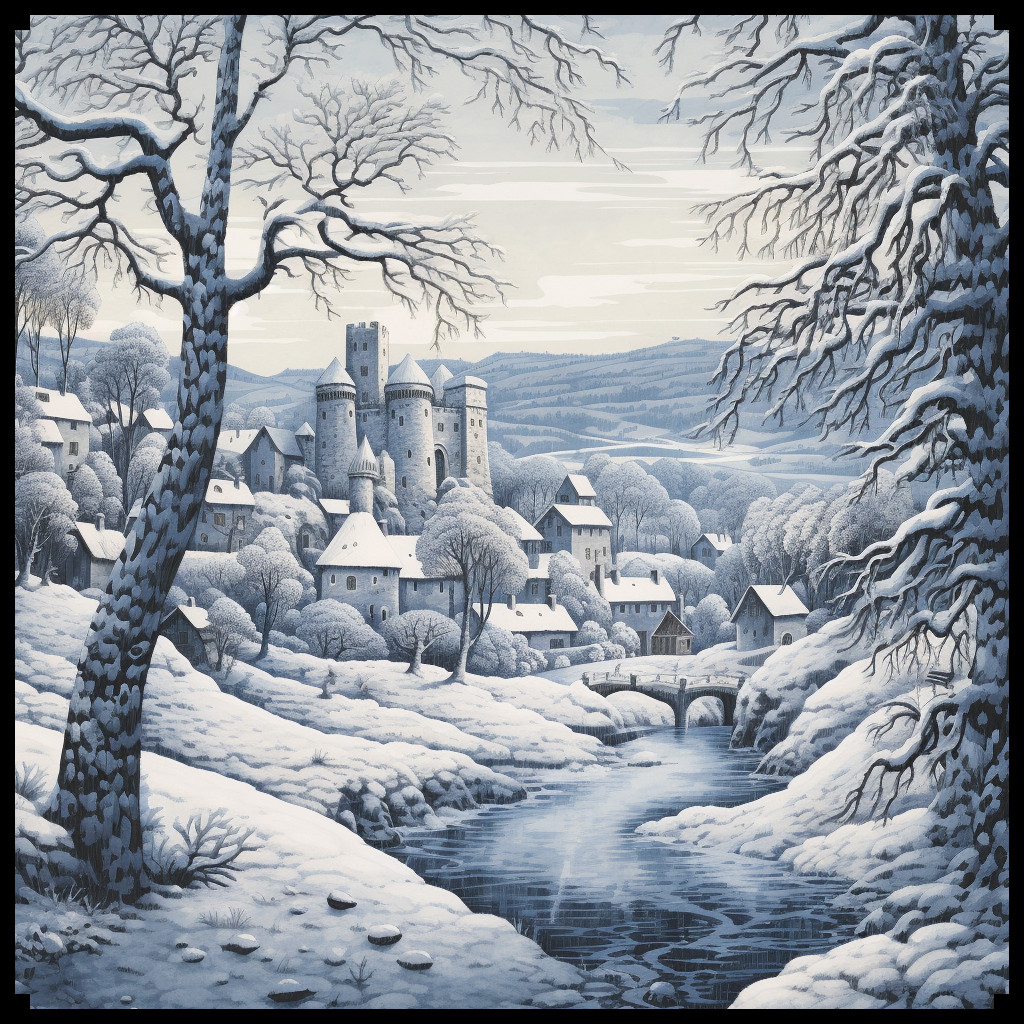
Journeying through the frozen landscapes depicted in antique maps and fantastical realms reveals a captivating tapestry of winter cartography. Beyond the allure of the Winter & Snow Complete Megapack – Vintage Assets Pack, this article seeks to unravel the historical and imaginative layers behind representations of snow-covered cities, ice castles, ancient ruins beneath the snow, and a myriad of other wintry elements.

BUY AND DOWNLOAD The Winter & Snow Complete Megapack – Vintage Assets Pack :

Snowy Cities and Frozen Abodes:

Snow-covered cities and hamlets have a storied history in cartography. The quaint charm of these settlements, blanketed in white, is reminiscent of ancient villages adapting to winter’s harsh embrace. Within the Winter & Snow Complete Megapack, the inclusion of snowy hamlets and villages preserves this aesthetic, transporting map enthusiasts to a world where the cold weaves its tales through the architecture of the past.

Ice Castles and Dungeons:

The megapack introduces the enigmatic allure of ice castles and fortresses, echoing both historical marvels and fantastical realms. Drawing inspiration from medieval structures and mythical tales, these frozen citadels stand as testaments to the power and mystery entwined in winter landscapes. Ice dungeons, with their chilling depths and hidden secrets, add layers of complexity, beckoning adventurers into subterranean realms of ice and intrigue.

Ruins Under Snow and Ancient Mysteries:

Beneath the pristine layers of snow lie the remnants of lost civilizations, beautifully represented in the megapack’s snowy ruins and remains. This concept draws from the real-world archaeological fascination with uncovering the mysteries of ancient cultures. The maps guide explorers through a landscape where echoes of the past linger, inviting contemplation of the stories etched into the frozen terrain.

Igloos and Arctic Dwellings:

Dotted across the wintry expanse are igloos and arctic towns, showcasing the adaptability of cultures to icy environments. The megapack captures the essence of these dwellings, providing a glimpse into the lives of those who thrive in the harshest of winter conditions. This inclusion not only adds realism but also serves as a nod to the diversity of winter landscapes across the globe.

Winter World Trees and Festive Decor:

World trees, depicting towering sapins or Christmas trees, evoke both a sense of wonder and cultural significance. In the megapack, these trees become focal points, representing not only geographical markers but also symbols of celebration. The addition of candy canes planted in the snow reinforces the festive atmosphere, blending mythology with a touch of holiday cheer.

Mythical Beings and Legends:

Winter maps wouldn’t be complete without the inclusion of legendary creatures like the yeti, bigfoot, and frost ogres. The megapack breathes life into these mythical beings, creating encounters that transcend mere navigation. Tracks in the snow add an element of realism, leaving adventurers to ponder the presence of these elusive entities in the frozen landscapes.

Crystal Formations and Enchanting Elements:

One of the standout features of the megapack is the meticulous representation of crystal formations embedded in the ground. These geological marvels not only add visual appeal but also introduce an enchanting aspect to the wintry landscapes. The sparkling crystals, with their varied shapes and sizes, contribute to the otherworldly ambiance of the maps.

Conclusion: Navigating the Uncharted Winter Realms

The Winter & Snow Complete Megapack – Vintage Assets Pack emerges as a treasure trove of winter cartography, seamlessly blending historical influences with fantastical elements. As we navigate the frozen landscapes, we find ourselves immersed in a world where the past, present, and mythical coalesce, creating maps that tell stories beyond navigation—stories of civilizations lost in the snow, of mythical creatures roaming icy expanses, and of the enchanting beauty of crystal-laden terrains. This megapack is not just a collection of assets but a gateway to exploring the uncharted realms of winter wonder.

Posted on

Navigating the Future: Exploring Cyberpunk, Steelpunk, and Dieselpunk Cartography

cyberpunk, steelpunk and dieselpunk city type, for fantasy map and old cartography, Wonderdraft, map making

Maps have always been a means to navigate our world, but what happens when cartography transcends the boundaries of reality and delves into the realms of the fantastic? I am an ardent fan of fantasy maps, particularly those of the cyberpunk, steelpunk, and dieselpunk genres. In this article, we will embark on a journey through the history and significance of these imaginative maps, exploring their portrayal of futuristic cities, industrial landscapes, mechas, spaceships, and much more. Moreover, we will unravel the allure of the Vintage Futuristic Complete Megapack, a treasure trove of 348 assets that promises to transport us to a bygone era of speculative cartography.

BUY AND DOWNLOAD The Vintage Futuristic Complete Megapack ( Cyberpunk, Dieselpunk, Steelpunk, Scifi ) – 348 assets :

Imaginary maps have a long and intriguing history, stretching back to ancient civilizations’ legends and mythological tales. However, it wasn’t until the advent of science fiction that these maps took on a life of their own. The cyberpunk, steelpunk, and dieselpunk genres emerged as distinct subgenres within the larger realm of science fiction, each with its unique aesthetic and vision of the future.

Cyberpunk, born in the early 1980s, introduced us to dystopian futures where mega-cities teemed with neon lights and cybernetic enhancements. The maps of cyberpunk worlds are characterized by towering skyscrapers, tangled streets, and sprawling virtual realms. These maps serve as essential tools for visualizing the complex, interconnected networks that define cyberpunk urban landscapes.

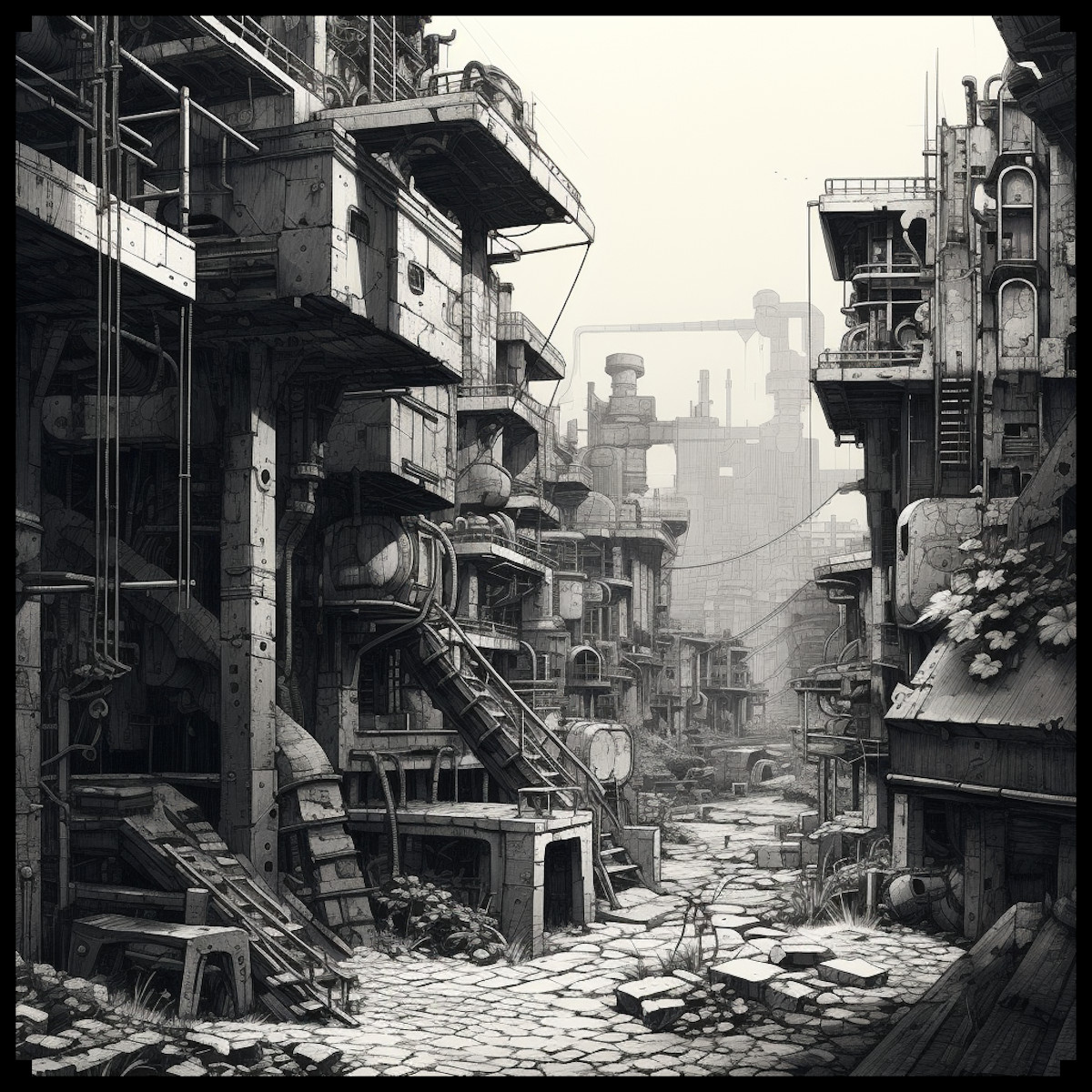
Steelpunk, a more recent addition to the speculative fiction pantheon, draws inspiration from the early 20th century’s industrial age. Steelpunk maps often feature massive factories, steel bridges, and smog-choked cities. They transport us to an alternate history where steel machines and megatechnology marvels reign supreme.

Dieselpunk, the elder sibling of steelpunk, harkens back to the interwar period and World War II. Dieselpunk maps are defined by their retro-futuristic vision, complete with sleek, Art Deco skyscrapers, prop-driven aircraft, and the gritty urban sprawl of noir-infused cityscapes.

Imaginary maps have found a prominent place in contemporary culture, transcending their origins in literature and branching into various mediums such as tabletop role-playing games, novels, and video games. Role-playing games like Cyberpunk 2020 and Shadowrun rely heavily on intricate maps to immerse players in their futuristic settings. These maps help players envision the gritty streets of Night City or the neon-lit alleys of the Sprawl, enhancing the overall gaming experience.

Novels like William Gibson’s Neuromancer and Philip K. Dick’s Do Androids Dream of Electric Sheep? owe much of their allure to the vivid descriptions and maps of dystopian worlds. These literary maps provide readers with a tangible sense of place within these speculative landscapes.

In the realm of video games, titles like Deus Ex, Bioshock, and Fallout have carved out their own niches with their detailed game worlds and accompanying maps. These maps serve as guides for players navigating through the post-apocalyptic wastelands, underwater cities, or cyber-enhanced urban jungles.

Now, let’s turn our attention to the pièce de résistance—the Vintage Futuristic Complete Megapack. With 348 meticulously crafted assets, this treasure trove brings the aesthetics of cyberpunk, dieselpunk, and steelpunk maps to life. From sprawling megacities to abandoned towns, from mechas to war machines with giant lasers, this megapack has it all.

The assets included in this megapack offer a charming blend of retro-futuristic aesthetics reminiscent of antique maps. Whether you’re looking to create a cyberpunk adventure for your tabletop RPG group or illustrate a dieselpunk novel, these assets provide the essential building blocks for your creative endeavors. The pack’s inclusion of compass roses and cartouches adds a touch of old-world elegance to futuristic landscapes.

Conclusion

In the world of speculative cartography, cyberpunk, steelpunk, and dieselpunk maps hold a unique place. They allow us to explore the dystopian visions of our future, to traverse neon-lit streets, and to witness the clash of old-world aesthetics with cutting-edge technology. As fans and creators of these imaginary maps, we have the privilege of shaping these fantastical worlds and sharing them with others.

The Vintage Futuristic Complete Megapack is a testament to our fascination with these genres, providing a wealth of assets to bring our visions of futuristic landscapes to life. So, whether you’re a seasoned cartographer or a curious enthusiast, don your virtual goggles and embark on a journey through the intricate and captivating worlds of cyberpunk, steelpunk, and dieselpunk cartography. The future, as they say, is what we make of it—even if it’s just on paper or pixels.