Posted on Leave a comment

The Art and History of Mountains in Fantasy Cartography Through Antique Cartography Assets

Fantasy map symbols, mountains, hills, plateaus, knolls, fantasy map icons, Wonderdraft assets, vintage cartography assets

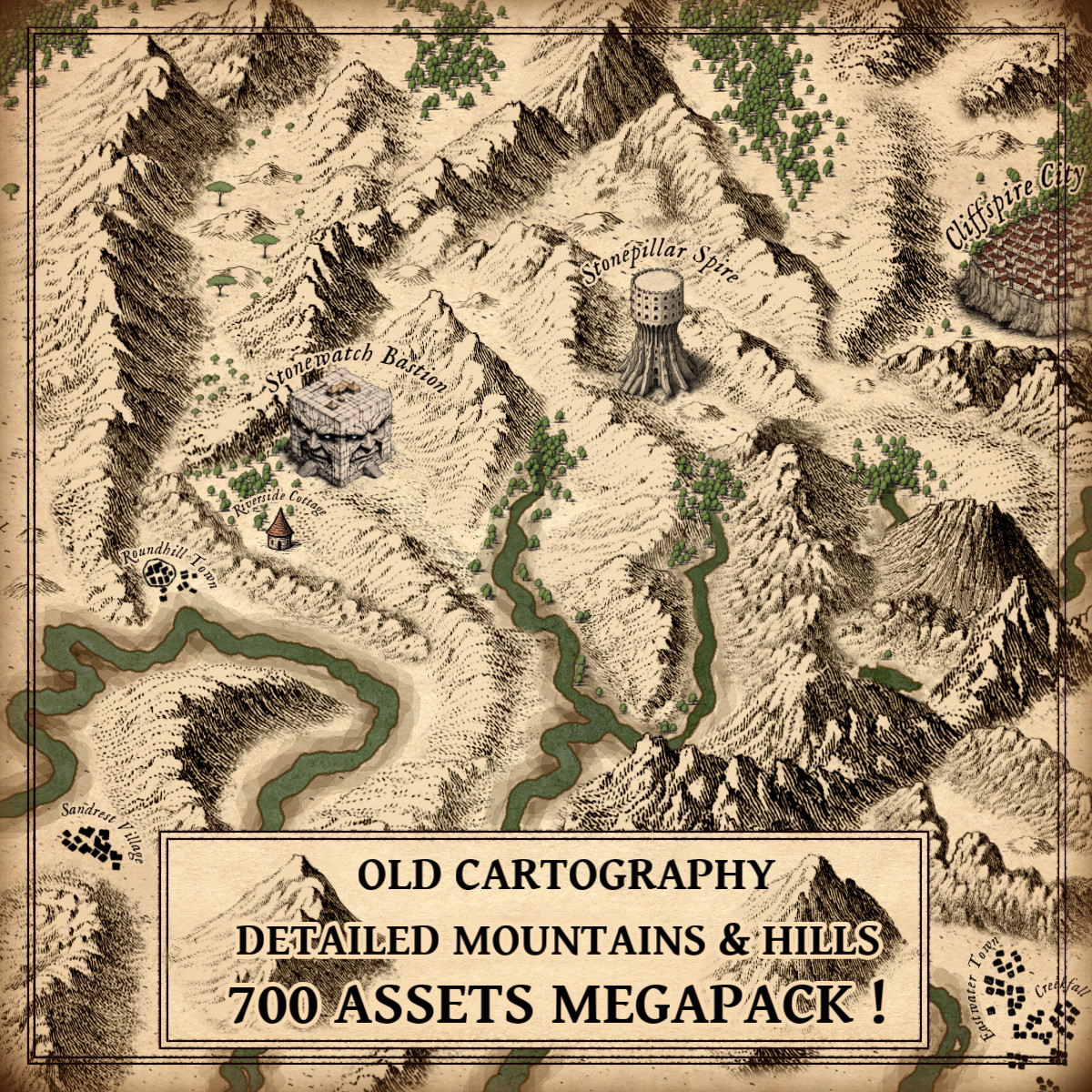
A deep exploration of terrain representation and the legacy revived by the Detailed Mountains & Hills – Old Cartography Assets Megapack

Mountains, hills, ridges, volcanoes, escarpments, and all the landforms included in the pack represent far more than decorative features. Across history, they formed a symbolic language that shaped geographical understanding, cultural identity, and storytelling. In both ancient traditions and modern fantasy map making, mountain drawings remain fundamental to how worlds, real or imaginary, are described.

The Detailed Mountains and Hills – Old Cartography Assets MEGAPACK faithfully revives antique engraving styles with carefully crafted landforms such as mountains, mountain ranges, hill formations, broken ranges, buttes, plateaus, craters, knolls or escarpments. These drawings recall centuries of handcrafted maps and bring their evocative aesthetic into digital worldbuilding.

BUY AND DOWNLOAD The Detailed Mountains and Hills – Old Cartography Assets MEGAPACK HERE :

1. Origins of Mountain Symbolism in Early Maps and Their Legacy in Fantasy Map Icons

The representation of mountains began long before the notion of modern topography existed. Ancient cartographers understood that terrain could not simply be sketched scientifically, they needed symbolic forms.

Antiquity

  • Ptolemy’s Geographia (2nd century CE) included simple hill-shaped symbols that defined early Western cartographic convention.
  • In East Asian maps, especially during the Han and Tang dynasties, mountains symbolized cosmic balance and were drawn in isometric, stacked forms.

Medieval Europe

  • The Hereford Mappa Mundi depicted mountains as dramatic clusters marking sacred regions, mythical realms, and uncharted territories.
  • Islamic cartographer al-Idrisi used mountains as climatic markers and boundaries between cultural zones.

The landforms included in the pack; from isolated peaks to crags, highlands, and ridges; mirror this historical variety, making them ideal as fantasy map icons that enrich worldbuilding with cultural weight and ancient symbolism.

2. Renaissance Cartographic Innovation and the Emergence of Engraved Wonderdraft Assets

With the Renaissance came a flourishing of geographical detail and artistic precision.

  • Ortelius’ Theatrum Orbis Terrarum (1570) introduced engraved mountain clusters with consistent shading and distinctive silhouettes.
  • The Blaeu family refined the art of hachuring, creating some of the most beautiful mountain engravings ever published.
  • Cassini’s cartographic work (18th century) brought proto-topographic systems that displayed altitude and slope through shading direction.

The mountains, hills, volcanoes, and landforms in the pack clearly follow these engraving traditions:
sharp hatching, coherent light direction, clean contours, and expressive silhouettes. As Wonderdraft assets, they allow mapmakers to reproduce Renaissance-level realism inside modern digital tools.

3. Cultural Symbolism and Narrative Weight of Mountains in Ancient Maps and Modern Cartography Assets

Across civilizations, mountains on maps expressed significance beyond terrain.

Mountains as Natural Borders

Historical maps often marked political or cultural divisions using mountain chains:

  • The Pyrenees between France and Spain
  • The Apennines shaping Italian regional identities
  • The Himalayas forming colossal boundaries in South and Central Asia

In fantasy worldbuilding, the same logic applies. The mountain ranges, escarpments, cliffs, fragmented highlands, and plateaus in the pack serve to define kingdoms, territories, and frontier zones.

Mountains as Myth and Mystery

Throughout history:

  • The Rhipaean Mountains of Greek lore
  • The Mountains of the Moon, believed to feed the Nile
  • Early depictions of Vesuvius as a gateway to the underworld

The presence of volcanoes, craters, broken ranges, and dramatic cliffs in the pack mirrors these mythic connotations, allowing creators to construct narrative-rich landscapes.

Mountains as Navigation

Travelers and explorers once relied on:

  • Buttes
  • Knolls
  • Coastal cliffs
  • Ridgelines

These features helped orient caravans, sailors, and pilgrims. Their equivalents appear in the pack, serving both functional map readability and aesthetic coherence within modern cartography assets.

4. Practical Uses of Terrain Symbols in Fantasy Map Making With Fantasy Map Icons

The antique style of the pack is not merely decorative, it offers structural clarity for map composition.

A. Building Geography Modularly

With elements such as:

  • Mountains + mountain ranges
  • Hills + hill formations
  • Highlands + fragmented highlands
  • Volcanoes + craters
  • Plateaus + escarpments

worldbuilders can assemble fully coherent continents and regions with remarkable natural flow.

B. Clarity at Multiple Scales

Classical engravers designed symbols to remain readable even in small atlases.
Similarly, the pack provides landforms that retain clarity in both continent-sized maps and close-up regional maps.

C. A Full Vocabulary of Landforms

Few collections offer such richness:

  • mountains
  • hills
  • knolls
  • crags
  • ridges
  • lowlands
  • broken ranges
  • cliffs
  • plateaus
  • craters

This gives worldbuilders control over geological storytelling.

D. Paintable and Customizable Designs

Following the tradition of hand-colored maps, the pack includes variants suitable for:

  • direct painting
  • digital recoloring
  • neutral monochrome engraving styles

These characteristics make the pack’s landforms perfect fantasy map icons for hybrid analog–digital creation.

5. The Artistic Craft Behind Antique-Style Wonderdraft Assets

The drawings in the pack reflect meticulous craftsmanship:

Engraving-inspired hatching

Line density and direction mimic copperplate techniques of the 16th–18th centuries.

Shading Consistency

Most peaks and hills employ a unified light direction, recalling classic European atlas design.

Natural Composition

Mountain ranges, broken ranges, and ridges cluster organically, just as in historic works by Ortelius, Blaeu, and Sanson.

Historical Geological Realism

  • Volcanic shapes evoke early depictions of Etna and Vesuvius
  • Crater symbols recall lunar cartography
  • Highlands resemble Swiss shaded-relief engravings

The result is a set of Wonderdraft assets that are both historically inspired and artistically robust.

6. The Modern Revival of Antique Mapping Through Digital Cartography Assets

Why does this antique mountain style remain the gold standard in fantasy worlds?

Authenticity and Immersion

These landforms instantly communicate history, age, and believability.

Narrative Depth

A towering range hints at epic quests.
A smoking volcano signals danger and myth.
A fragmented highland suggests ancient cataclysms.

Aesthetic Harmony

The engraved look pairs perfectly with parchment textures and serif fantasy typography.

The mountains, hills, seas of ridges, buttes, and broken ranges of the pack help creators revive centuries-old mapmaking tradition in a modern context.

Direct Connection With Historical Art

This is the same style used (and loved) by Tolkien, whose maps were heavily influenced by 16th-century engraving conventions.

Thus, the MEGAPACK stands at the crossroads of history and creativity, offering digital cartography assets that feel timeless.

Conclusion: A Timeless Artistic Language Reborn Through Fantasy Map Icons

The Detailed Mountains and Hills – Old Cartography Assets MEGAPACK is more than an asset collection, it is a revival of the classical cartographic language that shaped humanity’s understanding of the world.

From ancient Greek scholars to medieval cosmographers, Renaissance engravers, Enlightenment explorers, and modern fantasy storytellers, mountains have always been symbols of mystery, power, ambition, and identity.

With its mountains, hills, volcanoes, plateaus, craters, cliffs, ridges, lowlands, knolls, and countless other landforms, the pack enables modern creators to tap into this heritage and build worlds that feel alive, authentic, and beautifully crafted.

In fantasy cartography, a mountain is never just a shape on a page.
It is story, culture, geology, myth, and art, all expressed through ink.

Posted on

The Forgotten Art of the Insectoid: From Ancient Cartography Assets to Wonderdraft Assets

insectoid settlements, fantasy map making, Wonderdraft assets, insectoids, cartography assets, fantasy map icons, hives, nests

Exploring the Role of Insectoid Settlements, Hives, and Nests in Maps — Featuring the Insectoid Settlements – Vintage Assets Megapack for Wonderdraft

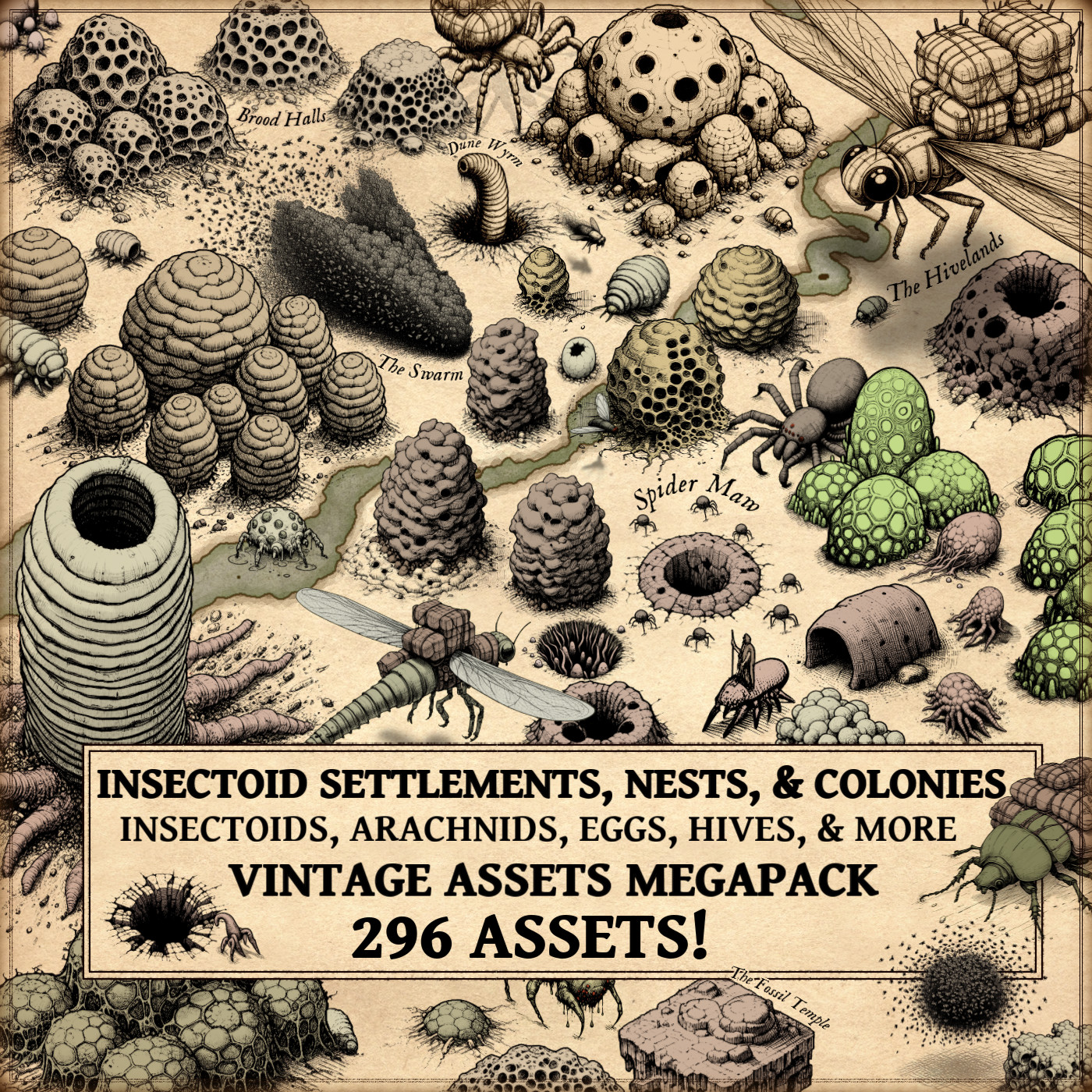
Throughout the long history of cartography, mapmakers have used symbols not only to guide travelers but to tell stories. Among the most fascinating and often overlooked visual traditions are those representing insectoid settlements, hives, lairs, and nests — motifs that appear in both antique maps and modern fantasy map making. These cartography assets, recreated in the Insectoid Settlements, Hives, Nests, & Colonies – Vintage Assets Megapack, revive a forgotten visual language that once expressed fear, fascination, and mystery toward the hidden world of insects.

BUY AND DOWNLOAD The Insectoid Settlements, Hives, Nests, & Colonies (Insectoids, arachnids, eggs, & more) – Vintage Assets Megapack here :

1. Ancient and Medieval Origins of Insectoid Imagery in Cartography

In the early eras of mapmaking — from Ptolemaic charts to the illuminated manuscripts of the Middle Ages — insects and arachnids were rarely literal depictions of fauna. Instead, they were symbolic creatures marking unknown or “forbidden” lands. Just as sea serpents guarded the uncharted oceans of the Carta Marina (1539) or the Hereford Mappa Mundi (c.1300), monstrous beetles, worms, and burrowing shapes sometimes appeared near deserts, caves, or ruins, suggesting infestation, decay, or divine punishment.

These fantasy map symbols were both warnings and metaphors. Insects, seen as agents of transformation, represented the volatile nature of unexplored territories. Burrows and pits echoed humanity’s fear of the subterranean — the unseen spaces beneath kingdoms and civilizations. Some early Islamic and Chinese cartographic manuscripts even featured hive-like structures to indicate subterranean cities or clustered dwellings, eerily similar to insectoid colonies depicted in modern fantasy maps.

2. The Cultural Meaning of Hives, Lairs, and Egg Clusters

The use of hives, nests, and egg clusters on maps was deeply tied to human perceptions of order and chaos. Beehives, for example, symbolized industriousness and divine architecture — a natural geometry that medieval monks associated with heavenly design. In contrast, spider lairs and worm burrows symbolized corruption or the demonic underworld.

In the context of fantasy map making, these same dualities persist. A hive might represent an alien civilization with perfect social structure, while a crater nest or egg sac can signify spreading corruption or plague. The “Insectoid Settlements” asset pack captures this range — from organic hive towers and cocoon chambers to sprawling burrows and larvae clusters — allowing map artists to visually express both civilization and contagion.

3. The Artistic Legacy in Fantasy Map Making

Modern creators, especially those using tools like Wonderdraft, have revived antique cartographic aesthetics through vintage-style fantasy map icons. The Insectoid Settlements, Hives, Nests, & Colonies – Vintage Assets Megapack continues this tradition by merging historical artistry with modern usability.

The pack displays an extraordinary variety of assets:

  • Insectoids and arachnids: from hulking beetles to agile spiders and mounted insectoid figures.
  • Flying insectoids: dragonflies, giant flies, and swarming species rendered in motion with aerial shadows.
  • Organic architecture: hive domes, brood pods, tunnels, pits, burrows, and hive towers recalling natural citadels.
  • Larval and parasitic lifeforms: eggs, sacs, clusters, and worm-like burrowers that evoke the life cycle of alien ecosystems.

Each of these cartography assets is designed in a vintage engraving style, echoing the textures of 17th–18th century natural history prints. The linework and muted tones emulate aged parchment — a deliberate nod to maps from explorers like Athanasius Kircher, whose Mundus Subterraneus (1665) famously combined geology, biology, and myth.

4. Insectoid Colonies and the Psychology of the Unknown

The fascination with insectoid civilizations is more than aesthetic. In ancient and modern maps alike, these forms represent the psychological projection of the alien within the familiar. The hive is not just a structure; it is a metaphor for collective intelligence, for the overwhelming and organized “other.”

In Tolkien’s Middle-earth, the “Mirkwood Spiders” and their forest lairs carry echoes of this tradition. In the Warhammer universe, Tyranid hives and brood chambers form the backbone of alien cartography. Even in the Dungeons & Dragons cosmology, underground maps of the Underdark feature nesting burrows and insectoid colonies, showing how this visual lexicon migrated from historical imagination into fantasy design.

These fantasy map symbols function as storytelling devices: the viewer instantly senses danger, fecundity, or expansion. A cluster of eggs near a swamp or crater signals life spreading uncontrollably — a cartographic shorthand for tension and threat.

5. The Decorative and Functional Purpose of Insectoid Map Icons

Historically, decoration in maps was never merely ornamental. Every embellishment had a purpose — to attract the eye, guide interpretation, and invoke emotion. The same is true for fantasy map icons in modern digital cartography.

In Wonderdraft map making, icons such as insectoid settlements, hives, or pits serve both narrative and compositional roles:

  • Narrative: indicating regions dominated by swarms, brood queens, or hive-minded species.
  • Compositional: providing textural variety, balancing visual density, and breaking the monotony of natural terrain.

By using these Wonderdraft assets, cartographers can emulate the layered symbolism of antique maps — where every mark on the parchment was a story, and every cluster of dots hinted at the unknown.

6. A Revival of Organic Cartography

The Insectoid Settlements, Hives, Nests, & Colonies – Vintage Assets Megapack is more than a design resource. It is a revival of organic cartography — a reminder that fantasy worlds, like the natural one, thrive on cycles of growth, decay, and rebirth.

The Megapack assets show the intricate diversity of forms:

  • Brood pods, organic ruins, and hive towers evoke long-lost civilizations.
  • Termite mounds and burrowing worms give a sense of subterranean life.
  • Hive queens, insectoid porters, and flying swarms illustrate hierarchy and labor, mirroring historical allegories of empire and order.

In this sense, these assets are educational tools. They teach us to read maps as living organisms — dynamic, evolving, and filled with hidden motion beneath the surface.

7. From History to Fantasy: The Timeless Allure of the Hive

From the sacred beehives carved on Egyptian temple walls to the monstrous ant cities of modern fantasy, the image of the insectoid settlement has never left our imagination. It bridges myth, biology, and architecture — a symbol of how societies, whether human or alien, organize themselves in the face of chaos.

By studying antique depictions and applying them to fantasy map making, today’s artists rediscover an ancient truth: that maps are not just guides through space, but through imagination. The Insectoid Settlements, Hives, Nests, & Colonies – Vintage Assets Megapack transforms that tradition into a visual language — one that speaks in silk, soil, and swarm.

Final Thoughts

Whether you are a historian, an artist, or a digital cartographer, these cartography assets remind us that fantasy maps inherit a deep artistic lineage. What once decorated the margins of medieval manuscripts now thrives in the digital realms of Wonderdraft — the same fascination with pattern, life, and mystery rendered anew.

Through these assets, the hive lives on — not just as a structure, but as a metaphor for all the unseen civilizations buzzing beneath the surface of the world.

Posted on

Ramparts in Fantasy Maps: From isometric castle walls to Wonderdraft assets

In both ancient cartography and fantasy map making, the depiction of ramparts, city walls, and defensive structures has always been more than mere decoration. These symbols tell stories of protection, power, and civilization itself. From the crenellated enclosures of medieval towns to the stylized fortifications of modern Wonderdraft assets and fantasy map icons, the way walls are drawn reflects both history and imagination.

The new Modular Medieval Ramparts & Castle Walls – Vintage Assets Megapack celebrates this rich tradition by bringing to life the artistic language of ancient and fantasy maps. Its hand-drawn style echoes the texture and charm of antique cartography while offering modern creators a vast library of cartography assets to build immersive worlds.

BUY AND DOWNLOAD The Modular Medieval Ramparts & Castle Walls – Vintage Assets Megapack here :


Walls as Borders and Symbols in Ancient Cartography

Long before satellite imagery and GIS data, maps were not purely geographic—they were conceptual. The Babylonian World Map (6th century BCE), etched on clay, is one of the earliest known examples: the world surrounded by a circular ocean, cities marked as fortified dots. The walls drawn around Babylon are not architectural records but symbols of order against chaos.

Similarly, in medieval mappa mundi—such as the famous Hereford Mappa Mundi (c. 1300)—Jerusalem sits encircled by massive ramparts, representing the divine center of the world. These circular walls are less about defense and more about sanctity and separation: the wall as the line between the holy and the profane.

Later, Renaissance cartographers like Sebastian Münster and Abraham Ortelius refined the visual grammar of fortification. Their maps of cities such as Venice or Nuremberg show detailed bastions and geometric ramparts—symbols of engineering pride as much as military might. Every line and crenelation was a proclamation of civilization’s control over the land.


City Walls and the Language of Fantasy Map Icons

When we shift to fantasy cartography, these traditions endure. Every fantasy map maker knows the satisfying logic of drawing a walled city—its circular perimeter promising safety from monsters, its gates marking trade and adventure. In worlds like Tolkien’s Middle-earth, Minas Tirith and Helm’s Deep are iconic examples of ramparted architecture, where geography and storytelling intertwine.

In Game of Thrones, George R.R. Martin’s King’s Landing and The Wall itself extend this visual heritage: fortifications not only divide nations but define entire mythologies. The map of Westeros—engraved with mountains, castles, and walls—owes much to the aesthetics of medieval European mapmaking.

Today, tools like Wonderdraft and other digital platforms continue this tradition. Through packs like the Modular Medieval Ramparts & Castle Walls – Vintage Assets Megapack, fantasy mapmakers can recreate these timeless symbols with authenticity and flexibility—choosing from medieval, gothic, eastern, Aztec, or Middle Eastern architectural styles to match the lore of their worlds.


The Practical and Cultural Role of Rampart Representation

Historically, the inclusion of ramparts and walls in maps served both utilitarian and symbolic functions.

  • Defensive visualization: Early military engineers—like those of Vauban’s France—used detailed rampart plans to organize sieges, fortify cities, or project imperial power. The accuracy of wall representation could determine victory or defeat.
  • Cultural identity: In ancient maps, walls were marks of prestige. A city without walls was not a city; it was wilderness. The Greek term polis implied both community and enclosure.
  • Decorative artistry: In illuminated manuscripts and portolan charts, ramparts framed the miniature world with rhythmic, ornamental lines. They gave texture and weight to the map, guiding the eye and evoking grandeur.

In modern fantasy map making, this duality remains. Ramparts not only define territory—they add visual depth and narrative significance. A ruined wall suggests history; a massive bastion hints at a bygone war. Even the placement of a gate can tell the story of trade, pilgrimage, or invasion.


A Tribute to Historical Styles: The Modular Medieval Ramparts Megapack

The Modular Medieval Ramparts & Castle Walls – Vintage Assets Megapack revives this centuries-old visual language with an artistic nod to antique map engraving. Designed for fantasy cartographers, it provides an extensive collection of modular pieces that can be combined to build believable fortified landscapes.

The pack includes:

  • Ramparts, castle walls, and ruined walls for every architectural taste—from western medieval to eastern or Aztec motifs.
  • Defensive towers, gatehouses, bastions, and watchtowers, allowing creators to illustrate strongholds of any scale.
  • Decorative elements such as gargoyles, shields, flags, stone ornaments, and palisades to enrich the storytelling texture of the map.
  • Natural and civic additions—trees, farms, ponds, churches, and medieval houses—that integrate the fortified city into its surrounding world.

The visual tone imitates the sepia and ink-washed quality of old world cartography, making these fantasy map icons ideal for both historical maps and fantastical realms. Whether you are recreating Constantinople’s Theodosian Walls, the ruins of an ancient Aztec temple city, or an entirely invented fortress kingdom, these assets provide both precision and atmosphere.


The Enduring Appeal of Fortifications in Fantasy Cartography

Why do walled cities continue to fascinate us? Perhaps because they embody the human instinct to draw boundaries—to separate safety from danger, civilization from wilderness, the known from the unknown.

In ancient times, this was a matter of survival. In mapmaking, it became a language of form. In fantasy, it has become a language of emotion. When a reader or player sees a crenellated line on a parchment map, they instantly understand: “Here lies a city of strength.”

Thus, the artistic tradition of rampart representation unites millennia of human creativity—from Babylonian clay tablets to digital fantasy maps. And in tools like Wonderdraft or other modern cartography asset packs, that heritage continues to evolve, allowing every creator to become both historian and world-builder.


Conclusion

The Modular Medieval Ramparts & Castle Walls – Vintage Assets Megapack is not merely a collection of images—it is a bridge between ancient cartographic artistry and the modern imagination. By reviving the timeless symbols of defense, order, and beauty, it empowers creators to craft maps that feel truly alive—rooted in history, yet rich in fantasy.

Whether you are designing a fortified city for a tabletop campaign, illustrating an ancient empire, or mapping a fictional continent, these fantasy map making tools give you the vocabulary of ages past, rendered with modern precision.

Walls may divide lands, but in the realm of cartography, they unite centuries of art, storytelling, and design.

Posted on

How World War 2 and 1 Cartography Assets Bring Maps to Life

Fantasy map assets, World War 2 propaganda poster, military infantry, WW1 WW2 resources, mapmaking

From ancient military sketches to modern fantasy maps, representations of military elements such as bunkers, trenches, tanks, camps, or aerial vehicles have always played a central role in crafting strategic and immersive narratives. These elements, both functional and symbolic, enrich maps by adding visual and narrative depth, whether to depict real battles or imagine fictional conflicts.

The Alternate WW1 & WW2 – Vintage Assets Megapack embraces this tradition. With over 545 assets, it brings together everything needed to create complex, realistic maps—whether to recreate historical battlefields or dive into alternate, steampunk-inspired worlds. These assets, including bunkers, tanks, fortifications, trenches, military bases, aerial vehicles, and more, draw direct inspiration from historical conventions and artistic styles of old maps.

BUY AND DOWNLOAD The Alternate World War 1 & 2 – Vintage assets Megapack here :


A Tradition Rooted in Military History

Military maps have always been more than just logistical tools; they are cultural artifacts and visual testimonies of conflict. Over centuries, these maps evolved to reflect technological advancements and the strategic needs of armies. Representations of fortifications, artillery placements, or troop positions were not only essential for military planning but also for documenting and immortalizing battles.

The maps of the First and Second World Wars marked a significant milestone in this tradition. Trench networks in the Battle of the Somme, the bunkers of the Maginot Line, or the massive cannons used during the Siege of Sevastopol were meticulously represented to guide generals and soldiers. These maps included elements such as modular trenches, bomb impacts, and tank positions, which are also featured in this asset pack.

What makes these elements so fascinating is their dual purpose. On the one hand, they provided crucial information on the disposition of forces and tactics used; on the other, they told a story. Bomb craters, rising smoke, ruined towns—all of these transformed a map into a vivid scene, a moment frozen in the chaos of war.


Immersion and Storytelling Through the Vintage WW1 & WW2 Pack

The Alternate WW1 & WW2 – Vintage Assets Megapack captures this military heritage and adapts it for the needs of modern creators. Each asset in the pack has been designed to seamlessly fit into fantasy, historical, or role-playing maps, blending historical accuracy with endless creative possibilities.

With this pack, creators can draw complex battle scenarios or post-apocalyptic landscapes, add massive defensive structures, or stage intimate skirmishes between soldiers. Here’s how these assets provide a unique sense of immersion:

Solid and Strategic Fortifications

Bunkers, trenches, and barbed wire are at the heart of any realistic war map. Inspired by the detailed plans of 20th-century wars, these assets allow you to recreate elaborate defensive lines. Whether building an impregnable stronghold or simulating a labyrinthine trench network, these elements ground your maps in credible, strategic narratives.

The Machinery of War

Tanks, armored vehicles, and giant cannons were central to modern warfare. This pack includes not only realistic representations of these machines but also massive mobile platforms and alternate-history cannons, perfect for steampunk or speculative worlds.

Aerial and Naval Dimensions

Biplanes, zeppelins, and military ships bring a new layer of depth to maps. These assets evoke both the aerial and maritime battles of the two world wars and provide opportunities for unique scenarios, such as airborne invasions or strategic bombings.

Life and Death on the Battlefield

Bomb craters, smoke, and ruined buildings add a dramatic dimension to your maps. These elements tell the stories of past battles, turning a simple map into a richly emotional scene. With these assets, you can depict a besieged city, a devastated frontline, or an abandoned battlefield.

Detailed Camps and Military Bases

Military camps, hangars, command posts, and communication towers bring strategic hubs and secured zones to life. Whether representing an advanced base or a well-established headquarters, these structures enrich your maps with detail and purpose.

Exceptional Flexibility and Modularity

With modular elements like security fences, trenches, and roads, the possibilities for customization are endless. You can create unique configurations tailored to your narrative and strategic needs.


A Blend of Realism and Creativity

This pack is not limited to historical recreations. It is equally suited for alternate-history or fantastical maps where creativity takes precedence over reality. Imagine a steampunk army defending a city against a mechanical titan, or zeppelins transporting giant cannons over war-ravaged lands. The possibilities are infinite.

The assets in the pack are equally at home in role-playing universes like Dungeons & Dragons, strategy games, or artistic projects. They serve as a solid foundation for serious scenarios and a fertile ground for experimenting with bold ideas.


Why This Pack is Essential

The Alternate WW1 & WW2 – Vintage Assets Megapack is more than just a collection of visual resources—it is a tool for storytelling, worldbuilding, and honoring a timeless tradition of military cartography. Every bunker, tank, trench, and vehicle tells a story. Every crater and ruined building carries the weight of imagined or real battles.

Whether you are a passionate historian, a fantasy map creator, or a fan of alternate worlds, this pack offers everything you need to design immersive, strategic, and visually stunning maps.

So, prepare your pens, digital tools, or dice, and dive into this rich collection to bring your most ambitious ideas to life. With the Alternate WW1 & WW2 – Vintage Assets Megapack, war—whether historical or fictional—comes alive in a new and fascinating way.

Posted on

How the Horror Fleshscape Redefines Fantasy Map Assets

Fleshscape map assets, cartography assets, RPG, Wonderdraft map assets, symbols

The art of map-making has always been more than a mere tool for navigation. From the fantastical beasts of medieval cartography to the allegorical representations of land and sea, maps have long reflected the cultural psyche of their times. With the advent of the Horror Fleshscape Complete Megapack, this tradition is transformed into something uniquely visceral—a nightmarish blend of terrain and body horror that reshapes how we imagine fantasy worlds. In this article, we explore the historical, cultural, and artistic roots of such a concept, tracing its lineage through antique maps, the aesthetics of body horror, and its place in the evolving world of fantasy cartography.

BUY AND DOWNLOAD The Horror Fleshscape Complete Megapack – Vintage Assets Pack here :


Antique Cartography: Maps as Cultural Artifacts

Antique maps, particularly those from the medieval and Renaissance periods, were as much works of art as they were practical tools. They were often decorated with fantastical creatures, allegorical figures, and ornate designs that revealed the worldview of their creators. Maps like the Hereford Mappa Mundi (circa 1300) and the Ebstorf Map (13th century) illustrate how medieval cartographers interpreted the world through a lens of religion, mythology, and fear of the unknown.

For example, the Hereford Mappa Mundi situates Jerusalem at its center and populates the margins with monstrous races—headless men, dog-headed creatures, and dragons—symbolizing the dangers and mysteries of uncharted territories. Similarly, the Ebstorf Map famously overlays the known world with the body of Christ, illustrating a theological interpretation of geography. Such maps were not about accuracy; they were about expressing ideas, beliefs, and anxieties.

These traditions align with the Horror Fleshscape Complete Megapack, which similarly prioritizes atmosphere and narrative over strict realism. The assets within the pack—flesh mountains, bone caves, tumor-infested cities—draw from this historical tradition, transforming maps into storytelling devices that evoke dread and fascination.


The Role of Grotesque Symbolism in Antique and Fantasy Maps

The grotesque has always held a special place in visual art. In cartography, grotesque symbols often marked areas of danger or the unknown, serving both a decorative and didactic function. For example, Renaissance-era maps often featured “Here Be Dragons” notations alongside illustrations of sea monsters. These grotesque elements were symbolic warnings of perilous waters, the boundaries of the known world, and humanity’s fear of the void.

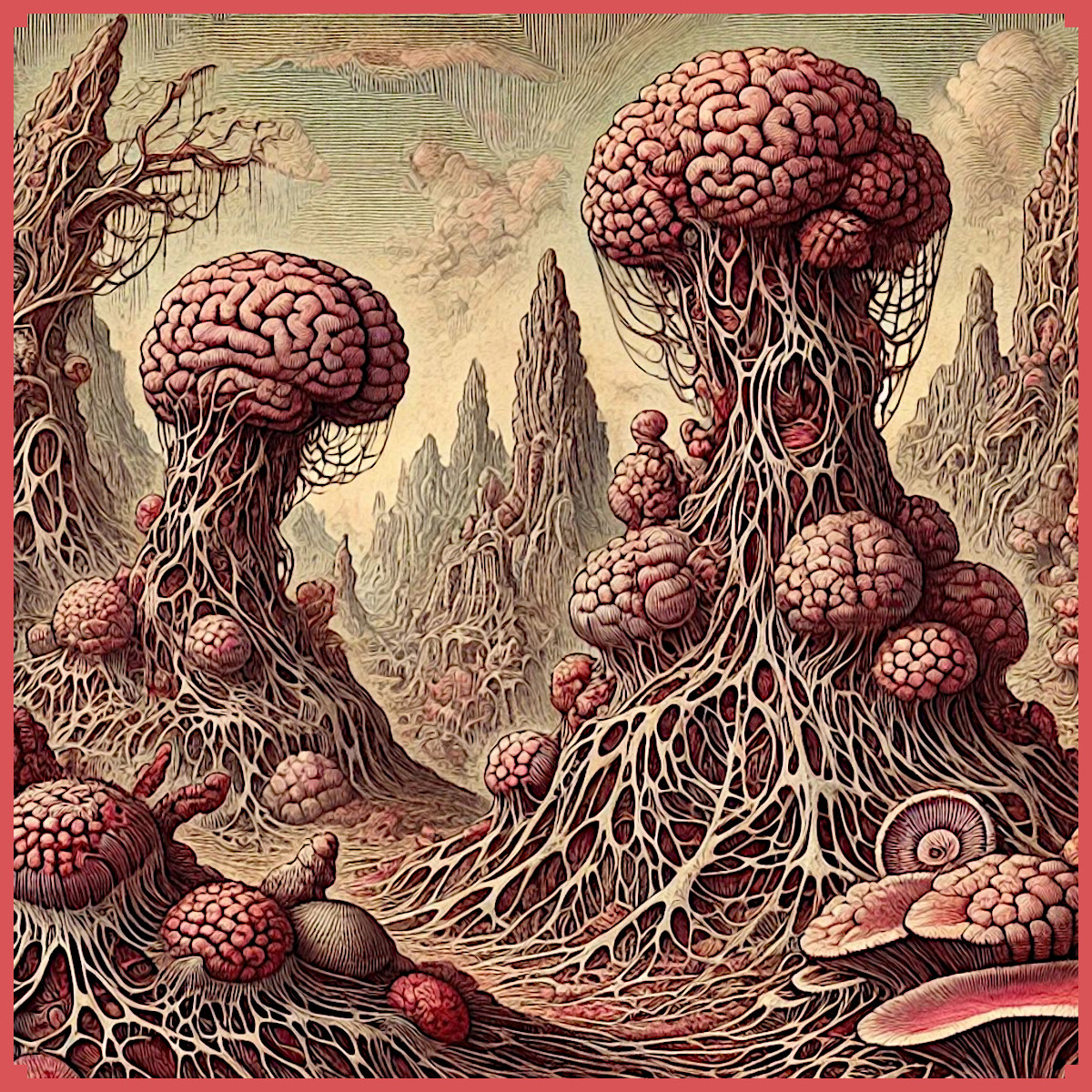
The Horror Fleshscape Complete Megapack reimagines these grotesque traditions in a deeply unsettling way. Instead of sea monsters and mythical beasts, it populates the map with organic horrors like veiny caves, brain mounds, and flesh plains. These elements create an otherworldly geography that feels alive, pulsating with an eerie vitality. Just as antique maps reflected the fears and superstitions of their time, the Fleshscape reflects a modern fascination with decay, mutation, and the uncanny.


Body Horror: From Ancient Myths to Modern Fantasies

To understand the appeal and impact of the Fleshscape, we must delve into the genre of body horror, a form of storytelling that explores the grotesque transformation of the human body. This genre is rooted in ancient myths but has been profoundly shaped by modern artists, filmmakers, and writers.

Mythological Roots

The earliest examples of body horror can be found in myths and folklore. From the Gorgon Medusa’s petrifying gaze to the monstrous transformations of werewolves, ancient stories often used physical distortion to symbolize moral or spiritual corruption. These tales were both cautionary and cathartic, allowing audiences to confront their fears of disease, death, and the unknown.

Modern Evolution

The modern era has seen the rise of body horror as a distinct genre, pioneered by artists like David Cronenberg and Junji Ito. Cronenberg’s films (The Fly, Videodrome) explore the intersection of technology, flesh, and identity, often depicting bodies that mutate beyond recognition. Junji Ito’s works (Uzumaki, The Enigma of Amigara Fault) take a more psychological approach, using surreal and grotesque imagery to evoke existential dread.

The Horror Fleshscape Complete Megapack draws heavily from these influences. Its landscapes are a macabre symphony of flesh and bone, evoking the visceral unease of Cronenberg’s transformations and the haunting surrealism of Ito’s worlds. Features like flesh cultist temples and tentacle-ridden towns could easily belong to one of their creations, reinforcing the pack’s ties to the body horror tradition.


Fleshscapes in Fantasy Maps: Aesthetic and Narrative Potential

The Fleshscape is not just a visual innovation; it’s a narrative tool that opens up new possibilities for storytelling in tabletop role-playing games (TTRPGs), fantasy novels, and video games. Its grotesque features can serve as metaphors for decay, corruption, and the fragility of the human condition.

A World That Feels Alive

In traditional fantasy maps, landmarks like mountains, rivers, and forests are static. The Fleshscape, by contrast, suggests a world that is alive and constantly transforming. Features like ground maws and colossal worms imply a geography that can shift and consume, challenging players to adapt to an ever-changing landscape.

Themes of Corruption and Transformation

Fleshscapes are particularly suited to dark fantasy and horror settings, where themes of corruption and transformation are central. A tumor-infested city, for instance, could symbolize the moral decay of its inhabitants, while a flesh knight or flesh mage might represent the dangers of tampering with forbidden powers.

Immersive Storytelling

By incorporating elements like eyeballs in flesh nests and giant rib bones, game masters can create immersive worlds that feel alien yet oddly familiar. These grotesque features provoke visceral reactions in players, heightening the emotional impact of the story.


Cultural Reflections: Why We Are Drawn to the Grotesque

The popularity of body horror and grotesque aesthetics reflects a broader cultural fascination with the fragility and malleability of the human form. In an era defined by rapid technological and medical advancements, the boundaries between human and non-human, organic and synthetic, are increasingly blurred. The Fleshscape taps into these anxieties, offering a grim exploration of what it means to be alive in a world of constant change.


Inspiration and Legacy: From Blame! to Fleshscape RPG

The Fleshscape owes much of its inspiration to groundbreaking works in speculative fiction and tabletop gaming. Tsutomu Nihei’s Blame!, with its sprawling biomechanical landscapes, offers a vision of a world that is both awe-inspiring and deeply unsettling. Similarly, the Fleshscape RPG explores themes of survival in an organic, ever-changing world, providing a perfect thematic parallel to the map assets in the pack.


Conclusion: A New Frontier in Fantasy Cartography

The Horror Fleshscape Complete Megapack is more than a collection of assets; it’s a gateway to new realms of storytelling and artistic expression. By merging the traditions of antique maps with the visceral aesthetics of body horror, it creates maps that are as thought-provoking as they are unsettling. Whether you’re a game master designing a dark fantasy campaign or an artist seeking to push the boundaries of cartographic art, the Fleshscape offers a wealth of possibilities.

Ultimately, the Fleshscape is a testament to the enduring power of maps to capture not just the physical world, but the fears, dreams, and obsessions of those who create them. It reminds us that, just as the Hereford Mappa Mundi once charted a medieval worldview, modern maps can chart the landscapes of our darkest imaginations.

Posted on

The Art of Aging: Fantasy Map Resources Featuring Stains & Distress Marks

Fantasy map effects, fantasy map assets, aging effects, distressed, distress effects, ink stains, blood stains, Wonderdraft

Maps have long held a dual role as tools of navigation and works of art. Whether found on the tanned hide of a medieval cartographer or a modern fantasy enthusiast’s parchment scroll, the marks of time and use—stains, smudges, tears, and more—evoke stories that stretch beyond the maps themselves. The Stains & Distress Marks – Aging Effects Kit – Assets Megapack masterfully captures this tradition, offering creators the tools to bring the soul of antique maps to their fantasy worlds.

This article delves into the history, utility, and aesthetic value of these aging effects, exploring their roots in antique cartography, their narrative power in fantasy map-making, and the cultural allure of these symbols of time.

BUY AND DOWNLOAD The Stains & Distress Marks – Aging Effects Kit – Assets Megapack here :


Antique Maps: A Legacy of Imperfection

Antique maps are as much historical artifacts as they are navigation tools. Consider the 1507 Waldseemüller Map, often hailed as the first map to name America. Its edges are worn, the ink is faded, and creases cut through its cartographic artistry. Such imperfections are not merely the result of age—they tell the story of its use and transport.

The Hereford Mappa Mundi, a 13th-century masterpiece, is another fine example. Though exquisitely detailed, the vellum is stained, its edges frayed. These blemishes reflect centuries of handling, environmental exposure, and reverence, encapsulating the journey of both the map and the world it sought to represent.


Marks of Time: Aesthetic and Functional Roles

Distress marks on antique maps served both practical and aesthetic functions:

  1. Utility and Preservation:
    • Wear Marks: Frequent handling would lead to natural wear, particularly at folds and edges, which can also reveal the map’s popularity and importance.
    • Tears and Creases: Indicate where the map was frequently folded or stored, providing insight into its use—whether tucked into a sailor’s chest or pinned to a scholar’s study wall.
    • Water Stains and Smudges: Often born from accidents, these marks are telltale signs of voyages, fieldwork, or hurried consultations.
  2. Symbolism and Cultural Value:
    • Burn Marks: On pirate treasure maps (real or fictional), singe marks suggest a dramatic backstory, possibly a rescue from destruction or a hidden existence near flames.
    • Aging Effects: Cracks, faded spots, and erasure marks mirror the human fascination with antiquity, signaling authenticity and connecting users to a sense of history.

Fantasy Maps: Bridging the Real and Imagined

Fantasy maps owe much of their visual language to antique cartography. J.R.R. Tolkien’s maps of Middle-earth and the detailed world-building of George R.R. Martin’s Westeros exemplify this. But why are distress marks so prevalent in these imaginary landscapes?

  1. Narrative Immersion:
    • Coffee Rings and Ink Stains: Suggest that the map was a working document, handled by explorers or adventurers within the fictional world.
    • Tears and Burn Marks: Imply perilous journeys, battles, or even deliberate attempts to conceal information.
    • Smudges and Smears: Evoke a sense of immediacy, as though the map was hastily sketched or altered in the heat of the moment.
  2. Aesthetic Appeal:
    • Distress marks lend an air of authenticity to fantasy maps, connecting audiences to the world as though the map had existed for generations.
    • The artistry of such marks—when done well—becomes a decorative feature that enhances the map’s overall beauty and allure.

Cultural Resonance: The Timeless Appeal of Distress

The cultural allure of aged maps goes beyond utility and storytelling. These imperfections carry emotional weight. They remind us of the passage of time, the fragility of human endeavors, and the enduring power of knowledge.

  • Maps as Heirlooms: Antique maps are often passed down through generations, with their blemishes serving as cherished reminders of familial or national history.
  • Artifacts of Exploration: For collectors, each stain or tear on an antique map represents a story—a ship’s journey, a scholar’s study, or the rough conditions of an expedition.

The Stains & Distress Marks – Aging Effects Kit: A Creative Toolkit

The Stains & Distress Marks – Aging Effects Kit – Assets Megapack captures the essence of these marks with an impressive variety of assets. Here’s how they enhance fantasy maps:

  1. Authenticity:
    • Ink Blots and Circular Marks: Perfect for recreating the look of hurried note-taking or accidental spills.
    • Water Stains and Smudges: Ideal for maps meant to look as though they’ve endured rain-soaked travels or misty libraries.
    • Cracks and Fissures: Add depth and texture, imitating the wear of centuries.
  2. Narrative Depth:
    • Burn Marks and Tears: Suggest danger and intrigue, enriching the story a map tells.
    • Faded Spots: Imply forgotten or hidden knowledge, drawing the viewer deeper into the fantasy.
  3. Aesthetic Beauty:
    • Dirt and Speckled Marks: Provide a touch of realism while enhancing the visual complexity of a map.
    • Drip Stains and Abrasions: Offer subtle decoration, turning a plain parchment into a piece of art.

Conclusion: A Marriage of History and Imagination

The Stains & Distress Marks – Aging Effects Kit – Assets Megapack is more than just a set of tools—it is a bridge between the historical and the fantastical, inviting creators to imbue their maps with the richness of age, wear, and use. From antique atlases to fantasy scrolls, distress marks breathe life into cartography, turning maps into storytellers.

By understanding the legacy and significance of these marks, mapmakers can craft creations that resonate not only with the eye but also with the imagination and the heart. Whether you’re charting the seas of reality or the realms of fantasy, these aging effects connect your work to a timeless tradition of exploration and artistry.

Posted on

The Role of Belle Époque Cities and Structures in Fantasy Map Assets

Fantasy map assets, belle epoque cities and towns, Wonderdraft assets, cartographic symbols, fantasy map resources

Introduction to Fantasy Mapmaking and the Belle Époque Era

The allure of fantasy and antique maps lies in their ability to tell rich and immersive stories. The Belle Époque Cities, City Buildings & Structures – Vintage Assets Megapack draws inspiration from an era celebrated for its architectural splendor and cultural advancement. This pack introduces sprawling cities, iconic buildings, intricate structures, and atmospheric details that echo the grandeur of 19th and early 20th century Europe. To understand the significance of these assets, we must explore their historical, cultural, and artistic roles in mapmaking and how they elevate both utility and aesthetics. The Belle Époque (“Beautiful Era”) marked a period of peace, prosperity, and creativity in Europe between 1870 and 1914. Cities grew into cultural epicenters adorned with architectural masterpieces, including neo-gothic cathedrals, Haussmannian buildings, grand glass domes, and ornate clock towers. These structures now find a second life on fantasy maps, where they serve both as narrative focal points and decorative landmarks.

BUY AND DOWNLOAD The Belle Epoque Cities, City buildings, & Structures – Vintage assets Megapack here :

Sprawling Cities and Colossal Cathedrals

During the Belle Époque, cities like Paris, Vienna, and London experienced rapid urban growth. These cities became canvases of innovation, with colossal cathedrals and basilicas rising as cultural and religious symbols. Examples include the Sacré-Cœur Basilica in Paris and the Neo-Gothic St. Vitus Cathedral in Prague, which blended medieval inspiration with modern construction techniques. In antique and fantasy maps, sprawling cities are often rendered as compact urban landscapes with a central cathedral towering above surrounding structures. This layout mirrors the real-world medieval city design, where churches served as the heart of towns. Real-world examples, such as the medieval maps of Nuremberg with the Frauenkirche at its center, showcase this influence. Similarly, Tolkien’s depiction of Minas Tirith in The Lord of the Rings mirrors this centralization with its iconic tiered city crowned by a grand structure.

In fantasy settings, sprawling cities often symbolize power and prosperity. They serve as capitals, hubs of trade, or centers of cultural significance. The inclusion of cathedrals or colossal buildings gives these cities a clear visual hierarchy and a point of narrative interest, whether as seats of religious or magical power, royal authority, or key plot locations. Such visual anchors elevate the storytelling aspect of maps while making the environment more immersive and realistic.

Belle Époque City Buildings and Haussmannian Architecture

The late 19th century saw cities transform through urban renovation, most notably in Paris under Baron Haussmann. His renovation projects introduced uniform city blocks, wide boulevards, and symmetrical facades that defined the Belle Époque aesthetic. These Haussmannian buildings brought elegance and order to the cityscape, creating an urban harmony that shaped both real-world cartography and its fantasy counterparts. Antique maps, such as the Turgot Map of Paris (1739), already displayed a preference for structured layouts, but the Belle Époque brought further refinement to city designs, influencing how maps today depict organized and elegant urban zones.

In fantasy cartography, such orderly city blocks provide a sense of grandeur and prosperity. They divide sprawling cities into manageable and visually distinct districts—wealthy quarters, merchant areas, or residential neighborhoods—offering layers of storytelling and realism. The assets for Haussmannian buildings reflect this detail, giving creators tools to showcase sophisticated urban centers while maintaining visual cohesion on their maps.

Neo-Gothic, Neo-Renaissance, and Baroque Structures

The Belle Époque celebrated architectural revivalism, drawing on Gothic, Renaissance, and Baroque styles. Cathedrals and basilicas of this era featured intricate designs with spiked towers, pointed arches, domes, and ornate decorations. Real-world landmarks like Notre-Dame de Paris or London’s St. Paul’s Cathedral exemplify these styles. This architectural language, rich with detail and historical resonance, translates seamlessly into fantasy mapmaking.

On maps, these structures symbolize both beauty and power. Neo-Gothic cathedrals can serve as seats of divine influence or arcane energy, adding layers of cultural significance. Neo-Renaissance basilicas, with their symmetrical grandeur, represent centers of authority or knowledge, such as royal courts or academic institutions. Whether as centers of worship, magical academies, or imperial palaces, these structures add depth to a fantasy world’s lore while serving as essential visual focal points.

Fictional works frequently draw on these influences. The Cathedral of Light in World of Warcraft evokes Neo-Gothic grandeur, symbolizing divine power and protection. In the same vein, the assets for cathedrals and towers in the Belle Époque Megapack allow creators to recreate such monumental structures with ease, providing tools to evoke cultural history and architectural beauty.

Clock Towers, Statues, and Obelisks

The Belle Époque saw cities punctuated by iconic structures such as clock towers, statues, and obelisks. These elements reflected advancements in engineering and served as symbols of progress, remembrance, or mystery. Landmarks like London’s Big Ben or the ancient Egyptian obelisks relocated to European capitals, such as the Luxor Obelisk in Paris, demonstrate how these icons became integrated into the cityscape. In maps, clock towers and statues serve both practical and narrative functions. Clock towers signify centers of authority or progress, while statues and obelisks can mark sacred sites, historic events, or hidden lore within a fantasy world.

Fantasy maps use these structures to create points of navigation and storytelling. For example, an obelisk may hint at forgotten magic or ancient civilizations, while a statue might commemorate a legendary hero whose deeds are central to the narrative. The assets provided in the Megapack allow creators to incorporate these timeless icons into their maps, enhancing both realism and depth.

Glass Domes, Greenhouses, and Café Terraces

The Belle Époque was a time of industrial progress and artistic expression, and nowhere was this more apparent than in the rise of glass and iron architecture. Structures like the Crystal Palace in London and the Grand Palais in Paris became symbols of modernity, innovation, and cultural enlightenment. Glass domes and greenhouses, often associated with botanical gardens and exhibition spaces, reflected the era’s fascination with science and exploration.

In fantasy maps, these structures can serve as magical academies, botanical sanctuaries, or places of innovation. Their elegance adds layers of sophistication to cityscapes, marking them as centers of knowledge and culture. Similarly, café terraces, emblematic of Belle Époque leisure, bring a human element to urban spaces, showcasing the social vibrancy of a city and its people.

Technology and Atmosphere: Vintage Cars, Biplanes, Balloons, and Fog

The technological advancements of the Belle Époque introduced automobiles, biplanes, and hot air balloons, which reflected humanity’s growing ambition and mastery over movement and travel. Vintage cars can evoke bustling streets and urban energy, while biplanes and balloons symbolize exploration and innovation. In maps, these assets add dynamism, marking trade routes, skyports, or hubs of adventure.

Meanwhile, atmospheric elements such as fog and smog provide mood and mystery. Industrial cities of the Belle Époque often featured thick smog, a detail that can enhance dark, mystical, or hidden regions on a map. Fog-shrouded ruins, smog-filled streets, or misty valleys add depth and layers of intrigue to any fantasy setting.

Conclusion: The Belle Époque in Fantasy Mapmaking

The Belle Époque Cities, City Buildings & Structures Megapack captures the architectural beauty, innovation, and cultural richness of this historical era, transforming it into a versatile toolkit for mapmakers. From sprawling cities and Haussmannian buildings to grand cathedrals, glass domes, and atmospheric details, these assets offer the tools needed to create immersive and visually stunning maps. Whether serving as narrative anchors, cultural symbols, or decorative landmarks, these elements breathe life into fictional worlds, honoring the grandeur of a bygone era while inspiring new stories in fantasy and beyond.

Posted on

The Magic of Fantasy Map Symbols: Flowers and Fairy Tales in Cartography

giant flowers, fantasy map symbols, Wonderdraft assets, fairy tale map assets, vintage cartography assets

Maps are powerful tools for storytelling, blending utility with artistic expression. The Fantasy Flowers, Flower Towns, & Fairy Tale Inhabitants – Vintage Assets Megapack offers a unique set of symbols to enrich fantasy maps, drawing from the artistic traditions of antique cartography and the cultural significance of flowers, mythical beings, and nature-inspired architecture. This article explores each asset in detail, examining its historical roots, aesthetic appeal, and storytelling potential, including the fascinating concept of fortified cities with giant flowers.

BUY AND DOWNLOAD The Fantasy Flowers, Flower Towns, & Fairy Tale Inhabitants – Vintage Assets Megapack here :


Floral Beauty and Symbolism in Fantasy Maps

Flowers have always been imbued with rich cultural and symbolic meanings. On maps, they serve both decorative and functional purposes. In medieval and Renaissance maps, flowers were often used to depict paradisiacal lands or regions of abundance. For example, the Ebstorf Map includes lush floral imagery to represent Eden, while 17th-century European maps often decorated fertile regions with floral motifs.

Flowers and Clumps: Breathing Life Into Landscapes

In the context of fantasy maps, individual flowers and flower clumps are versatile tools. They can signify enchanted fields, magical gardens, or even sacred groves. Beyond their narrative function, they serve as decorative elements that break up large, empty spaces on maps, giving landscapes a natural, organic feel.

These floral symbols also evoke mystery and magic. A lone flower on a map might mark the site of a magical relic, while a dense cluster could signify a place teeming with natural energy or hidden life. Historically, flowers like the lotus (a symbol of purity and enlightenment) and roses (associated with divine love or secret knowledge) have carried deep meaning, making them ideal markers for fantastical settings.


Fortified Cities with Giant Flowers: Guardians of Magic and Power

One of the most striking assets in this pack is the concept of fortified cities with one or more giant flowers at their core. These unique settlements combine the grandeur of monumental floral architecture with the practicality of defensive structures, creating an evocative mix of beauty, power, and mysticism.

Symbolism of the Giant Flower

The giant flower at the heart of a city represents growth, life, and magical energy. Historically, large floral imagery has been used to signify divine favor or prosperity. For example:

  • In Mesoamerican temples, floral motifs adorned altars to honor gods of fertility and creation.
  • The Hanging Gardens of Babylon, one of the Seven Wonders of the Ancient World, were an iconic blend of floral beauty and architectural ingenuity.

In a fantasy setting, a giant flower could serve multiple narrative purposes:

  • A magical source: Perhaps the flower is the heart of the city, providing life and energy to its inhabitants.
  • A divine symbol: The flower might represent a deity or spiritual force, making the city a center of pilgrimage.
  • A protective force: The flower could emit magical barriers or deter enemies, aligning its beauty with a practical defensive role.

The Aesthetic of Fortification

Fortified cities have long been staples of cartography, their high walls and strategic layouts symbolizing strength and security. Adding a giant flower to such a city creates a fascinating visual and thematic juxtaposition. The hard, angular lines of the fortifications contrast with the soft, organic curves of the flower, emphasizing the harmony between nature and civilization.

Decoratively, this combination also speaks to the map’s viewer, suggesting a place of unique importance. It draws the eye, much like monumental buildings or castles in historical maps, such as the elaborate depictions of walled cities in the Hereford Mappa Mundi.

Cultural and Narrative Depth

Including such a city on a map opens countless storytelling possibilities:

  • The Flower as a Beacon: The city could be a sanctuary, attracting travelers and pilgrims seeking its magical protection.
  • A City of Guardians: The fortifications might exist to defend the flower from those who would exploit its power.
  • A Mystery to Uncover: What ancient civilization planted the flower, and what secrets does it hold?

Villages and Towns in Bloom

Smaller settlements built around flowers or floral themes exude peace and harmony. Flower villages, with their charming, nature-inspired architecture, suggest communities deeply connected to the land. These could be elven hamlets or fairy enclaves, where residents live in symbiosis with their environment.

Flower towns, on the other hand, are larger, more bustling hubs. Their floral architecture symbolizes prosperity and creativity. Historically, towns often celebrated their natural surroundings through festivals and floral decorations, such as the Battle of Flowers parades in Europe. These influences can inspire fantasy towns where flowers are integral to daily life, industry, or magic.


Flowered Dungeons and Giant Altars

While flowers are often symbols of beauty, they can also evoke mystery and danger. Flowered dungeons are overgrown ruins, their floral decorations hinting at ancient rituals or forgotten powers. These locations could be:

  • Temples reclaimed by nature, much like Angkor Wat, where tree roots and flowers intertwine with stone walls.
  • Dangerous traps, where the beauty of the flowers hides their deadly nature, such as poisonous spores or enchanted guardians.

Giant flower altars serve as focal points for sacred or magical ceremonies. These structures, often surrounded by smaller flowers, could represent places where the natural and supernatural meet. Such altars might be sites of ancient worship or central points in a grand quest.


The Inhabitants of a Fairy Tale World

The inclusion of fairies, elves, and goblins in the megapack allows map creators to populate their worlds with rich characters. Each brings its own cultural and narrative significance:

  • Fairies: Symbolic of magic and mischief, they are natural guardians of floral landscapes.
  • Elves: Masters of craftsmanship and wisdom, their connection to floral towns and fortified cities suggests civilizations built on beauty and magic.
  • Goblins: Inhabitants of rougher, more chaotic regions, their presence contrasts with the elegance of other creatures.

These characters breathe life into the map, giving each settlement or forest a sense of purpose and personality.


Fairy Tale Ships and Tree Towns

The fairy tale ships included in the pack bring an element of whimsy and adventure to waterways. These vessels, with sails shaped like leaves or petals, suggest magical trade routes or voyages of discovery.

Tree towns, meanwhile, add verticality and uniqueness to the map. Built high in the branches of colossal trees, these settlements evoke images of secrecy and safety. Such designs, inspired by real-world examples like the treehouses of Papua or the Ficus villages of India, emphasize the resourcefulness and harmony of their inhabitants.


The Art of Antique-Style Fantasy Maps

The vintage aesthetic of this pack pays homage to the artistry of antique cartography. Maps from the 16th to 18th centuries often featured decorative embellishments—floral patterns, mythical creatures, and ornate cities—that made them as much works of art as navigational tools. This pack replicates that style, with detailed linework and shading that bring a sense of timelessness to fantasy maps.

The inclusion of flowers, fortified cities, and mythical characters creates a layered storytelling experience. These elements do more than decorate; they invite the viewer to imagine the history, culture, and magic behind each symbol.


Conclusion

The Fantasy Flowers, Flower Towns, & Fairy Tale Inhabitants – Vintage Assets Megapack is a celebration of the intersection between art, history, and fantasy. From fortified cities with towering flowers to enchanted fairy tale ships, each asset tells a story and enriches the map it adorns. These symbols bridge the gap between utility and beauty, offering mapmakers the tools to create immersive worlds that feel alive and brimming with magic.

Whether you’re crafting a tabletop RPG campaign, designing a fantasy novel’s world, or simply creating a beautiful map for fun, this pack ensures every location stands out as a unique and vibrant part of your world. Let the flowers bloom, the fairies play, and the fortresses rise—a whole fantasy world awaits creation.

Posted on

The Elder Scrolls Cartography Assets: Illustrating Cities, Temples, and Towers

The Elder Scrolls, Wonderdraft assets, fantasy cartography resources, settlements, towns, ruins, towers, altmer, orsimer, khajiit

Fantasy worlds, especially those as rich as The Elder Scrolls, inspire awe and immersion, largely due to their intricate maps and unique cultural landmarks. Beyond navigation, these maps serve historical, cultural, and aesthetic purposes that deepen players’ connection to the lore and landscapes of Tamriel. The Elder Scrolls-inspired Settlements, Towns, Ruins, & Structures – Vintage Assets Megapack offers an exquisite collection of icons that add an exotic touch and profound depth to any fantasy map, bringing the diversity and complexity of Tamriel’s cultures and architectures to life. From Altmer towers to Orsimer strongholds, these assets provide worldbuilders and cartographers with a set of tools to create maps that feel both historically grounded and visually captivating.

BUY AND DOWNLOAD The Elder Scrolls inspired Settlements, Towns, Ruins, & Structures – Vintage assets Megapack here :

1. Altmer Cities and Towers: Elegance and Legacy

The Altmer, or High Elves, of Summerset Isle are renowned for their sophisticated architectural style, with cities and towers that embody their wisdom, artistry, and pursuit of perfection. Iconic structures like the Crystal Towers and Adamantine Towers represent the Altmer’s reverence for elegance and magical mastery. In this vintage asset pack, Altmer cities are portrayed with intricate spires and graceful designs, mimicking the towering beauty of their real-world counterparts. These soaring structures emphasize the Altmer’s aspirations and their deep connection to celestial forces. Maps featuring Altmer cities are more than simple navigation tools; they serve as visual reminders of the Altmer’s lasting influence and refined aesthetics. These towers don’t just mark locations—they symbolize enlightenment and grandeur, reaching toward Aetherius as if striving for divine perfection.

2. Bosmer Tree Villages: Harmony with Nature

In Valenwood, the Bosmer (Wood Elves) build their homes within the Graht-Oak Trees, enormous living structures that can house entire communities. Unlike traditional wooden buildings, Bosmer settlements are fully integrated into these massive trees, reflecting their Green Pact with Y’ffre, which forbids them from harming plant life unnecessarily. The assets representing Bosmer tree towns capture the organic, interconnected nature of these homes nestled among roots and branches, illustrating the Bosmer’s profound harmony with their environment. Maps that display Bosmer villages highlight the balance between nature and community, marking areas of spiritual and cultural significance where the Bosmer live in unity with the forest. These tree towns serve not only as symbols of shelter but as visual representations of the Bosmer’s naturalist lifestyle, emphasizing their inseparable bond with the lush landscape of Valenwood.

3. Argonian Temples and Pyramids: Mysterious and Resilient

Argonian architecture, often inspired by Aztec or Mesoamerican styles, radiates mystery and resilience. The stone villages and pyramid-like temples depicted in the assets convey a sense of durability and deep connection to the ancient roots of Black Marsh. These Argonian pyramids symbolize the enigmatic spiritual practices of their culture and their strong ties to the Hist, the ancient trees that hold ancestral wisdom. When these structures appear on maps, they not only mark Argonian territories but also represent the enduring spirit of a people who have thrived in Tamriel’s most challenging landscapes. Their structures reflect a steadfast strength, blending with the rugged environment to stand as proud testaments to Argonian survival and independence.

4. Dunmer Settlements and Curved Architecture of Morrowind

The Dunmer (Dark Elves) of Morrowind are known for their unique, curved architectural style that sets them apart from other cultures in Tamriel. Unlike the rigid and angular structures seen elsewhere, Dunmer architecture flows in organic, circular shapes, as seen in their temples, spiraling walkways, and rounded domes. This curved design is deeply rooted in the mystical and volcanic landscape of Morrowind, reflecting the Dunmer’s adaptability to their harsh environment. The assets in this pack capture the elegant and fluid lines of Dunmer structures, with sweeping spirals and softly rounded edges that give their buildings a harmonious, almost ritualistic feel. The Red Mountain, a central landmark often illustrated with fiery eruptions on maps, serves as a potent symbol of the challenges the Dunmer face. Maps featuring these curved structures not only highlight the geography of Morrowind but also express the deeply spiritual and resilient nature of the Dunmer people, whose culture is shaped by both fire and faith.

5. Dwemer Ruins: A Legacy of Lost Knowledge

One of Tamriel’s most mysterious landscapes is dotted with Dwemer ruins, remnants of an ancient, vanished civilization known for its advanced technology and intricate metalwork. These ruins, scattered across Skyrim, Morrowind, and beyond, are depicted as complex, industrial structures that stand in stark contrast to the natural world around them. On maps, Dwemer ruins serve as reminders of a forgotten era, evoking intrigue and speculation about the knowledge and achievements of this enigmatic race. The assets representing Dwemer ruins capture this distinctive design with intricate gears, metallic frameworks, and towering edifices that stand as silent monuments to lost wisdom. Cartographers place these ruins as cultural landmarks, transforming them into prime locations for adventurers and scholars alike to seek the secrets hidden within.

6. Khajiiti Cities and Temples: A Fusion of Cultures

The Khajiit of Elsweyr, with their oriental and Middle Eastern-inspired architecture, bring a unique and exotic flair to Tamriel’s map. Their cities and temples are characterized by domed roofs, pointed arches, and intricate carvings, reflecting their desert homeland and cultural diversity. These structures are symbols of the Khajiit’s adaptability and rich history of trade with other Tamrielic cultures. When represented on maps, Khajiiti cities are visualized as vibrant and exotic hubs, often surrounded by sand dunes or lush greenery. Their architecture provides protection against the harsh desert climate while embodying their spirituality and lively culture. Maps featuring Khajiiti towns and temples immerse players in the multicultural allure of Elsweyr, where the desert’s mysteries blend seamlessly with the ingenuity and artistry of the Khajiit.

7. Orsimer Fortresses and Strongholds: Resilience and Strength

The Orsimer, or Orcs, of Orsinium are famed for their imposing fortresses and rugged structures, which embody their values of resilience and might. Built atop mountains or within heavily fortified compounds, these Orsimer strongholds often feature both solid stone walls and, at times, reinforced wooden walls, designed to withstand both natural elements and hostile forces. The assets in this pack showcase Orsimer architecture with robust wooden or stone defenses, pointed stakes, and spiked towers that capture the Orcs’ warrior spirit and enduring fortitude. When depicted on maps, these strongholds signify the unyielding will of the Orsimer people and their determination to carve out a place in Tamriel despite centuries of struggle. These fortresses are more than strategic outposts; they are powerful cultural symbols, marking Orsimer territory with an unmistakable presence that underscores their fierce independence and pride.

8. Mountain Fortresses and Citadels: Commanding the Peaks

Across Tamriel, mountainous regions host fortresses and citadels that stand high above the surrounding landscapes. These strongholds, including those of the Orsimer, are strategically placed for defense, fortified with stone walls. The assets in the vintage pack illustrate these mountain strongholds with layered settlements and towering structures that embody the strength of a civilization that has endured countless invasions. Mountain fortresses on maps serve as symbols of authority, marking the dominance and resilience of those who inhabit them, from the Orsimer of Orsinium to the isolated tribes who have carved out lives in these lofty realms.

9. The Iconic Towers of Tamriel: White-Gold, Crystal, and Adamantine

No map of Tamriel is complete without the inclusion of its legendary towers: the White-Gold Tower in Cyrodiil, the Crystal Tower in Summerset, and the Adamantine Tower in High Rock. These towers are ancient, mystical landmarks woven deeply into Tamriel’s history, representing the pinnacles of magical and architectural achievement. Each tower holds profound historical and mythological significance, serving as centers of power, governance, and arcane knowledge. The White-Gold Tower, for instance, is both a literal and symbolic heart of the Empire, while the Crystal Tower shines as a beacon of Altmer magic. Maps featuring these towers are not just geographical markers—they are icons of Tamriel’s legacy, standing as emblems of realms of power, mystery, and majesty known across Nirn.

10. The Decorative and Utilitarian Aspects of Antique Map Design

Beyond their lore and geographic details, the vintage design of these map assets serves dual roles: practical navigation and decoration. Antique maps often feature intricate frames and borders, as seen in this asset pack, which not only embellish the map but also provide visual boundaries that draw the viewer’s focus to the contents within. Each icon and structure is crafted with an eye toward historical styles, creating a sense of immersion in a hand-drawn, antique cartographic aesthetic. These maps do more than guide—they tell stories, preserving cultural lore and geographical significance that enrich the player’s understanding of Tamriel.

Conclusion

The Elder Scrolls-inspired Settlements, Towns, Ruins, & Structures – Vintage Assets Megapack offers more than just a collection of icons; it’s a tribute to the complex histories, cultures, and mysteries of Tamriel. Each asset, from Altmer towers to Bosmer tree cities, captures the essence of the race it represents, adding an exotic flair and a profound depth to any fantasy map. By integrating these assets, cartographers and fans of The Elder Scrolls can create maps that are not only visually captivating but also culturally resonant, echoing the age-old stories and mystical landscapes that make Tamriel an unforgettable world.

Posted on

Fantasy Map Symbols and Ground Detail Assets: Adding Depth to Your Maps

shrubs, landforms, low terrain, wonderdraft assets, vintage cartography assets, fantasy map symbols, vines, vineyard

The art of cartography, especially in ancient and fantasy mapmaking, has always been more than a mere representation of geography. Maps tell stories—about the land, its people, its history, and even its culture. The Old Cartography Ground Details & Low Landforms – Assets Megapack masterfully revives the essence of ancient maps, offering 291 high-quality assets that bring fantasy worlds to life with unparalleled authenticity. Through these assets—grass, tall grass, thickets, shrubs, vines, low landforms, old cartography paths, and shading lines—I’ve tried to capture both the functional and artistic aspects of old maps, blending utility with the storytelling of map art. To understand the significance of these elements, let’s take a journey through history and explore the practical and cultural importance of these details in real-world and fictional cartography.

BUY AND DOWNLOAD The Old Cartography Ground Details & Low Landforms – Assets Megapack here :

Historical Role of Ground Details in Ancient Maps

In the ancient world, maps were not just tools of navigation; they were artistic representations of knowledge, power, and perception of the world. The earliest known maps, such as the Babylonian clay tablets (circa 600 BCE), utilized symbolic elements to represent terrain features like mountains, rivers, and fields. Greek and Roman maps, such as the Tabula Peutingeriana (a 4th-century Roman map), used illustrations to show paths, towns, and geographic boundaries, often with artistic flourishes that had cultural or religious significance.

The vegetation, landforms, and ground details on these maps were functional, serving as navigational aids, but they were also deeply intertwined with the mapmaker’s worldview. For example, in medieval European maps like the Hereford Mappa Mundi (circa 1300), vegetation such as forests and fields weren’t just geographical features but were also imbued with symbolic meanings, often representing danger, wilderness, or the untamed frontier.

In a similar vein, vineyards represented not just agricultural lands but also the bounty of civilization and the fertility of the land. Vines symbolized order amidst chaos, a cultivated landscape in contrast to the wild thickets and forests. By including these elements in the Old Cartography Ground Details & Low Landforms – Assets Megapack, mapmakers today can evoke these same meanings, giving their fantasy maps depth and narrative.

Utilitarian and Cultural Functions of Ground Details

The ground details featured in this asset pack—thickets, shrubs, grass, tall grass, and vines—are essential for adding realism and functional depth to maps. Here’s how each of these elements historically and culturally enriched maps:

  • Grass and Tall Grass: In ancient cartography, grassy areas were often used to demarcate agricultural lands, grazing fields, or open plains. In Roman maps, open grassy areas indicated places suitable for settlement or military encampment. In fantasy mapmaking, these assets help fill empty spaces, providing a realistic representation of nature. Additionally, they guide the eye, offering visual breaks and texture that add to the immersive quality of the map.
  • Thickets and Shrubs: Thickets and shrubs have always served a practical role in representing the wild or unexplored regions of a map. In medieval cartography, forests were depicted as dense, dark regions often filled with dangers, and thickets signaled impassable areas or natural boundaries. In fantasy maps, they similarly serve to delineate areas that may be difficult to navigate, creating natural obstacles or strategic points for adventurers. Culturally, thickets have often represented the boundary between civilization and wilderness—a theme that persists in many fantasy worlds today.
  • Vines (Vineyards): Historically, vines have symbolized abundance and cultivation. In maps from the Roman Empire, vineyards were depicted to showcase agricultural wealth, and in medieval maps, they were often a symbol of prosperity. The inclusion of vines in a fantasy map offers not only a visual representation of farmland but also adds a layer of cultural richness, suggesting a region’s agricultural history and its ties to civilization.
  • Low Landforms: Landforms have always been a critical element in cartography. In ancient times, low landforms such as hills, valleys, and plateaus were marked using shading and elevation lines to give the map depth and to inform travelers about the terrain they would encounter. These landforms, while subtle in appearance, were vital in shaping how people navigated the world. In fantasy maps, low landforms serve a similar function, creating natural obstacles or strategic vantage points while adding a dynamic three-dimensional feel to a two-dimensional medium.
  • Paths: One of the oldest and most essential elements in maps, paths (or roads) symbolize human movement and interaction with the land. Roman maps like the Tabula Peutingeriana meticulously depicted road networks, crucial for military campaigns and trade. In fantasy cartography, the representation of paths provides a narrative direction for the map, guiding players or readers toward destinations, indicating trade routes, or highlighting the easiest ways through dangerous terrain.
  • Shading Lines: The use of shading lines on old maps was not just an artistic choice; it was a practical method for representing elevation and depth. These lines helped travelers understand the topography of the land, particularly in mountainous or hilly regions. In the Old Cartography Ground Details & Low Landforms – Assets Megapack, shading lines play a crucial role in grounding the various elements within the map, ensuring they feel cohesive and integrated. Shading lines prevent assets from appearing to “float” and give a better sense of depth and solidity. They allow assets to be anchored naturally into the terrain, enhancing the overall flow and realism of the map.

Decorative and Symbolic Aspects in Fantasy Mapmaking

While ancient maps were utilitarian, they were also highly decorative. Maps like the Carta Marina (1539), created by Swedish cartographer Olaus Magnus, didn’t just depict the geography of Scandinavia—they also featured sea monsters, ships, and mythological creatures, blending fact with fiction. This decorative aspect has carried over into modern fantasy cartography. The elements in the Old Cartography Ground Details & Low Landforms – Assets Megapack serve both functions: they add real-world detail to the map while also creating a sense of mystery and adventure.

For instance, a thicket in the middle of a map could signal a dangerous zone filled with monsters, while vines may indicate an ancient, abandoned vineyard. Each element tells a story and invites players to explore further.

Bringing Your Fantasy Maps to Life

The Old Cartography Ground Details & Low Landforms – Assets Megapack is not merely a set of decorative assets; it is a storytelling tool. By using these assets, mapmakers can evoke the same sense of adventure, danger, and discovery that ancient cartographers did in their work. Whether you’re filling in empty spaces with tall grass or breaking up the landscape with thickets and shrubs, these elements provide both visual interest and narrative depth.

For creators inspired by the likes of Tolkien’s maps in The Lord of the Rings or George R. R. Martin’s maps in A Song of Ice and Fire, the pack offers a treasure trove of possibilities. These assets allow for the creation of detailed fantasy worlds that feel as alive and intricate as the real world, with a timeless vintage aesthetic that grounds the fantastical in the familiar.

In conclusion, the Old Cartography Ground Details & Low Landforms – Assets Megapack offers a rich set of tools for fantasy mapmakers who seek to blend historical cartographic techniques with creative storytelling. Through the use of grass, thickets, vines, and shading lines, this pack not only enhances the visual quality of maps but also imbues them with the depth and meaning seen in the greatest maps of the ancient and medieval worlds. Whether you’re creating maps for a tabletop RPG, a novel, or a video game, these assets will help you craft a world that feels authentic, immersive, and steeped in history.